
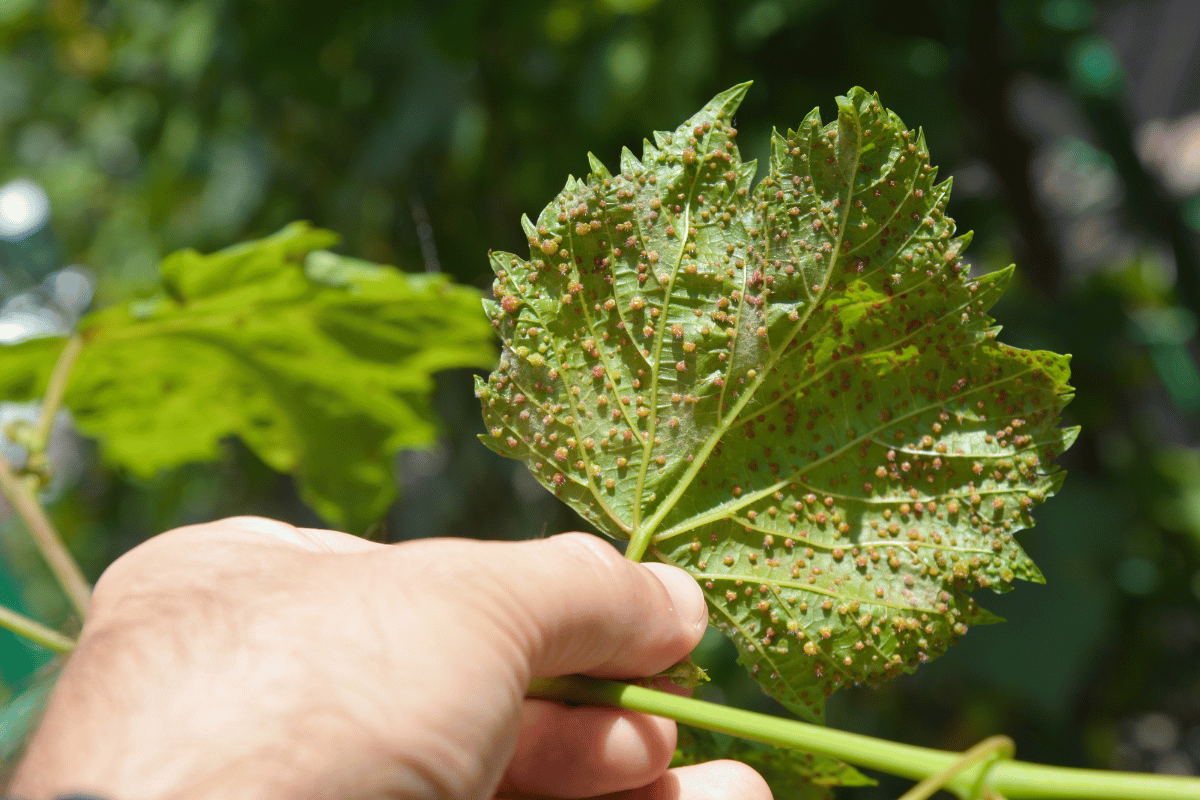
Across most of Greece's wine-growing regions, flowering is over, and the berries are sizing up, from shot to pea size. This is when the European grapevine moth enters its most dangerous phase, and the plant-protection bulletins issued by the Greek Ministry of Rural Development and Food for Crete, Eastern Macedonia and Thrace, and Central Greece all agree that June is the most critical month for the vineyard.
The picture, though, differs from region to region. In Crete, the moth's second flight is already underway, in Central Greece, the first flight is closing, and the next is being watched, while in Eastern Macedonia and Thrace, the flight of the fruit-feeding generation is only just starting. Below, we bring together what each region's bulletin shows and when treatment is advised.
Why the grapevine moth decides the crop in June
The European grapevine moth (Lobesia botrana) produces several generations over the season, and it is the fruit-feeding generations, whose larvae develop inside the berries, that do the most damage. Once a larva enters a berry, the loss is irreplaceable, and the wounds open the door to botrytis as well. That is why control is preventive and targets the eggs and young larvae before they can bore into the berry.
The right moment comes from the pheromone traps. When the daily average of adults shows an upward trend, an ovicidal product is advised within two or three days, while larvicides are applied four or five days later. Sprays target the bunches and work best when applied at dusk.
| Region | Grapevine moth stage | Indicative spray window |
|---|---|---|
| Crete (Heraklion, Lasithi) Bulletin 5 June |
Second flight underway, first egg-laying 4-6 June in the mid-early zone | Mid-early zone 8-10 June. In early areas, a repeat spray 6-8 June |
| Eastern Macedonia and Thrace (Kavala) Bulletin 5 June |
The flight of the fruit-feeding generation has just started | To be set in a dedicated bulletin, with continuous trap monitoring |
| Central Greece (Volos) bulletin 3 June |
End of the first flight, watching for the second | Once the daily average of adults trends upward. First infestations appear 4-5 days later. |
These dates are indicative, and every vineyard is a separate case. Check your own traps twice a week, follow the most recent local bulletin, and, where needed, consult your agronomist. Among the larvicides, Bacillus thuringiensis formulations are preferred because they are harmless to beneficial fauna, while good leaf removal helps the spray cover the bunches well.
Downy and powdery mildew on the sensitive berries
Alongside the grapevine moth, all three bulletins flag a rising risk from downy and powdery mildew. The unsettled weather, with night dews and scattered rain, favors downy mildew, and from fruit set until veraison, the berries remain susceptible. Protection is applied preventively, preferably with systemic products, and the spray must thoroughly cover the canopy and bunches, treating each row from both sides.
Powdery mildew is present in almost every vineyard, and protection should not stop during this period. At flowering and fruit set, dusting sulfur works well. Take care in high temperatures, though, because above 28 to 30°C, depending on the region, it causes phytotoxicity. Powdery and downy mildew can be handled in a single spray, while rotating products with different modes of action keeps resistance at bay.
Botrytis on the young bunches
In Central Greece, the bulletin adds botrytis. The young bunches need protection for as long as the weather remains wet, and treatment is advised immediately after hail or strong winds, which can injure the tender growth. Cultural measures matter here more than anywhere else. Good airflow from summer pruning, drainage, and a curb on nitrogen fertilization, which drives excessive and vulnerable growth, noticeably reduces the severity of the disease.
Mealybug on table grapes
The vine mealybug (Planococcus ficus) mainly threatens table grapes, as it leaves honeydew and sooty mould near harvest, which downgrade market value. It is a light-shy insect, so at this time of year it stays in sheltered spots, mostly under the bark of the trunk, and its presence is indicated by heavy ant activity. In vineyards with a history of infestation, growers first scout, then use mating disruption or spray after flowering, with full coverage of the trunk, heads, and arms. The same spray also hits the grapevine moth.
When to treat leafhoppers and thrips
Leafhoppers show up in patches with high populations, mainly in Crete. Treatment goes in only when scouting shows 50 to 100 wingless individuals per 100 leaves, because the insect develops resistance easily, and insecticides should be used as little as possible. Where needed, the spray can be combined with the grapevine moth spray.
In Eastern Macedonia and Thrace, the bulletin also flags thrips. Scouting is done with blue sticky traps or by shaking clusters and shoots over white paper. Thrips are not always easy to spot, and the damage shows up later as characteristic scarring on the berries, which lowers market value. Since the infestation cannot be undone once it appears, early monitoring is decisive.
How to choose and apply the products
For every treatment, we use only products approved for grapevine and for the specific pest or disease. The full list is available in the official database of the Greek Ministry of Rural Development and Food. Read the label carefully for dosage, tank-mix compatibility, and the pre-harvest interval, rotate products with different modes of action to avoid resistance, and avoid spraying bee-toxic products during flowering.
On Farmclick you can find approved plant-protection products for grapevine from suppliers across Greece.
| Vineyard plant protection on Farmclick Browse approved insecticides and fungicides from suppliers across Greece. |
The dates and recommendations above come from each region's bulletin and hold as a general trend. Conditions vary from vineyard to vineyard, depending on microclimate, exposure, variety and infestation history, so final decisions should rest on your own pheromone traps and the most recent local bulletin.
For serious or uncertain infestations, consult an agronomist. Where possible, favour cultural measures and low-impact solutions, and use only approved products, following the label instructions and the operator-safety measures.
Sources
All figures come from the plant-protection bulletins of the Greek Ministry of Rural Development and Food:
- Regional Plant Protection Centre of Heraklion, grapevine bulletin No11 (5 June 2026).
- Regional Plant Protection Centre of Kavala, DAOK of Eastern Macedonia and Thrace, grapevine bulletin No21 (5 June 2026).
- Regional Plant Protection Centre of Volos, Central Greece, grapevine bulletin No7 (3 June 2026).