
The Business Case for Looking Up
Conventional horticulture faces converging pressures: scarce arable land, volatile climate, and expectations for pesticide-free, local produce. Indoor vertical farming—stacking crops in climate-controlled layers under LED lighting—offers a resilient alternative. Controlled-environment researchers at UC Davis show that containerised vertical farms can cut water use by up to 90% and all but eliminate field-borne pathogens. Yet questions remain about energy costs, scale, and profitability. This article distils current university and agency research to help growers evaluate the technology.
How Vertical Farming Works
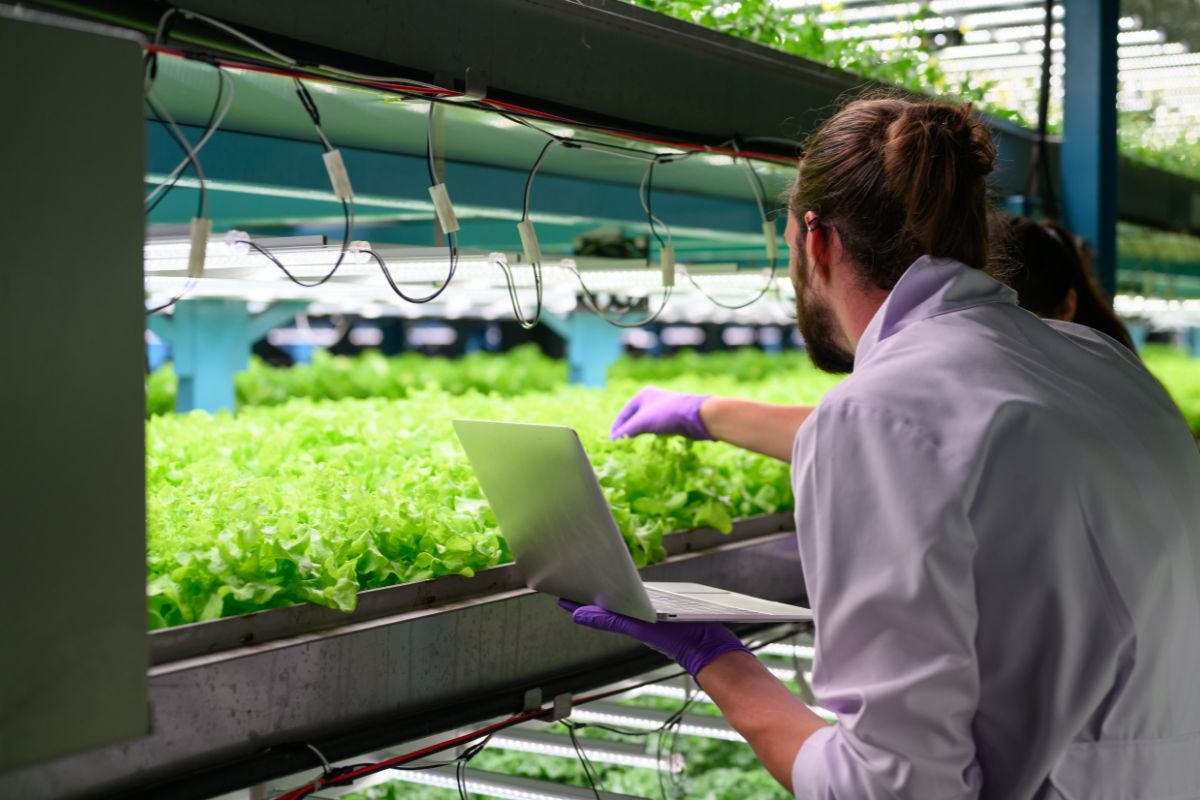
Instead of soil, crops grow in hydroponic, aeroponic, or aquaponic channels. Sensors regulate temperature, humidity, CO₂, and nutrient solution around the clock. A Purdue-led USDA project demonstrated that bringing LED fixtures within 15 cm of the canopy while dimming intensity (the “close-canopy strategy”) maintained lettuce yield yet used 16% less electricity than conventional mounting heights.
Common Production Systems
- NFT (Nutrient Film Technique) – A thin film of fertiliser solution flows continuously along shallow channels; ideal for leafy greens and herbs.
- Raft or deep-water culture – Plants float on beds of oxygenated nutrient solution; widely adopted for lettuce.
- Vertical panels or towers – Hydroponic slabs mounted on walls maximise cubic metres, an approach refined in NASA’s Biomass Production Chamber trials.
- Aeroponics – Roots hang in air and receive nutrient mist; high oxygen boosts growth but requires precise droplet control.
Regardless of system, management hinges on sensors and software that balance pH, EC, airflow, and photoperiod.
Capital & Operating Economics
Start-Up Outlay
Researchers modelling 1,000 m² facilities estimate turnkey build costs near US $1 million exclusive of real estate. Major capex categories:
- Racking and food-grade troughs.
- HVAC and dehumidification sized for latent heat of transpiration.
- LED arrays (often > 35% of capex).
- Automation (seeding, transplant conveyors, harvesters).
Operating Costs Of a Vertical Farm
A Rutgers Business Review analysis lists energy (for lights, HVAC, pumps) and labour as roughly 60% of OPEX in U.S. farms. Purdue’s close-canopy LED strategy achieved 28% energy savings per kilogram of lettuce, softening that burden. Locating near urban load centres further cuts transport and spoilage losses, offsetting some utility costs.
Revenue Streams
High-margin salad greens, basil, and microgreens dominate because of rapid cycles (18-35 days) and premium retail pricing. Yield per square metre can exceed 100 kg y⁻¹ for lettuce—over ten times field output—when crops are successively transplanted and spaced by automated “moving-gutter” rigs.
Sustainability Metrics
- Water use efficiency – NASA trials and UC Davis data confirm > 90% water savings versus soil cultivation, as condensate is captured and recirculated.
- Land sparing – One hectare of vertical stacks can match 10–20 ha of open-field lettuce production.
- Chemical reduction – Indoor exclusion of pests enables pesticide-free certification pathways.
- Energy intensity – The chief environmental trade-off. Employing high-efficacy LEDs (> 3.2 µmol J⁻¹) and heat-recovery ventilation is vital to lower carbon footprint. Where grid renewables exceed 50%, lifecycle analyses find vertical lettuce can rival or beat greenhouse emissions per kg.
Technical Pillars for Success
1. Lighting Engineering
Plant physiologists recommend spectral blends heavy in red (660 nm) and blue (450 nm) to drive photosynthesis, supplemented by far-red for stem elongation when needed. Purdue’s focused-lighting trials show targeting only active canopy leaves, rather than flooding whole tiers, can cut kWh 14% without sacrificing biomass.
2. HVAC & Dehumidification
Transpiring lettuces release 95% of absorbed water to the air. Proper latent heat removal is mandatory to prevent condensate and microbial growth. Calculating 4–6 L d⁻¹ of transpiration per m² of leaf area enables right-sizing equipment.
3. Nutrient Management
Closed-loop fertigation demands constant EC and pH logging. NC State’s Hernandez lab demonstrated that tailoring temperature and RH during seedling graft-healing phases boosts uniformity and downstream yields.
4. Automation & Labour Efficiency
Moving-gutter or shuttle-rack systems developed in Israel and refined at Technion allow crops to self-space as they grow, freeing labour from repetitive moves and increasing plants per worker-hour.
Risk and Mitigation
- Energy Price Volatility – Hedge with power-purchase agreements or locate farms adjacent to renewable assets or waste-heat streams.
- Biological Contamination – Despite clean rooms, waterborne pathogens (e.g., Pythium) can spread rapidly. Integrate UV or ozone sterilisation and maintain separate reservoir loops per zone.
- Market Saturation – Premium salad segments may crowd quickly. Diversify to high-value transplants or nutraceutical herbs; NC State notes strong demand for disease-free grafted tomato seedlings.
Policy & Incentives
The 2018 U.S. Farm Bill formally recognised indoor farms under USDA programs, making them eligible for Specialty Crop Block Grants and Value-Added Producer Grants. EU regional funds likewise support pilot vertical farms to meet Green Deal targets.
Step-by-Step Entry Roadmap
- Feasibility Study – Use university economic models to benchmark capex, opex, and payback for your region’s power and real-estate costs.
- Crop Selection – Start with leafy greens that mature under 30 days and command year-round prices.
- Pilot Facility (≤ 100 m²) – Validate local market and calibrate recipes before scaling.
- Data Integration – Adopt IoT sensors for nutrient, climate, and energy dashboards; iterative optimisation can raise grams kWh⁻¹ by 20% within months.
- Certification & Branding – Leverage pesticide-free, water-saving claims backed by third-party audits to capture premium contracts with retailers or food-service chains.
- Scale Strategically – Expand in 500–1,000 m² modules to match demand, utilising standardised racking and plumbing “building blocks”.
Looking Ahead
Continued LED efficiency gains (targeting 4 µmol J⁻¹) and integration of renewable microgrids promise to narrow energy gaps. Genetic breeding for indoor-specific cultivars is under way at UC Davis and Purdue, aiming for faster mass and dwarf morphology suited to high-density racks. As these innovations converge, vertical farming is poised to shift from premium niche to mainstream supply for leafy greens and beyond.
Bottom Line
Research from NASA, land-grant universities, and USDA projects confirms that vertical farming can deliver high yields with dramatic water savings and biosecurity advantages. Profitability hinges on disciplined energy management, automation, and market alignment. For producers prepared to master controlled-environment logistics, the sky—stacked layer upon layer—is the limit.
References
New Led Strategies Could Make Vertical Farming More Productive Less Costly – Purdue
NASA’s Contributions to Vertical Farming (NASA TM-2020-5008832) (PDF)
Commercial Models Cost Benefit Analysis Vertical Connor Lnvmc – Linkedin
Uc Davis Vertical Farming Facility Takes Hydroponics Whole New Level – UC Davis
Growing Up Vertical Farming Makes the Most of Limited Space – Ncsu
https://assets.researchsquare.com/files/rs-943119/v1_covered.pdf?c=1632935173
EPRS ATAG What If Vertical Farming Final (PDF) – European Union
Return water management for hydroponic leafy greens
All About Vertical Mushroom Farming
Water Management for Hydroponic Leafy Greens
Why Leafy Greens CEA needs more than just innovation
Key Traits Breeders Prioritize for Enhancing Greenhouse Crop Performance
Controlled Environment Agriculture in the Mediterranean: A Sustainable Future
The Global Future of Vertical Farming (2025–2035): A Scenario Analysis Across Continents
What is Controlled Environment Agriculture (CEA)?
Urban Farming with Rooftop Greenhouses: A Path to Sustainable Food Security