









Star jasmine is the first plant recommended to anyone who wants an evergreen screen on a balcony or in a garden, because it combines four things that rarely come together. It climbs fast, holds its foliage through winter, lives for years in a pot, and tolerates both summer heat and temperatures down to -10°C. It flowers from mid-spring to late July with small white blooms of intense fragrance, and it will cover pergolas and trellises to a height of 6 to 9 metres, exceeding 12 in ideal conditions. This guide covers where and when to plant it, care in pots and in the ground, pruning, flowering, propagation, and the problems that occasionally show up.
What star jasmine is
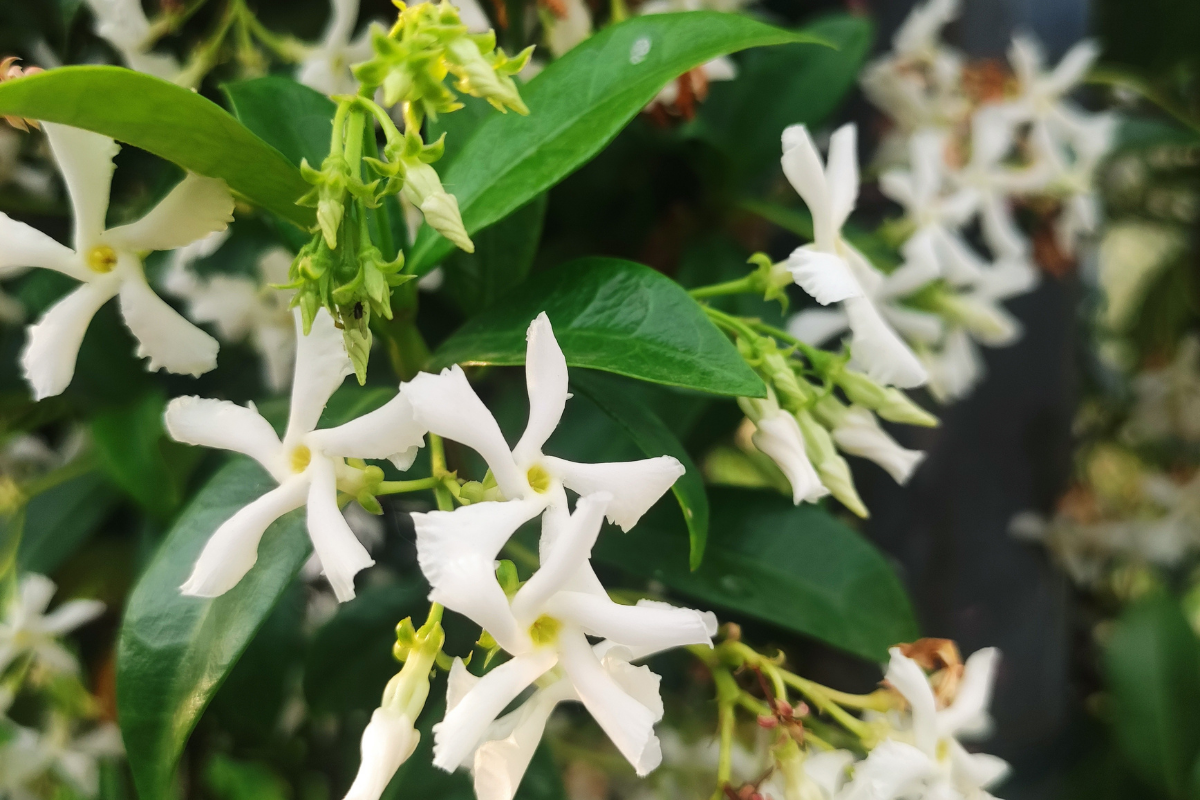
Star jasmine (Trachelospermum jasminoides) is an evergreen perennial climbing shrub in the family Apocynaceae, native to China, Japan and the wider southeast of Asia. Its leaves are leathery, oval, glossy, dark green, and set opposite along the stem. The flowers are small, white and five-lobed, shaped like a star or a propeller, and at peak bloom they cover almost the whole canopy.
Growth is slow in the first year, while the root system establishes, and then becomes rapid from the second year onward. It is a long-lived plant, and the oldest specimen our editorial team has examined at close quarters was 24 years old, with older ones certainly out there. Beyond its ornamental use, the essential oil extracted from its flowers has been shown to have antibacterial and anti-inflammatory activity.
Star jasmine is not a true jasmine
Star jasmine is sold under several names, including confederate jasmine, Chinese jasmine and Chinese star jessamine, but botanically it is not a jasmine at all. True jasmine belongs to the genus Jasminum in the olive family (Oleaceae), while star jasmine sits in the Apocynaceae alongside oleander and frangipani. The confusion comes from the scent, which genuinely resembles jasmine, and from the flowers' appearance.
The difference matters in practice. Star jasmine is evergreen and keeps its foliage year-round, while most true jasmines are deciduous or semi-deciduous and strip bare in winter. It is also hardier and needs less attention, which is why it is the default choice for permanent screens.
Why does it work as a screen?
- Fast climbing: from the second year, it weaves quickly across a pergola or trellis, and the dense dark green leaves build a green wall that is completely impenetrable to sight
- Evergreen foliage: unlike most climbers used as screens, it does not strip bare in winter and keeps providing cover all year
- Long life in containers: it lives for many years in a pot, which makes it suitable for apartments and spaces with no open ground
- Wide tolerance: it handles summer heat and cold down to -10°C, and performs well in coastal gardens
When and where to plant
Plant in spring, from March to May, or in autumn, from September to November. Autumn planting has the edge in Mediterranean climates because mild temperatures and rain allow plants to root well before winter, in line with other autumn planting jobs.
The position needs at least an hour and a half of direct sunlight a day for the foliage to fill in quickly, though the plant also grows in partial shade. More sun means denser growth and heavier flowering, while in deep shade, it survives but barely blooms. Choose a spot sheltered from strong, cold winds, which damage young shoots.
Star jasmine is not fussy about soil and grows almost anywhere, provided drainage is good. Excess moisture at the roots is the one thing it will not tolerate. For a screen in open ground, space plants 80 cm to 1 m apart so they close the gaps without competing heavily. Put the support in place, whether wires, mesh or trellis, on the first day, because the plant climbs by twining its stems and needs something to grip.
Growing star jasmine in pots
After buying from the nursery, move the plant into a larger container, plastic or terracotta, that has drainage holes so excess water drains within minutes. Start with a relatively small pot, though larger than the nursery one. A plant bought in a 9-litre container, for instance, moves comfortably into a 20-litre pot.
Use a free-draining potting mix lightened with river sand or perlite and enriched with compost. At the start, the main shoot needs to be guided and sometimes tied until it turns and climbs onto the trellis or pergola. After that, the plant continues upward on its own. In a large container, mature star jasmine eventually covers 6 to 9 square metres of surface area.
Watering
Star jasmine tolerates drought, but far less so in a pot than in open ground, because the limited volume of compost dries out fast. Throughout the summer, it needs watering two to three times a week, and much less often in winter. The rule is to water once the compost surface has dried, and never to let water stand in the saucer.
A layer of compost on the surface of the pot slows evaporation and helps the mix retain moisture, noticeably reducing watering frequency throughout summer. Plants in open ground become fairly self-sufficient once fully established and need only occasional watering.
Feeding
Plenty of growers add nothing beyond compost and still have plants of impressive size and flowering. Even so, especially in the first two years, a balanced fertiliser such as 7-7-7, applied once a month from spring to the end of summer, pays off. It can be granular, in which case it is water-soluble immediately after application.
Overfeeding does not help. Nitrogen-heavy fertilisers, in particular, push the plant into leafy growth at the expense of flowers, so balanced products, or those higher in phosphorus and potassium, suit it better.
Pruning
Every spring and autumn, clear away dry leaves, dead twigs and any dead plant material. The main pruning, however, runs from the end of flowering to early autumn, meaning through the summer, because that way the season's blooms are not sacrificed and the plant has time to build the growth that will flower next spring.
In practice, star jasmine is pruned mainly for shape and containment. When it starts growing away from the pergola or trellis, those shoots are cut back so the plant directs its resources where they are wanted, into covering the surface quickly. From the third to the fourth year, once growth becomes vigorous, thinning cuts are needed to improve airflow within the canopy. Without them, new growth piles onto old, and ventilation suffers.
Handling calls for care because cut tissue exudes a milky-white sap that can irritate the skin. Gloves are essential, and tools should be sharp and clean.
Flowering
Flowering starts in mid-spring, April to May, depending on the region, and runs to the end of July. The scent is strong and sweet, most noticeable on sunny days and in the evening, and the flowers draw bees and butterflies.
When a star jasmine flowers poorly, the reasons are usually three. The position is too shady, the feeding carries too much nitrogen, or the plant is still young and putting its energy into growth. A complete fertiliser in early spring and a sunnier position correct the picture within the following season.
Star jasmine in winter
In winter, the foliage often takes on bronze or reddish tones, which is a normal response to cold rather than a sign of trouble. The plant is hardy to about -10°C, but in very cold areas, move pots against a wall or protect them with horticultural fleece during hard frosts.
Cut watering back sharply, since the compost holds moisture far longer, and water only when it has dried. Stop feeding until spring, and avoid heavy pruning. Light thinning and the removal of dead twigs can be done in late winter, once the hardest frosts have passed.
Propagation
Star jasmine is propagated three ways, with cuttings by far the most practical:
- Cuttings: take sections of semi-ripe stem about 20 cm long, dip the base in rooting hormone and set them in a loose, moist medium in a shaded spot
- Layering: bend a low shoot down, bury the point where it touches the soil until it roots, then sever it from the parent plant
- Seed: rarely used, since germination is difficult and it takes a long time to produce a plant of usable size
Why do leaves turn yellow, or the plant dries out
Star jasmine ranks among the toughest climbers and has few serious disease problems. When yellowing or dieback does appear, the causes are specific:
- Overwatering or poor drainage: water sits, roots rot, leaves yellow and drop. This is the most common cause in containers
- Drought: in pots and in windy positions, the plant dries quickly, foliage scorches and stems go bare
- Iron or micronutrient deficiency: yellowing on young leaves with the veins staying green, corrected with chelated iron
- Restricted root space: a plant that sits for years without growing in a small pot needs to be moved into a larger container with fresh mix
The check always starts with the compost. Dig in a finger, and if it is sodden, stop watering and improve drainage, while if it is bone dry, water thoroughly. Cut out any fully dead stems so the plant can put its energy into new growth.
Frequently asked questions
When should star jasmine be planted?
In spring, from March to May, or in autumn, from September to November. Autumn planting gives better rooting before winter in mild climates.
Is star jasmine the same as jasmine
No. True jasmine belongs to Jasminum in the family Oleaceae, while star jasmine belongs to the Apocynaceae. Star jasmine is evergreen and hardier, whereas most true jasmines drop their leaves in winter.
Is star jasmine toxic to cats and dogs
According to the ASPCA, Trachelospermum jasminoides is non-toxic to dogs, cats and horses. Its milky sap can irritate human skin, though, so handle it with gloves.
How far apart should star jasmine be planted for a hedge
Space plants 80 cm to 1 m apart, with the support structure installed from the start. Full coverage usually arrives in the second or third year.
How tall does star jasmine grow
Typically 6 to 9 metres, depending on the support it is given, and over 12 metres in ideal conditions. In a container, growth is naturally limited by the compost volume.
Does star jasmine lose its leaves in winter?
No, it is evergreen and keeps its foliage year-round, beyond normal routine leaf drop. The bronze or reddish winter colouring is a cold response, not damage.
Important notes
Conditions vary from garden to garden, so please take the guidance above as a general starting point, and check local hardiness before planting in areas with hard winters.
Wear gloves when pruning or handling cut stems, since the milky sap irritates skin.
References
- Royal Horticultural Society, Trachelospermum jasminoides.
- ASPCA Animal Poison Control, Star jasmine.