







Spinach (Spinacia oleracea) is an annual leafy vegetable of the family Amaranthaceae, formerly classified in Chenopodiaceae, and a relative of beetroot and Swiss chard. It is dioecious, meaning it has separate male and female plants. It was most likely domesticated in ancient Persia about 2,000 years ago from the wild species Spinacia turkestanica, and it appears in no ancient Greek or Roman source. It reached China in the 7th century and Europe in the 11th, through Moorish Spain. Today China produces about 91.5% of world output, while in Greek cuisine spinach is a staple of spanakopita and spanakorizo. This article covers the plant and its relatives, its history, the leaf types, world production and its uses.
The plant
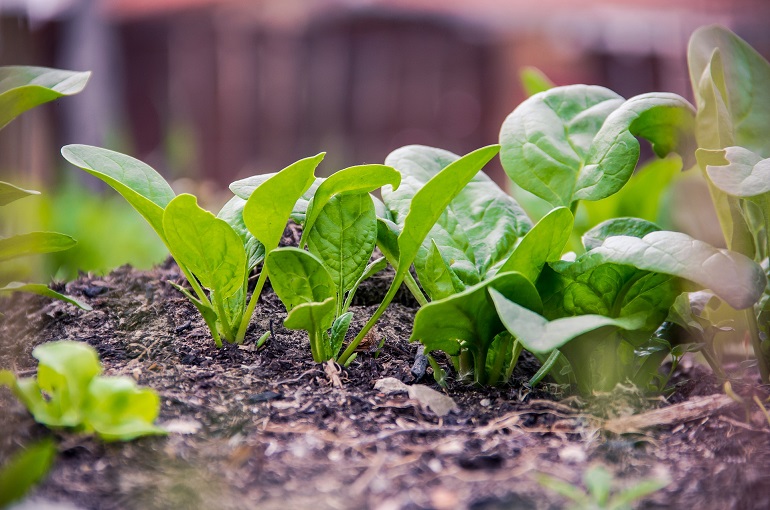
Spinach forms a rosette of leaves around a very short stem, which stays close to the ground as long as the days are short. Once day length exceeds 13 hours, the stem elongates and forms a flower stalk, which is why spinach is an autumn and winter vegetable.
The flowers are small and green, and pollination is by wind. Because male and female flowers grow on separate plants, only female plants set seed. The closest wild relatives, Spinacia turkestanica and Spinacia tetrandra, grow in areas around the Caspian Sea, and the former is considered the wild ancestor of cultivated spinach.
The history of spinach
According to scientific reviews of its origin, spinach was most likely domesticated in the region of present-day Iran, although genetic studies suggest domestication may have occurred further east than previously thought. It spread late in history, and the oldest written records mentioning it come from 4th-century Mesopotamia. The fact that it appears in no ancient Greek or Roman source indicates that the ancient Greeks did not know it.
The oldest written sources report that spinach reached China via Nepal in the 7th century. In Europe, the first written evidence of its cultivation comes from 11th-century Moorish Spain, and the oldest archaeobotanical finds from the Pyrenees, dating to the late 12th or early 13th century. From there it spread gradually across the continent.
During domestication, two traits changed most: the morphology of the female flowers and the loss of seed dormancy. Thanks to the latter, seed of cultivated spinach germinates readily as soon as it meets the right temperature and moisture, which makes growing spinach one of the simplest jobs in the vegetable garden.
Leaf types and varieties
Varieties fall into three types by leaf surface:
- Smooth leaf: flat, even surface, mainly for frozen and canned products, because it is easy to clean of soil
- Savoy: crinkled surface and dark green colour, mainly for the fresh market
- Semi-savoy: slightly crinkled surface, for both the fresh market and processing
There are also winter and summer varieties, depending on their tolerance of cold and of early bolting. Baby spinach is simply young, tender leaves picked early for salads, from various varieties. Two vegetables sold as "summer spinach", New Zealand spinach (Tetragonia tetragonioides) and Malabar spinach (Basella alba), are not true spinach.
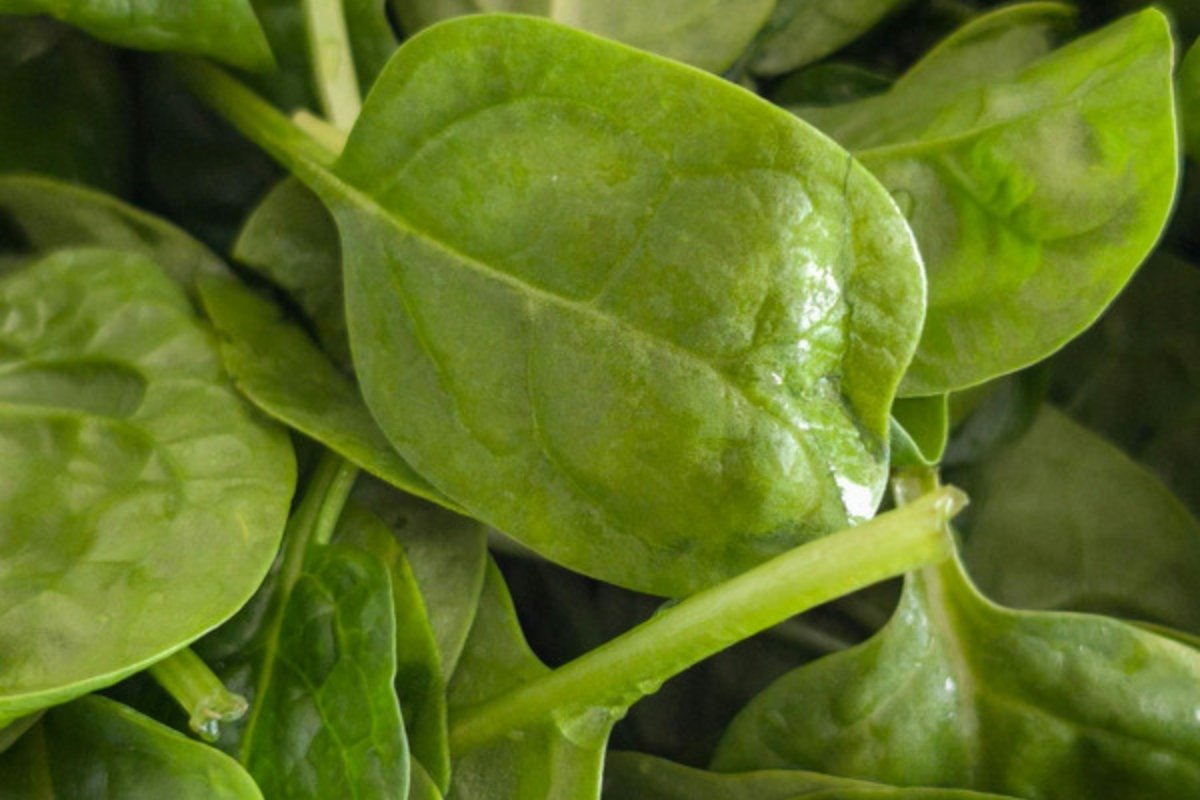
Spinach varieties are grouped by leaf surface into smooth, savoy and semi-savoy types.
World production
According to a 2020 review of the genetic resources and breeding history of spinach, China alone produces about 91.5% of world output. In Greece, commercial spinach production serves both the fresh market and the freezing industry, the latter under contract farming.
Uses in the kitchen
Spinach is eaten both raw and cooked:
- Raw: tender leaves and baby spinach in salads, on their own or with other greens, fruit and cheese
- In pies: spanakopita, with feta and herbs, is one of the best-known Greek dishes, and spinach also goes into mixed greens pies
- Stewed: spanakorizo, a braised dish with rice, dill and lemon, is a classic Greek fasting dish. Spinach is also cooked with eggs, in soups and in omelettes
- Frozen: processing spinach is frozen as whole leaves or chopped, and is available all year
Spinach shrinks a great deal when cooked, because it is mostly water, so a potful of fresh leaves gives a small amount of cooked food. For its nutrients and precautions, spinach nutrition facts stand out mainly for vitamin K and folate.
Frequently asked questions
What family does spinach belong to
The family Amaranthaceae, which now includes the former family Chenopodiaceae. It is related to beetroot and Swiss chard.
Where does spinach come from
It was most likely domesticated in ancient Persia, present-day Iran, about 2,000 years ago, from the wild Spinacia turkestanica. Genetic studies suggest domestication may also have occurred further east.
Did the ancient Greeks eat spinach
No. Spinach appears in no ancient Greek or Roman source, and it reached Europe in the 11th century, through Moorish Spain.
Which country produces the most spinach
China, with about 91.5% of world production, according to a 2020 review.
What is baby spinach
It is young, tender spinach leaves picked early for salads, from various varieties.
What is the difference between smooth and savoy spinach
Smooth spinach has flat leaves and is preferred for freezing and canning, while savoy spinach has crinkled, dark green leaves and is preferred for the fresh market. Semi-savoy is an intermediate type suited to both.
References
- On the origin and dispersal of cultivated spinach (Spinacia oleracea L.), Genetic Resources and Crop Evolution, 2021.
- A review on the genetic resources, domestication and breeding history of spinach, Euphytica, 2020.
- PLOS DNA Science, Spinach genome reveals a living fossil.
- Plant Protection, Spinach cultivation guide (in Greek).
- UC Master Gardeners, Malabar spinach, anyone.