













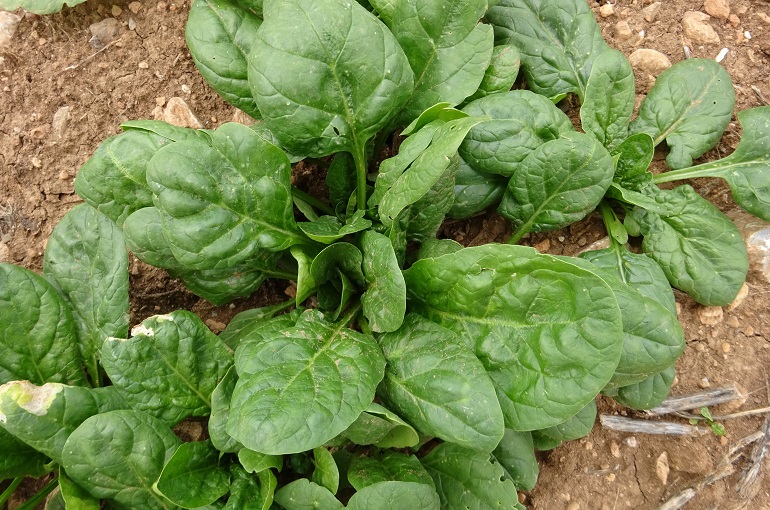
Spinach (Spinacia oleracea) is direct-seeded in the field, in Mediterranean regions from August to late spring, at a depth of 2 to 3 cm, with 10 to 30 kg of seed per hectare, or just 3.5 to 5 kg with a precision seeder. It needs 90 to 180 kg of nitrogen per hectare in split doses and is harvested at 40 to 50 days for the fresh market, or mechanically for the freezing industry. Yields reach 10 to 20 tonnes per hectare for fresh spinach and close to 30 tonnes for processing spinach, with autumn crops yielding most. In Greece in 2026, producer prices ranged from €0.30 to €0.60 per kilo for fresh spinach and 16 to 17 cents for processing spinach. This guide covers the two market routes, leaf types and varieties, climate and soil, sowing, fertilisation and nitrate limits, irrigation, crop protection, harvest and the economics of the crop.
Fresh market and processing spinach
| Trait | Fresh market spinach | Processing spinach |
|---|---|---|
| Destination | Markets, greengrocers, supermarkets, salads | Freezing and canning |
| Leaf type | Savoy or semi-savoy | Smooth or semi-savoy |
| Harvest | By hand, usually in a single pass | Mechanical, with the option of a second cut |
| Yield per hectare | 10 to 20 tonnes | Close to 30 tonnes |
| Producer price in Greece, 2026 | €0.30 to €0.60 per kilo | 16 to 17 cents per kilo |
| Sales | Open market | Contract farming with processors |
Processing spinach is almost always grown under contract, with a pre-agreed price and a guaranteed buyer, usually a frozen food company. The low price per kilo is offset by higher yield and mechanical harvesting. Fresh spinach earns a better price but is harvested by hand, and according to Greek growers speaking to AgroTypos in 2026, harvesting may be the crop's biggest problem, because labour is both expensive and hard to find.
Leaf types and varieties
According to the Greek Ministry of Rural Development integrated crop protection guidelines, spinach varieties fall into three types by leaf surface:
- Smooth leaf: flat, even surface, mainly for frozen and canned products
- Savoy: crinkled surface and usually dark green, mainly for the fresh market
- Semi-savoy: slightly crinkled surface, for both fresh market and processing
There are also winter and summer varieties. For spring sowings, choose slow-bolting varieties, because long days encourage premature flower stalks. One criterion of growing importance is downy mildew resistance. Seventeen races of the pathogen have been officially recognised, designated Pfs:1 to Pfs:17, and modern hybrids state which races they resist. The choice depends on the races present in the area.
Climate
Spinach grows across a wide temperature range, from 5 to 24°C, while leaf production is favoured at 15 to 18°C. It tolerates frost down to −10°C, because at low temperatures it synthesises protective proteins in its leaves. The biggest climatic problem is bolting, the premature flower stalk. Once day length exceeds 13 hours, spinach forms a flower stalk, and high temperatures speed this up before the leaves reach a good size. That is why autumn crops give the highest yields and spring crops the lowest.
Soil and water
The crop prefers medium or light soils with good drainage, especially in winter, and high organic matter. The best pH is 6.5 to 7.5, although the plant grows in slightly acid soils at pH 6 and even in very alkaline ones.
Spinach is sensitive to salinity, which applies both to soil and to irrigation water:
| Electrical conductivity of irrigation water | Yield reduction |
|---|---|
| 2.2 dS/m | About 10% |
| 3.5 dS/m | About 25% |
| 5.7 dS/m | About 50% |
In soil, yield loss begins at an electrical conductivity of about 2 dS/m and continues at about 8% for every additional 1 dS/m. Soil and water analysis before sowing is therefore essential, especially in coastal areas.
Sowing
Spinach is sown into ploughed and rotavated soil with the base fertiliser incorporated. In autumn and winter crops, especially on soils that hold moisture, it is usually sown on ridges for better drainage.
- Season: from August to late spring. For late spring sowings, choose varieties and sites that limit bolting
- Depth: 2 to 3 cm, depending on soil type
- Seed rate: 10 to 30 kg per hectare, with roughly 100,000 seeds per kilo. With a precision seeder, 3.5 to 5 kg per hectare is enough. Processing spinach, harvested mechanically, is sown more densely in double or quadruple rows with more seed
- Spacing: 25 to 40 cm between rows and 5 to 10 cm within the row
- Thinning: when plants have 3 to 4 leaves, to 8 to 12 cm, or 15 to 20 cm for larger plants. With precision seeding, thinning is unnecessary
- Seed quality: germination should exceed 60%, and good-quality seed reaches about 75%
Soil temperature determines how quickly seed emerges:
| Soil temperature | Days to emergence |
|---|---|
| 5°C | About 23 |
| 10°C | About 12 |
| 15 to 30°C | 5 to 7 |
| Below 2°C or above 30°C | Germination sharply reduced |
Fertilisation and nitrates
Under the integrated crop protection guidelines, where no soil data are available, about 20 to 40 tonnes of well-rotted manure per hectare is recommended before sowing. Phosphorus and potassium go into the base dressing:
- Phosphorus, as P₂O₅: about 90 to 100 kg per hectare on soils of medium content, and up to 180 kg on poor soils
- Potassium, as K₂O: about 90 to 100 kg per hectare on soils of medium content, and up to 180 kg on poor soils
- Nitrogen: 90 to 180 kg per hectare, one third before sowing and two thirds in 2 or 3 doses during the season. Part of the nitrogen can also be applied as a 1.5% urea foliar spray 15 days after emergence
Nitrogen must be applied with restraint, because excessive rates cause nitrate accumulation in the leaves, which bears directly on whether the produce can legally be sold. Regulation (EU) No 1258/2011 set a maximum nitrate level of 3,500 mg/kg for fresh spinach and 2,000 mg/kg for preserved, deep-frozen or frozen spinach. The Regulation itself acknowledges that the main factor behind nitrate levels is climate, and above all light, which the grower cannot control. Winter crops, with short and cloudy days, are therefore more vulnerable, and correct nitrogen rates are the grower's main tool. Rates are also adjusted to rainfall and irrigation to avoid nitrogen leaching.
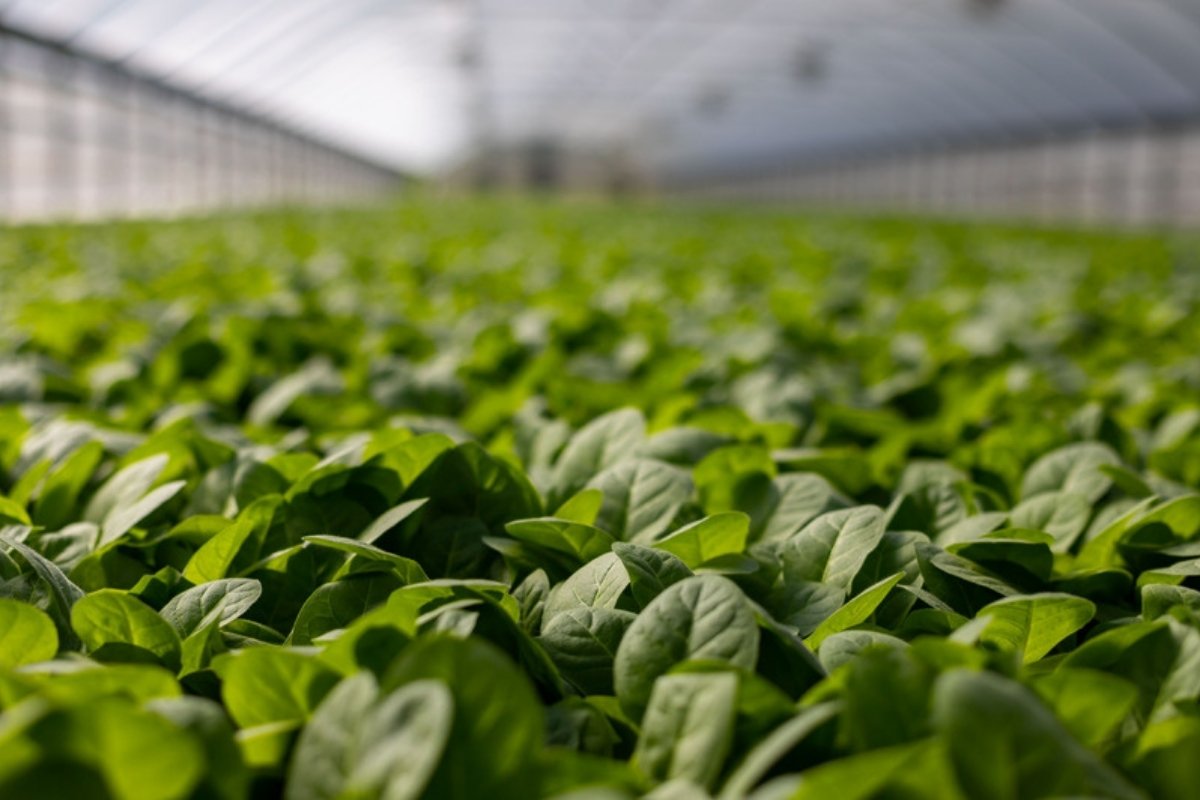
Light is the main factor behind nitrate levels in spinach, so winter crops and crops under cover need careful nitrogen rates.
Irrigation
Spinach has a shallow root system and needs light, frequent irrigation. Light irrigations follow sowing, after which the crop is watered roughly every 10 to 12 days in autumn and winter and every 4 to 6 days in spring and summer, always depending on the weather. The most common systems are sprinklers and flood irrigation. Sprinklers, however, wet the foliage and favour leaf diseases, above all downy mildew.
Weeds
Processing spinach must be completely free of weeds, because mechanical harvesting collects everything in the row. Prevention rests on rotation, adding organic matter, adjusting sowing date and density, black plastic mulch on small areas, and soil solarisation, covering the soil with clear plastic for 6 to 8 weeks in summer. Where chemical control is needed, use only herbicides registered for spinach, with advice from an agronomist.
Crop protection
Downy mildew (Peronospora effusa, referred to in older literature as P. farinosa f. sp. spinaciae) is the most important disease of spinach worldwide. The pathogen attacks only spinach and thrives in cool, moist conditions. Yellow lesions appear on the older leaves, with a greyish growth on their undersides, making the produce unmarketable. The main defences are hybrids resistant to the local races, rotation, avoiding dense sowing and sprinkler irrigation in wet periods, and registered fungicides where needed.
Other important diseases are white rust, leaf spots, damping-off and viruses. Among pests, the most common are aphids, which suck sap and downgrade the produce, and slugs and snails, especially on moist soil. Every treatment uses only products registered for spinach, observing the pre-harvest interval, which matters particularly in such a short-cycle crop.
Harvest
Fresh market spinach
Most crops are ready in 40 to 50 days, when plants have fully developed 5 to 6 large leaves. The whole plant is cut with a knife just below the soil surface, at the crown, lower and damaged leaves are removed, and the produce is packed in plastic crates. Harvest is usually done in a single pass once most plants are uniform, and in 2 or 3 passes when growth is uneven, which usually happens in late autumn and winter. The produce goes straight to market or is held at 0°C and 95% relative humidity.
Processing spinach
Harvest is mechanical, cutting at the base of the leaves. If the cut is high enough to leave the growing point, the plant regrows and a second cut follows. In all cases, harvest stops before the plant forms a flower stalk.
When produce is marketed, labelling includes the product name, the grower's name and address, the control body where applicable, and the lot code for traceability.
Yields and economics
Yields range from 10 to 30 tonnes per hectare, depending on region, season and market route. Autumn crops give the highest yields and spring crops the lowest, because high temperatures and long photoperiods encourage flower stalks at the expense of leaf growth.
At 2026 Greek prices, a simple indicative calculation shows the difference between the two routes. For processing spinach, 30 tonnes at 16.5 cents gives gross revenue of about €4,950 per hectare. For fresh spinach, 15 tonnes at €0.45 gives about €6,750, but with considerably higher harvesting costs. Spinach often works as a supplementary crop in the winter cycle, because it occupies the field for only a few months and leaves time for the next crop.
Frequently asked questions
What is the yield of spinach per hectare
From 10 to 30 tonnes per hectare. For fresh market spinach about 10 to 20 tonnes, and for processing spinach close to 30 tonnes, with autumn crops yielding most.
How much spinach seed is needed per hectare
About 10 to 30 kg, with roughly 100,000 seeds per kilo. With a precision seeder, 3.5 to 5 kg per hectare is enough, while processing spinach is sown more densely.
What is the price of processing spinach
In Greece in July 2026, the producer price for processing spinach was 16 to 17 cents per kilo, according to the president of the ThESgi cooperative. Fresh spinach ranged from €0.30 to €0.60 per kilo.
How much nitrogen does spinach need
From 90 to 180 kg per hectare, one third before sowing and the rest in 2 or 3 doses. Excessive rates cause nitrate accumulation in the leaves, and the EU maximum for fresh spinach is 3,500 mg/kg.
Why does spinach bolt before it grows
Because spinach forms a flower stalk once day length exceeds 13 hours, and heat speeds this up. That is why spring sowings use bolt-resistant varieties.
What is the most serious spinach disease
Downy mildew (Peronospora effusa), which attacks only spinach and thrives in cool, wet weather. The main defence is hybrids resistant to the local races, out of the 17 officially recognised.
Important notes
Seed rates, spacing and fertilisation are adapted to variety, soil and market destination, and treatment timing follows local plant protection guidance.
Use only products registered for spinach in your country, follow the label and the pre-harvest interval, and apply cultural measures first. For serious or persistent problems, consult a local agronomist for an accurate diagnosis.
For small plots and home use, growing spinach in the garden and in pots follows the same principles in simpler form.
References
- Plant Protection, Spinach cultivation guide (in Greek), based on the Greek Ministry of Rural Development integrated crop protection guidelines for spinach and C. Olympios, Agricultural University of Athens.
- Agrogen, Spinach cultivation (in Greek).
- lf.gr, Spinach cultivation guide (in Greek).
- AgroTypos, Spinach growers speak on stability and difficulties (in Greek), 2026.
- AgroTypos, Spinach, up to 60 cents fresh, 17 cents for processing (in Greek), 2026.
- Regulation (EU) No 1258/2011 on maximum levels for nitrates in foodstuffs.
- Choi Y.-J., Hong S.-B., Shin H.-D., Re-consideration of Peronospora farinosa infecting Spinacia oleracea as distinct species, Peronospora effusa, Mycological Research, 2007.
- Effects of temperature and light on germination of Peronospora effusa sporangia, bioRxiv.