
Below-normal rain is the most likely outcome across much of South Africa from November 2026 to March 2027, especially in the interior and the north-eastern half of the country, according to the seasonal forecast of the South African Weather Service (SAWS). The forecast comes as maize planting begins, while the Crop Estimates Committee (CEC) puts the 2026 crop, harvested this year, at 17.5 million tonnes of commercial maize, the largest on record. After the last two moderate to strong El Niño episodes, in 2015/16 and 2023/24, the country's maize production fell by more than 20% from the previous year.
SAWS forecasts below-normal rain from November to March
In its October issue, SAWS says that El Niño is in a strong state and is likely to strengthen further in the coming months, and that below-normal rainfall is the dominant category over large parts of the country for the three-month periods November to January, December to February and January to March. The area where less rain is most likely grows from December and covers mainly the regions that receive most of their annual rainfall in summer, while minimum and maximum temperatures are expected to be above normal over most of the country. The service attributes the forecast to El Niño and notes that a drier, hotter summer will likely have a negative impact on crop and livestock production, which is in line with what is known about the 2026 El Niño and the risk it poses to crops and food prices.
Planting starts in November in the Free State and North West
According to GEOGLAM's crop calendar, maize is planted in November in the Free State and North West and from October to November in Mpumalanga and KwaZulu-Natal, while ripening and harvest in the Free State run from March to April and the season closes in May. The Free State, Mpumalanga and North West are expected to produce 82% of the 2026 crop, according to the CEC, and so account for most of the country's commercial maize production. The Free State planted 1,215,000 hectares of commercial maize in 2026, North West 605,000 and Mpumalanga 538,000, out of 2,724,200 hectares nationwide.
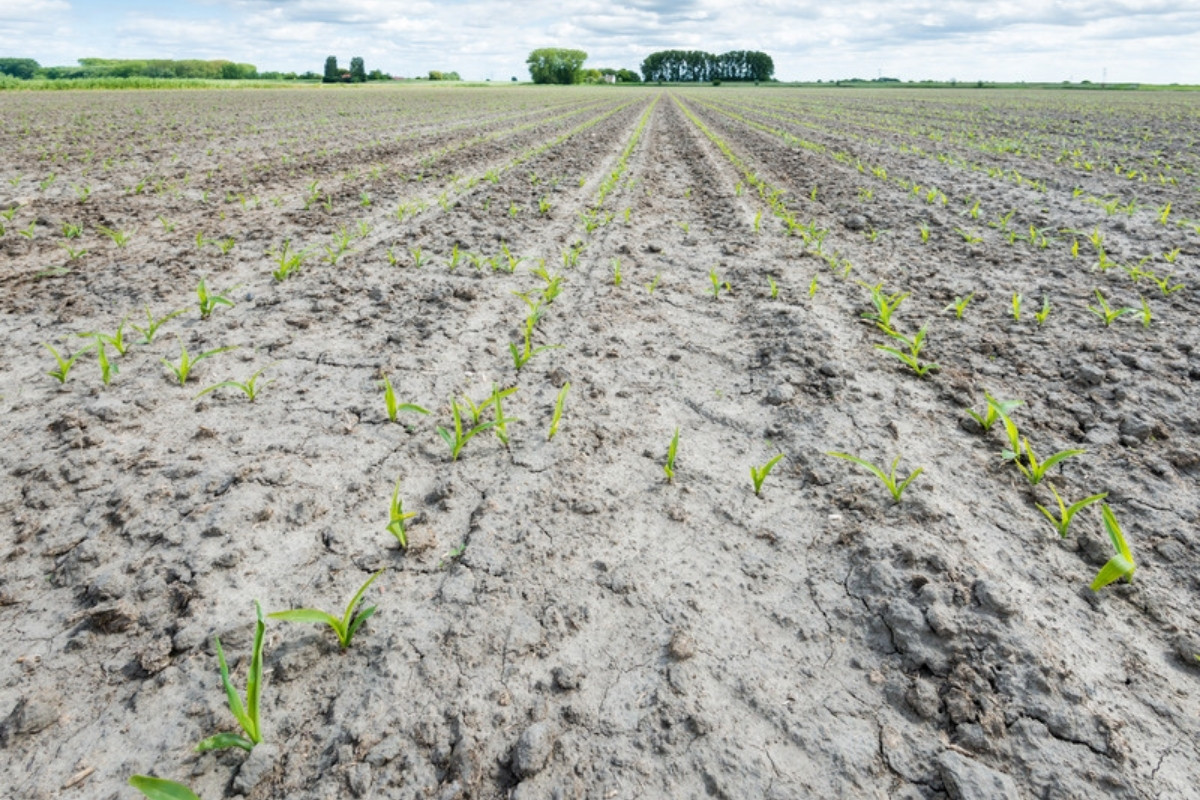
The US Department of Agriculture (USDA) weekly weather and crop bulletin of 20 October reports that rainfall remained largely absent across the summer crop areas, with only isolated light showers below 25 mm in some western and southern locations, and that temperatures averaged 2 to 7 °C above normal across much of the country. Heat and limited rain further reduced soil moisture ahead of planting in the eastern areas, so the bulletin notes concern for early-season crop establishment in Limpopo, Mpumalanga and KwaZulu-Natal, while in the western areas, where conditions were also dry, planting was still several weeks away.
GEOGLAM sees a higher drought risk across much of southern Africa
In its special report on El Niño of 16 October, GEOGLAM, the international crop monitoring initiative, writes that drought risk is higher than usual across much of southern Africa for the 2026/27 main cropping season. The Southern Africa Regional Climate Outlook Forum (SARCOF-33) predicts below-normal rain from October to December over most of South Africa, and multi-model forecasts give a 40 to 50% probability of below-normal rain in the same period in the eastern half of the country. NASA's FLDAS system forecasts surface soil moisture in the driest third of historical forecasts in central South Africa from November to January, which could make it harder to establish rainfed crops.
Models also give a probability above 70% that temperatures will often exceed the 90th percentile during the growing season from November 2026 to April 2027, and the report recalls that during the 2023/24 El Niño a mid-season dry spell with record-high temperatures developed over central southern Africa. Because the start of the rains varied widely in previous moderate to strong El Niño episodes, GEOGLAM notes that rainfall observations and short-range forecasts may be the best guide to the onset of the rains.
The maize crop fell by more than 20% after the last two moderate to strong El Niños
According to the abstract of agricultural statistics of South Africa's Department of Agriculture, in 2016, after the 2015/16 El Niño season, total maize production fell to 8.2 million tonnes from 10.6 million in 2015, about 23% less, having reached 14.9 million tonnes in 2014. In 2024, after the 2023/24 El Niño, production fell to 13.4 million tonnes from 17.1 million in 2023, about 21% less, and the CEC's final figure for commercial maize in 2024 was 12.85 million tonnes against 16.43 million in 2023. This is an association across two seasons, and each year's crop depends on when and how much rain falls during the growing season. In the weaker 2018/19 episode, for example, the 2019 crop fell by about 10%.
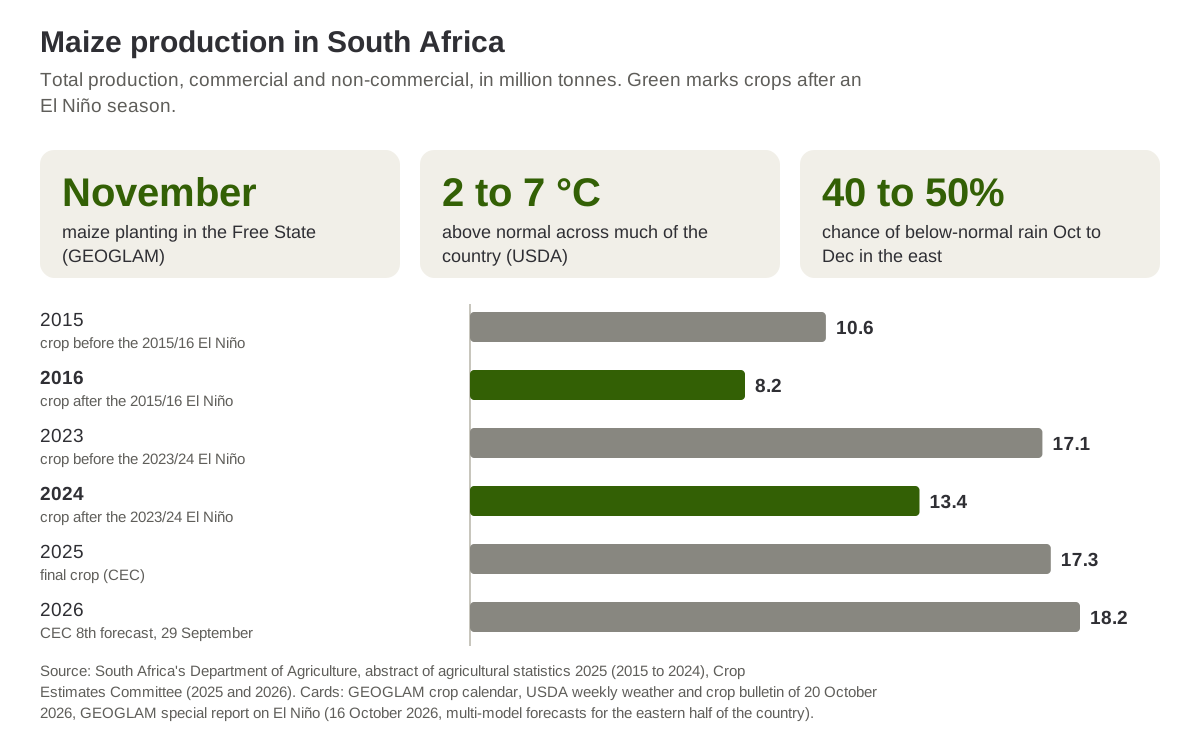
Source: South Africa's Department of Agriculture, abstract of agricultural statistics 2025 (total production 2015, 2016, 2023 and 2024), and Crop Estimates Committee (final 2025 crop and 8th forecast for 2026, 29 September 2026, commercial and non-commercial maize). Cards: GEOGLAM, USDA.
The 2026 crop is estimated at 17.5 million tonnes
In its 8th forecast of 29 September 2026, the CEC puts the 2026 commercial maize crop at 17,522,840 tonnes, of which 9,608,790 tonnes are white and 7,914,050 tonnes yellow maize, about 4.8% more than the final 2025 crop of 16,725,000 tonnes. Including non-commercial maize, the country's production reaches 18,217,865 tonnes. On 27 October the CEC publishes its 9th forecast for the 2026 crop, which will replace these figures, and its intentions to plant summer crops for the season to be harvested in 2027.
The 2027 crop depends on rain from December to March
For growers in the Free State, North West and Mpumalanga, October and November planting starts, at least in the eastern areas, with reduced soil moisture and a forecast of less rain and more heat than normal through the summer, so the crop will depend on when the first substantial rains arrive and on the weather at flowering and grain filling, in line with maize water needs at each growth stage. For buyers of white and yellow maize in southern Africa, the country enters the new season with a 2026 crop larger than the 2025 one, while the size of the 2027 crop will start to emerge with the CEC's planting intentions and its first production forecasts for 2027. The picture may change if summer rainfall beats the forecasts.
Frequently asked questions
When is maize planted in South Africa?
According to GEOGLAM's calendar, maize is planted in November in the Free State and North West and from October to November in Mpumalanga and KwaZulu-Natal. Ripening and harvest in the Free State take place in March and April, and the season closes in May.
What does SAWS forecast for the 2026/27 summer?
SAWS forecasts that below-normal rainfall is the dominant category over large parts of the country from November to March, mainly in the interior and the north-eastern half, with above-normal temperatures. The forecast describes average conditions for each three-month period and not when rains or heat waves will occur.
How did El Niño affect previous maize crops?
After the 2015/16 El Niño season, production fell to 8.2 million tonnes in 2016 from 10.6 million in 2015, and after the 2023/24 El Niño it fell to 13.4 million tonnes in 2024 from 17.1 million in 2023, according to South Africa's Department of Agriculture.
How much maize did South Africa produce in 2026?
The CEC's 8th forecast gives 17,522,840 tonnes of commercial maize, 9,608,790 tonnes white and 7,914,050 tonnes yellow, and 18,217,865 tonnes including non-commercial maize.
When will it be clear whether dry weather affects the 2027 crop?
The CEC publishes its planting intentions on 27 October 2026, together with the 9th forecast for the 2026 crop, and the growing season runs from November to April, so the effect of the weather will show in the production forecasts that follow during 2027.
Important notes
The article is based on the SAWS seasonal forecast (Seasonal Climate Watch for November 2026 to March 2027), GEOGLAM's special report on El Niño and crop calendar, the USDA weekly weather and crop bulletin, the abstract of agricultural statistics of South Africa's Department of Agriculture and CEC estimates. The production falls in 2016 and 2024 are an association with El Niño seasons and not a forecast for 2027. The abstract figures cover total production, commercial and non-commercial, while the 2025 crop and the 2026 forecast come from the CEC. Forecasts are probabilities for average three-month conditions and change with each new issue. The article does not give planting or marketing advice.
Sources
- South African Weather Service. (2026). Seasonal Climate Watch, November 2026 to March 2027, October 2026 issue.
- GEOGLAM Crop Monitor. (2026, October 16). Special Report, El Niño 2026-2027, Regional Outlooks.
- GEOGLAM Crop Monitor. (2026). Crop calendars, retrieved 23 October 2026.
- U.S. Department of Agriculture. (2026, October 20). Weekly Weather and Crop Bulletin.
- Crop Estimates Committee. (2026, September 29). Summer crops, area planted and eighth production forecast 2026.
- Crop Estimates Committee. (2025, February 13). Final area planted and crop production figures of commercial maize, sunflower seed, soybeans, groundnuts and sorghum for 2024.
- Crop Estimates Committee. (2024, February 8). Final area planted and crop production figures of commercial maize, sunflower seed, soybeans, groundnuts and sorghum for 2023.
- Department of Agriculture, Land Reform and Rural Development. (2025). Abstract of agricultural statistics 2025.