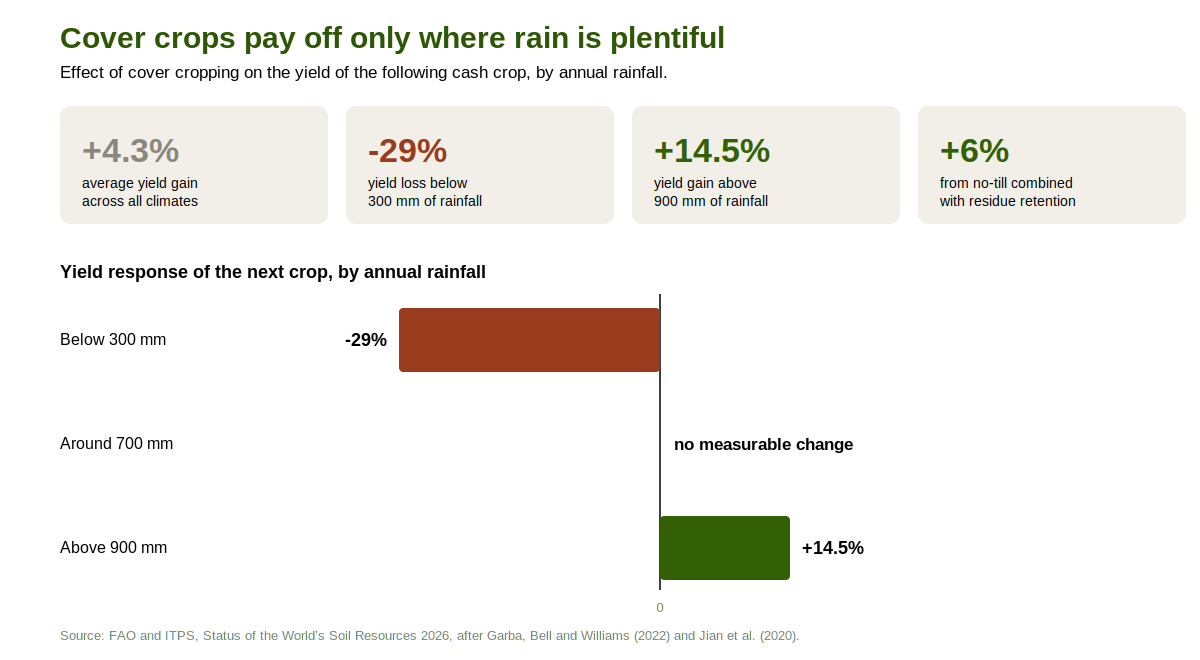
Cover crops increase the yield of the following cash crop by an average of 4.3%, measured across more than a thousand comparisons worldwide. In places receiving less than 300 mm of annual rainfall, the same practice cuts the next crop's yield by 29%. Both figures appear in the Status of the World's Soil Resources 2026, and the distance between them explains why soil advice travels badly from one climate to another.
The report compiles the measured yield effect of the main soil management practices, along with what they cost. For anyone deciding what to try on their own ground, the pattern is more useful than any single average, because several of the most recommended practices behave differently depending on water.
What the numbers say for each practice
Cover crops average a 4.3% yield gain in the following crop. The average conceals a strong rainfall gradient. Where annual precipitation is below 500 mm, cover crops reduced the next crop's yield in 38% of comparisons, had no effect in 56% and increased it in only 6%. Below 300 mm the reduction reaches 29%. Above 700 mm the response turns neutral, and above 900 mm cover crops raise yields by 14.5%. The mechanism is water, since a cover crop transpires soil moisture that the cash crop would otherwise use, which matters where moisture is the limiting factor and does not where it is abundant. The broader benefits are documented in the account of how cover crops improve soil health, and they still apply, but the yield trade-off in dry conditions is real.
No-till on its own produces a median yield decline of 1.9%. Combined with residue retention it delivers a median increase of 6%. The pairing matters more than either component, and the report is specific about where no-till performs best, namely under rainfed management in dry climates, where it matched conventional tillage yields for maize and legumes and exceeded them for wheat, rapeseed and cotton. The comparison with cover crops is worth holding onto, since the practice that suffers in dry conditions and the practice that shines there are often recommended together as a package. Reduced disturbance also carries the soil and water conservation benefits that make tillage decisions consequential beyond a single season's yield.
Residue retention alone produces a median yield increase of 8.2%, the strongest simple result in the set. One long-term dataset covering 30 experiments found no significant yield effect from retaining rather than removing residues, so the size of the gain varies, but no study reports a penalty.
Enhanced efficiency fertilisers raise yield by an average of 24% against conventional fertilisation, the largest agronomic effect in the list. The economics rarely follow. Across maize and rice, the yield increase failed to cover the extra cost of the product, with rice the only crop where the gain paid for itself.
Biochar produces a mean yield increase of 9.9%. At realistic prices, that gain does not justify the cost of the material on yield grounds alone.
Manure shows no yield benefit beyond the nitrogen and phosphorus it supplies, performing much like equivalent nutrients from synthetic fertiliser. Its value lies in the organic matter and biological effects rather than in a yield premium over correctly matched mineral nutrition.
Why the dry-climate result matters for Mediterranean farms
Greek and other Mediterranean growers sit in exactly the rainfall band where the cover crop evidence turns unfavourable, and much of the standard advice reaching them was developed in wetter northern European or North American conditions. Cover crops still have a place in dry regions, provided their design changes. Terminating the cover earlier, choosing species with lower water demand, and treating the residue as surface mulch rather than incorporated green manure all shift the water balance back toward the cash crop.
No-till and residue retention run the other way. Both perform strongest under exactly the rainfed, dry conditions where cover cropping struggles, because keeping residue on the surface reduces evaporation and improves infiltration when rain does arrive. For a farm in a summer-dry climate, the evidence points toward residue and reduced disturbance first, with cover cropping added carefully and adapted, rather than the reverse order. Similar reasoning drives the practices discussed in the guide to combating desertification and drought with regenerative approaches.
The reason good practices stay unadopted
Farmers adopt for economic reasons, and the survey evidence says so directly. Among adopters of sustainable land management technologies, the most cited motivations were production at 24%, increased profitability at 20%, improved wellbeing and livelihood at 20% and reduced workload at 5%. Together those economic considerations account for 69% of all stated motivations.
Set that against the numbers above and the adoption problem explains itself. The practices with the clearest yield gains, namely enhanced efficiency fertilisers and biochar, are the ones whose costs exceed their returns. The practices that pay, namely residue retention and no-till with residue, deliver modest single-digit gains that arrive gradually and can be preceded by a short-term yield dip during transition. A farmer weighing an uncertain 6% against a certain up-front cost is making a reasonable decision when they decline.
Across nearly 18,000 papers reviewed on this question, the finding was consistent. Where payments fail to offset the cost of switching, farmers rarely change practice. Where payments compensate or more than compensate for the income lost and the extra costs, willingness to adopt is normally high. Long-term benefits were often clear to the farmers surveyed, and the barrier was the initial investment period rather than doubt about the value.
What kind of support actually changes behaviour
Incentives fall into four types, namely market instruments such as input and output prices and subsidies, non-market support such as technical advice and technology transfer, regulatory measures such as standards and certification, and cross-compliance payments tied to environmental outcomes. The soil science literature points consistently to cross-compliance as the most effective for practices that benefit the environment while lacking short-term profit, since it addresses the exact obstacle the surveys identify, which is large up-front costs against a household's immediate needs.
Poorly designed incentives can make soil management worse. Heavy subsidies on nitrogen fertiliser across South Asia pushed farmers toward urea in preference to other nutrients, limiting the yield response achievable from unbalanced applications while raising the environmental cost. Support aimed at soil has to be aimed at the practice rather than at a product, or it ends up funding the imbalance it was meant to correct.
The underlying case for any of this holds regardless of subsidy, since soil health sets the ceiling on what a field can yield over the long run. What the evidence adds is precision about which practice to reach for first, and honesty about which ones will not pay for themselves without help.
Sources
- FAO and ITPS. (2026). Status of the world's soil resources 2026. Rome, FAO.