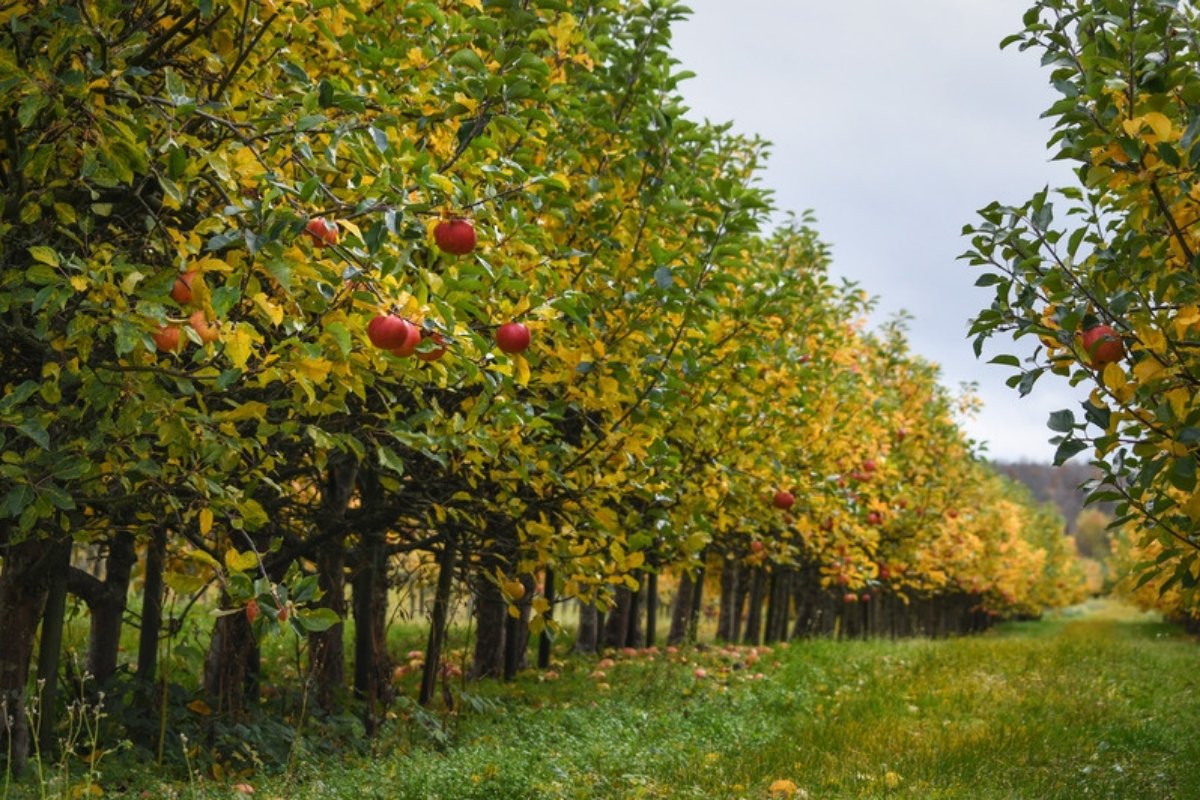
The leaves that drop in the orchard this autumn carry next spring's scab, while the bark of the trees fills with pear psylla that will stay there until late winter. From harvest until the end of dormancy, pome fruit orchards call for a series of cultural measures and treatments that cut insect and mite populations and the fungal and bacterial inoculum left in the orchard. Each measure taken now makes control in the next growing season more effective and cheaper.
Why fallen leaves carry apple scab
The scab fungi of apple, pear and quince overwinter in fallen leaves, where they form their fruiting bodies. These release ascospores in spring that cause the first infections on young growth, so every leaf that decomposes before then is one less leaf producing spores.
The first measure is to work fallen leaves into the soil, and to remove and burn infected shoots and twigs. Chopping leaf litter with a flail mower speeds up its decomposition and reduces the fungus's fruiting bodies, so fewer ascospores reach the orchard in spring.
When urea is needed on the leaves
In orchards with significant infection, the foliage is sprayed with urea or with a suitable approved fungicide at the highest recommended rate, or the same spray goes onto leaves that have already dropped. Urea speeds up leaf decomposition, and US guidelines recommend a 5% urea solution on trees after harvest or on leaf litter in autumn or spring.
On the trees, the spray goes on just before leaf fall, so that urea does not push new growth that could suffer winter injury. In experiments, shredding leaf litter or treating it with urea reduced leaf scab the following spring by 46 and 42% and fruit scab by 59 and 65%.
These measures only work when all growers in an area apply them, because ascospores are carried by wind and infect over long distances. The same measures also cover pear Septoria leaf spot and brown rot, while for Monilinia the mummified fruit is collected and removed from the orchard as well. The spring programme for fire blight and apple scab then starts with less inoculum.
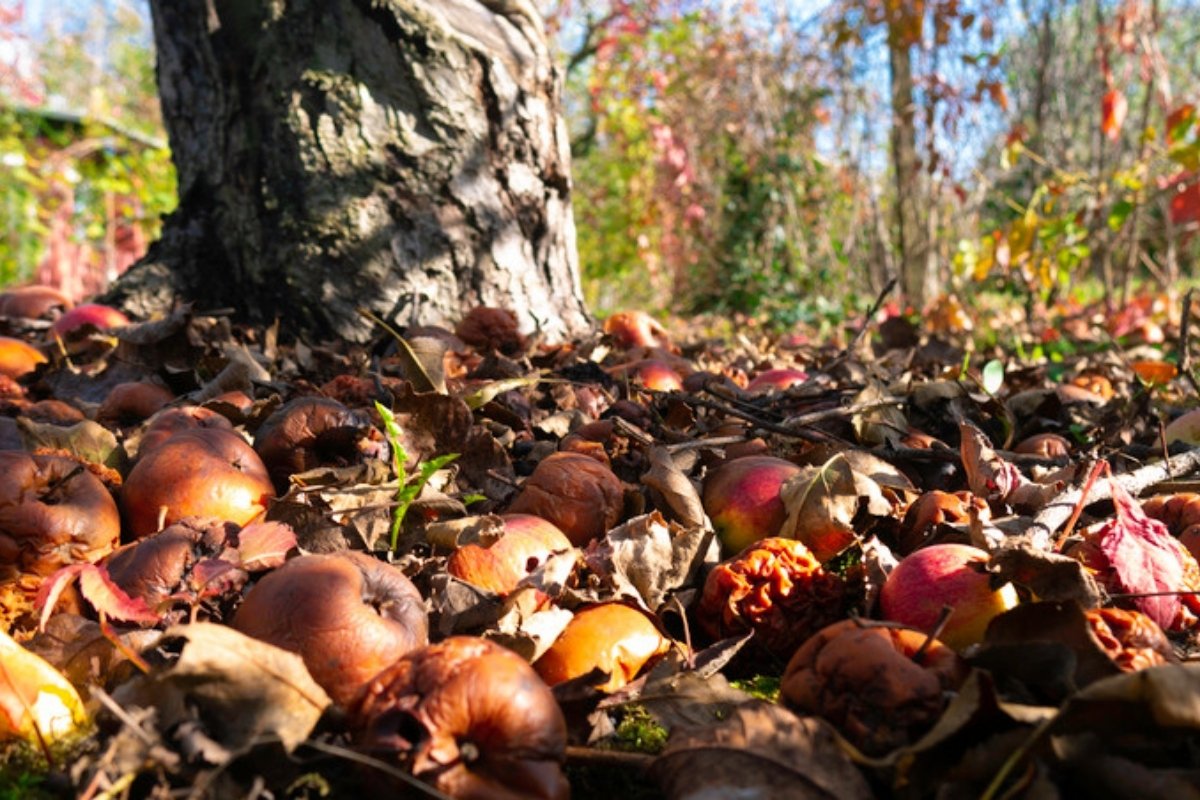
Fallen leaves and fruit left under the trees carry apple scab and Monilinia into the next season.
How to limit fire blight in autumn
The bacterium Erwinia amylovora overwinters in limb cankers and is spread by rain splash and insects. Where the disease is present, orchards are sprayed with an approved copper product at the start and at the end of leaf fall.
In orchards with a fire blight problem, trees infected on the trunk or on scaffold limbs less than 50 cm from the trunk are uprooted and burned at once. Infected shoots, branches and limbs are removed and burned together with 30 to 60 cm of healthy wood, and wild trees and shrubs around the orchard that show symptoms are also removed, because they act as alternative hosts.
Sources disagree on the length of healthy wood to remove. In California cuts are made at least 20 to 30 cm below the visible injury, shorter than the Greek bulletin asks for, so the Greek recommendation is the stricter of the two and leaves a wider safety margin.
The work is done in dry weather and is not combined with winter pruning at this time of year. Cuts are protected with a suitable product, and pruning tools are disinfected after every cut in a 10% bleach solution.
Why pear psylla is sprayed before leaf fall
Pear psylla overwinters as adults in bark crevices, and winterform adults appear from September, with part of them leaving the orchard in a dispersal that peaks around leaf fall, in late October and early November. The insect also transmits the phytoplasma that causes pear decline, and during the growing season pear psylla is managed together with wood-boring moths in the spring and summer programme.
In heavily infested orchards with high populations, after harvest and before leaf fall a spray with an approved pyrethroid is recommended against the adults that will overwinter. This season suits that class of insecticide because large numbers of predators and parasitoids are not active, and the spray goes on during a sunny, warm day, when adults move the most.
Until leaf fall, winterforms stay relatively sedentary on the trees, which is why the spray does not wait for the leaves to drop. As a guide to what counts as a high population, US guidelines set a post-harvest threshold of psylla on 5 or more of 20 top shoots, or more than 250 psylla on 20 shoots.
In the United States pear psylla has developed resistance to pyrethroids, so where earlier pyrethroid sprays failed, the insecticide is chosen from a different mode-of-action group.
What to do in winter for clearwing moths and scale insects
The apple clearwing moth, a wood borer, overwinters as a larva in tunnels in the trunk and at the base of scaffold limbs, which is where most of the damage is found. To reduce its numbers, dead branches and branches weakened by the attack are removed and burned.
In orchards with scale insects, such as San Jose scale, which leaves a typical red halo around the scale on apples, dead and weakened parts and anything carrying dense scale populations are removed and burned in winter. Between leaf fall and bud swell, one spray of approved mineral oil, alone or mixed with an insecticide, also kills the overwintering eggs of aphids and mites.
| Problem | Where it overwinters | What to do | When |
|---|---|---|---|
| Scab, Septoria, Monilinia | Fallen leaves, mummified fruit | Work leaves into soil, urea or fungicide, collect mummies | Before and after leaf fall |
| Fire blight | Limb cankers | Copper, remove infections with 30 to 60 cm of healthy wood | Start and end of leaf fall |
| Pear psylla | Bark crevices | Pyrethroid on a sunny, warm day | After harvest, before leaf fall |
| Apple clearwing moth | Tunnels in trunk and limbs | Remove and burn dead branches | Winter |
| Scale insects, aphid and mite eggs | Branches and bark | Mineral oil, alone or with an insecticide | Leaf fall to bud swell |
Source: Plant Protection Centre of Volos, pome fruit bulletin No 12, 5 October 2026
Frequently asked questions
Why spray urea on apple trees in autumn
To make fallen leaves, where scab overwinters, decompose faster. A 5% urea solution is applied to trees after harvest or to leaf litter and reduces primary inoculum in spring.
When should copper be sprayed for fire blight
Where the disease is present, at the start and at the end of leaf fall, with an approved copper product.
How far below fire blight should you cut
The Greek bulletin asks for at least 30 to 60 cm of healthy wood to be removed, while in California cuts are made 20 to 30 cm below the visible injury. Tools are disinfected in 10% bleach after every cut.
When should pear psylla be sprayed in autumn
After harvest and before leaf fall, in heavily infested orchards, on a sunny, warm day, when the adults are most active.
What is the red halo around spots on apples
It is the typical sign of San Jose scale, which leaves a red halo around the scale. It is controlled with a dormant mineral oil spray.
When is the dormant oil spray applied to pome fruit
From leaf fall until just before bud swell, with mineral oil alone or mixed with an insecticide, in orchards with scale insects.
Important notes
Conditions vary by region, variety, tree age and year, so the above is a general guide and a starting point for checking the orchard. For heavy or persistent problems, an agronomist should be consulted for an accurate diagnosis and treatment plan.
Cultural measures come first, meaning working leaves into the soil, collecting mummified fruit and removing infected branches. When chemical control is needed, use only products authorised for the crop, which in Greece are listed in the ΥΠΑΑΤ plant protection database, and follow the label instructions.
Sources
- Regional Centre for Plant Protection, Quality and Phytosanitary Control of Volos, Pome fruit, post-harvest treatments, Bulletin No 12, 5 October 2026 (in Greek).
- Porsche F. M. et al., A new phytosanitary method to reduce the ascospore potential of Venturia inaequalis, Plant Disease, 2017.
- eXtension, Apple scab.
- UMass Amherst, Apple IPM, apple scab.
- UC Statewide IPM Program, Fire blight in pear.
- UC Statewide IPM Program, Pear psylla.
- A whole ecosystem approach to pear psyllid (Cacopsylla pyri) management in a changing climate, Journal of Pest Science, 2024.
- Washington State University Tree Fruit, Pear psylla management, postharvest sprays.
- UMass Amherst, Pear psylla, New England Tree Fruit Management Guide.