By 2030, every EU member state will be legally required to show that pollinator populations are recovering. It is a binding target under the Nature Restoration Regulation, in force since August 2024. For food companies sourcing from European farms, that changes the conversation about pollination. It moves from a sustainability footnote to a procurement variable.
And here is the part most boardrooms have not caught up with. The standard response, put more honeybee hives in the field, is not the answer. Recent research suggests it can make the underlying problem worse.
A $577 billion supply chain input that almost no one tracks
The Intergovernmental Science-Policy Platform on Biodiversity and Ecosystem Services (IPBES) put the annual value of global food production reliant on animal pollination at between USD 235 and 577 billion. About 75% of leading global food crops benefit from pollinators to some degree. In the EU specifically, the European Environment Agency estimates the value of pollination services for agriculture at EUR 5 to 15 billion a year, with around 80% of crop and wildflower species dependent on insect pollination.
Apples, almonds, sunflowers, oilseed rape, tomatoes, blueberries, coffee, cocoa, and avocados. The list of crops that move through international supply chains and depend on pollinators is long. The list of food companies that explicitly track pollinator health as a sourcing input is short.
This is the gap. Pollination is an ecosystem service that has been priced into the cost of food for decades without anyone paying for it directly. As the service degrades, the bill is being passed along through yield variability, contract pricing, and now regulation.
The myth that more hives equals more pollination
There is a reasonable assumption that runs through corporate sustainability reports, NGO partnerships, and back-of-the-magazine adverts. If bees are in trouble, support beekeepers. Sponsor a hive. Put colonies on the corporate campus.
The evidence is now telling us this is the wrong instinct.
A 2025 study from the Villavicencio Nature Reserve in Mendoza, Argentina, published in Biological Conservation, introduced managed honeybee hives to an arid ecosystem and measured the effect on wild wood-nesting bees. Wild bees closer to the managed hives showed reduced nest pollen provisions and altered reproductive performance. The honeybees, foraging in large numbers, drew down the floral resources wild bees needed.
A separate 2025 experiment published in Current Biology, run on an Italian island where honeybee hives had been introduced only three years earlier, used an island-wide hive-removal protocol to test trophic competition. Researchers documented strong overlap in floral visits between managed honeybees and wild bees, and found the population effects on wild bees were measurable within a single foraging landscape.
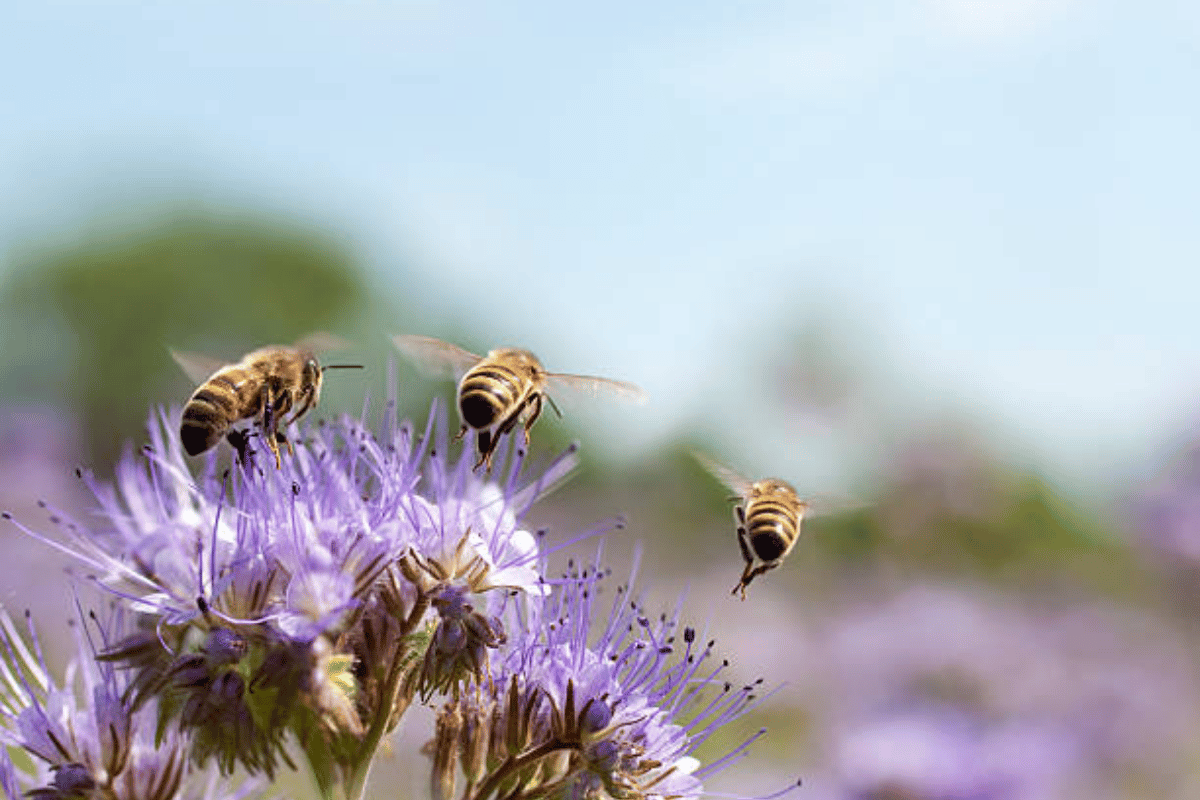
The point is not that honeybees are bad. The point is that honeybees are a managed livestock species. Wild bees are the biodiversity asset that delivers pollination services across the much larger landscape that surrounds any single farm. They are not interchangeable. Treating them as if they were is similar to assuming you could replace the wild fish stock in an ocean by farming more salmon. The math does not work, and the system around it pays the price.
The decline is happening to the asset, not the herd
The numbers that landed in 2025 should change how anyone with a stake in food supply thinks about this.
In March 2025, the Proceedings of the National Academy of Sciences published the first taxonomically diverse assessment of pollinator extinction risk across mainland North America. Of the 1,579 species assessed, 22.6% face elevated extinction risk. Bees were the most threatened insect group, with 34.7% of the 472 native bee species assessed at risk. The top drivers were climate change, agricultural practices, modifications to water and fire regimes, and urban expansion.
In June 2025, the European Environment Agency published Briefing 06/2025, Protecting and restoring Europe's wild pollinators and their habitats. Its findings are similar in direction. Roughly 40% of European hoverfly species, 20% of butterfly species, and 9% of bee species are at risk of extinction. Wild bees, hoverflies, butterflies, and moths are all in measurable decline across the continent.
None of this is about Apis mellifera, the western honeybee. Managed honeybee numbers in the EU and the US have been stable or rising for decades. The decline is in the wild pollinator community that delivers most of the pollination service to the surrounding landscape. The herd is fine. The asset is shrinking.
What the 2030 deadline means in practice
Article 10 of the EU Nature Restoration Regulation requires member states to reverse the decline of wild pollinators by 2030 and to maintain an increasing trend after that, measured at least every six years. In September 2025, the European Commission adopted the methodology for the EU Pollinator Monitoring Scheme. Member states have until 16 December 2026 to begin implementation.
Once monitoring is in place, the regulatory chain reaches farm level. National restoration plans will translate the binding target into agricultural practices, conditionality under the Common Agricultural Policy, and, in time, the kind of supplier specifications that already govern pesticide residues, water stewardship, and soil cover.
For buyers sourcing from EU origin, the implication is direct. Pollinator-friendly production is moving from a voluntary sustainability claim to a verifiable input. The companies that begin asking about it now will be the ones that find resilient suppliers when the data starts to flow.
What action looks like at scale
The most useful reference point is already on the shelves. Mulino Bianco's Carta del Mulino program, run by Barilla with WWF Italy and validated by the Universities of Tuscia and Bologna, applies a set of ten sustainability rules across 2,400 farms and around 50,000 hectares of soft-wheat production. One rule requires producers to allocate 3% of each field to flower strips for pollinators. Suppliers commit to the protocol as part of the procurement contract, not as a side initiative.
That is what pollinator-aware sourcing looks like operationalized. Specifications in the contract. Verification in the audit. Trace back through the supply chain. The same approach can be adapted to almonds, oilseed rape, sunflower, apples, or any other pollinator-dependent crop in a procurement portfolio.
The question is worth carrying into the next planning cycle
The conversation about pollinators is shifting from "should we plant more flowers" to "is our supply chain ready for what is coming?" The science is settled enough to act. The regulation has dates on it. The cases that work are documented.
By 2030, the food companies that priced this in will look like they were paying attention. The ones that were still buying hive sponsorships will look like they were not.
World Bee Day is 20 May. The case for action is no longer about saving the bees. It is about understanding which bees are doing the work, and what it takes to keep them doing it.
References
- European Commission, Environment Directorate-General, "Pollinators," covering Article 10 of the EU Nature Restoration Regulation and the EU Pollinator Monitoring Scheme adopted 19 September 2025.
- European Environment Agency, Protecting and restoring Europe's wild pollinators and their habitats, EEA Briefing 06/2025, June 2025.
- IPBES, The Assessment Report on Pollinators, Pollination and Food Production, Intergovernmental Science-Policy Platform on Biodiversity and Ecosystem Services, Bonn, 2016.
- Pascual Tudanca, M.P. et al., Beekeeping in natural areas and its effects on wild bees, Biological Conservation, 2025.
- Pasquali, L. et al., Island-wide removal of honeybees reveals exploitative trophic competition with strongly declining wild bee populations, Current Biology, 35(7), 1576–1590, April 2025.
- Cornelisse, T. et al., Elevated extinction risk in over one-fifth of native North American pollinators, Proceedings of the National Academy of Sciences, 122(14):e2418742122, April 2025.