Onions (Allium cepa) belong to the Liliaceae family and are among the most widely consumed and cultivated vegetables globally. Onion plants can grow in various environmental conditions, from cooler climates to tropical regions. In nature, onions are biennial or perennial plants, like Egyptian and multiplier onions and shallots, but they are cultivated as annuals for commercial purposes, primarily for the bulbs they produce during their first year. For onions to initiate bulb formation, day length must fall between 11 and 16 hours, depending on the variety. The bulb initiation is regulated by photoperiod, and the bulb’s final size is influenced by the size and number of the plant’s leaves. Generally, each leaf layer translates to an onion ring.
The onion plant typically comprises a pseudostem formed by multiple layers of older, fleshy, and enlarged leaves. New leaves grow from the top of the pseudostem, and the lower edge of these leaves contributes to bulb formation. The leaves are elongated, green, cylindrical, and hollow. The flower stem emerges in the second year directly from the center of the pseudostem. The flower head is an umbel with clusters of 5 to 2,000 small white, white-green, or purple flowers. These flowers are self-infertile and require insect pollination for seed production. In some varieties, such as Allium cepa var. viviparum (Egyptian onion), tiny bulbs form in place of flowers on top of the flower head. Onion seeds are small, triangular, and black.
Onions require about 130-170 days from sowing to harvest, depending on the variety. During early growth stages, cool weather and adequate rainfall or irrigation are ideal. Onion seeds germinate in soil temperatures ranging from 15-25 °C (59-77 °F). Optimal growth occurs with mean daily temperatures between 13-25 °C (55.4-77 °F), while dry, warm conditions (25-27 °C or 77-80.6 °F) are essential during bulb maturation for maximum yield and quality. Extremely low temperatures (8-13 °C or 46.4-55.4 °F) can delay bulb formation by up to four weeks and may even induce premature flowering (bolting).
Classification and Selection Criteria for Onion Variety
Onion varieties are mainly categorized based on 4 main characteristics.
1. Daylength Requirements
Onion varieties are primarily categorized by their day length requirements for bulbing:
- Short-Day Varieties: Begin bulb formation at day lengths of 10-13 hours and are typically suited to southern regions with milder winters.
- Intermediate-Day Varieties: Start bulbing with 13-14 hours of daylight, making them suitable for central regions.
- Long-Day Varieties: Require over 14 hours of daylight and thrive in northern regions, where days are longer during the growing season.
2. Shape including flat, turbinate, discoidal, pear-shaped, oblate, and conical globe. Shape influences market preference and can also affect how onions are sliced and used in cooking.
3. Color and Flavor Profiles
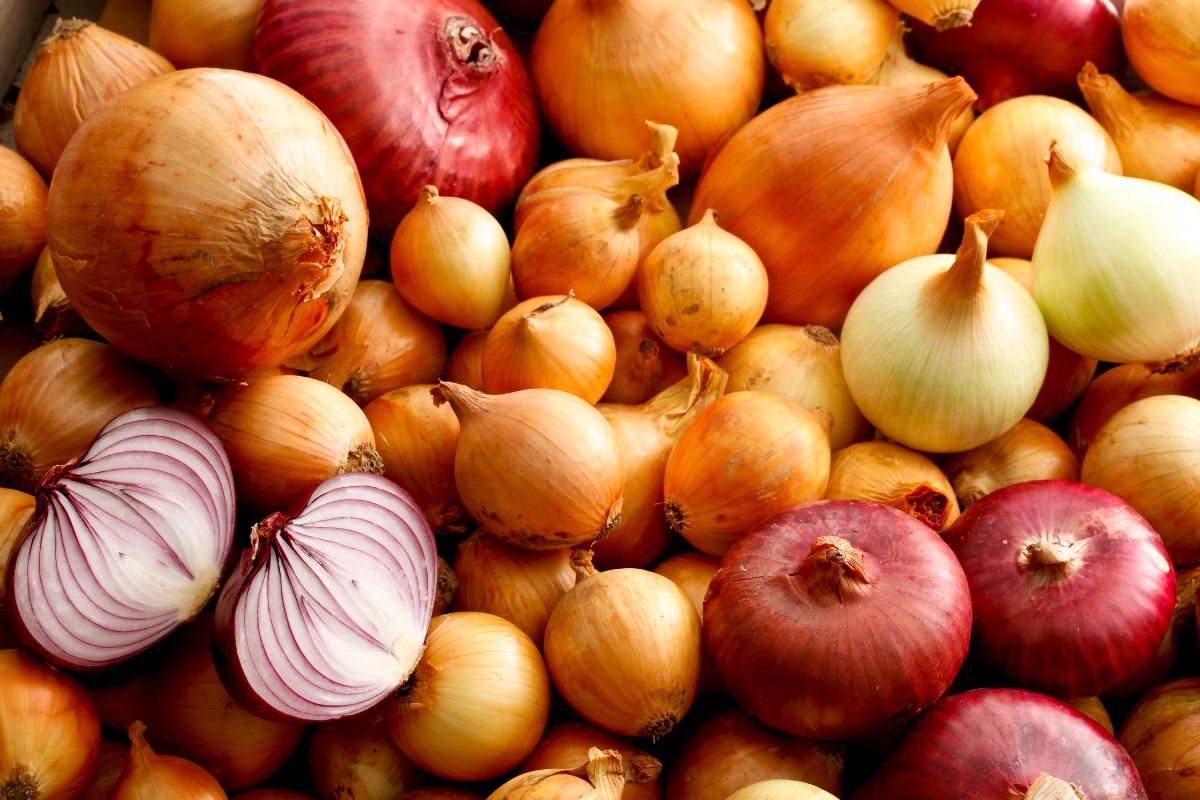
The primary onion colors are yellow, red, and white, each with distinct flavor profiles and culinary uses:
- Yellow Onion: The most popular and versatile variety, often used for its mild, sweet flavor that deepens when cooked. It is very popular in the USA.
- Red Onion: Red onions is considered the second most used onion type and has recently gained popularity due to the extra color it offers in salads and burgers. Red onion varieties generally have a stronger taste compared to yellow varieties and are mainly used raw, roasted, or grilled.
- White Onion: A favorite in Mexican and Southwestern cuisine, known for its spicy, full flavor. White onions typically have a shorter storage life than yellow and red onions.
Each category includes numerous onion varieties of different characteristics. Some commonly used varieties are: Yellow Granex, Early and Texas Grano, Creamgold onion (or Pukekohe Longkeeper) (in Australia), Bombay Red, Red Creole, Red Star F1, and Neptune F1 (in Japan and Africa). Varieties like Sweet Sandwich, Walla Walla, and Sweet Spanish are popular for producing giant bulbs.
4. Resistance and Suitability
Selecting a suitable onion variety is critical for success. Growers should consider local conditions like temperature and photoperiod, as well as specific pest and disease resistance, particularly against soil-borne pathogens like Fusarium and Botrytis species. Resistance to common pests, such as onion thrips and maggots, is also important. Furthermore, growers should choose varieties based on market demand and the intended end use, whether fresh consumption, processing, or storage. For instance, varieties with thicker, tighter skins generally have a longer storage life.
It is essential to select a variety that is well adapted to your local conditions (temperature, photoperiod, etc.), is resistant to pathogens and pests of interest for your region, and produces high-quality bulbs suitable for the market goal and the preferences of your targeted consumers (canning, raw consumption, etc.).
References
- Onion Production Guide
- Onion Color Flavor Usage Guide – Onions-usa
- Crop Information: Onion — FAO
- Allium (PDF) – Hamilton
- How Grow Big Onions – North Dakota State University
- Production Guidelines Onions (PDF) – gov.za
Further information
- Interesting Facts about Onions
- Onion: Info, Nutritional Value, and Health Benefits
- Onion Plant Information and Variety Selection
- How to Grow Onions At Home: Onion Growing Guide for Beginners
- Commercial Onion Farming - How to Grow Onions for Profit
- Onion Soil Requirements, Soil Preparation, and Planting
- Which Factors Can Affect Bulbing in Onions?
- Onion Water Requirements and Irrigation Systems
- Onion Nutrient Needs and Fertilization Requirements
- Major Onion Pests and Diseases and Sustainable Management Practices
- Onion Weed Management: How to Control Weeds in an Onion Field
- Onion Harvest, Yields, and Storage