

Spain harvest surges, Greece faces shortages, Tunisia enforces price support, Italy maintains premium
The global olive oil market is entering a pivotal phase as Spain accelerates production, Greece struggles with quality and logistics, Italy maintains its high prices, and Tunisia implements measures to stabilise export prices. Producers, traders, and bottlers are closely monitoring supply, quality, and pricing dynamics as year-end demand approaches.
Stay up to date with our Weekly Olive Oil Digest
Spain: Harvest momentum builds, good quality
The 2025/2026 olive oil campaign in Spain is advancing with optimism. At Finca La Pontezuela in Toledo, the estate reports healthy analytical results despite weather-related disruptions. Harvesting began in mid-October as usual, but heavy autumn rainfall has slowed collection.
“It’s raining more than normal right now,” says Pablo Burrueco, ecommerce manager at the estate. “We’re in the rainy season, but we’re still managing—we’re getting it done.” After years of drought, producers welcome the moisture: “The trees were grateful for it,” he adds.
Early EVOO shows high polyphenol content and clean, balanced flavour profiles. “So far, the olive oil is of good quality—everything is turning out really well,” Burrueco says.
Production outlook: Rebound
After multiple difficult seasons, producers are more upbeat. “We are more optimistic than in previous years,” Burrueco confirms.
The farm expects to surpass 500,000 kg of olives and convert about 75% of them into oil, representing a significant improvement over last season.
Prices may soften as supply grows.
Spanish producers expect mild downward pressure on prices. “We expect the price will decrease a little,” says Burrueco. If yields remain strong nationwide, this easing could bring some relief after months of high prices.
Finca La Pontezuela emphasises the importance of global exports, noting that Japan and South Korea are emerging as key growth markets. They also highlight organic certification as a key selling point for international buyers, adding that they will certify all their varieties by next year.
Abundant harvest in Andalusia puts downward pressure on prices
Southern Spain is preparing for mass olive oil production, especially in Jaén and Córdoba, in the coming weeks. Daily output is expected to reach around 15,000 tons through early January. This surge comes amid relatively weak demand, creating downward pressure on prices.
.jpg)
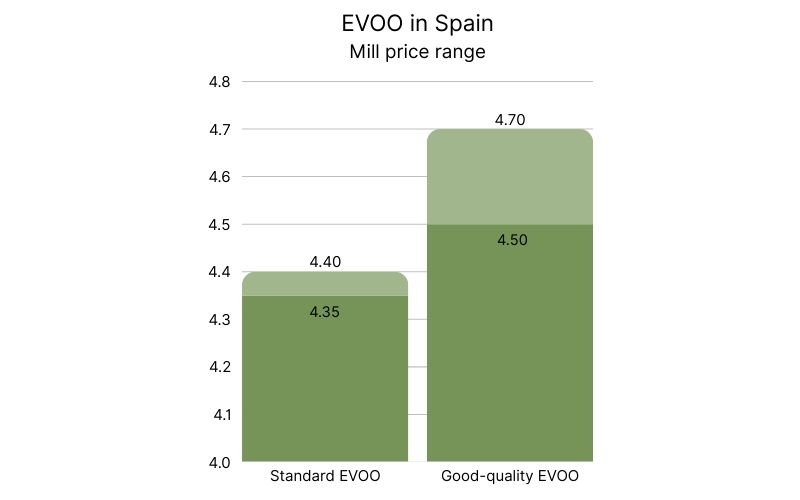
EVOO quality-based price differentiation
Other categories
- Lampante oil: rising due to shortages, from €3.65–€3.70/kg to €3.85–€3.95/kg
- Pomace oil: steady at €1.95–€2.05/kg
- Refined oil: rising to €3.65/kg due to Lampante scarcity
Adverse temperatures and harvest delays may also increase the share of Lampante and lower-grade EVOO.
Greece: Quality challenges, limited supply, high prices
The Greek market is under significant pressure, with quality inconsistencies, supply shortages, and logistical hurdles.
Peloponnese: Producers holding back
Many mills are reluctant to sell at current prices, offering only 5–10 tons at a time. This makes securing full-truck exports difficult for traders. Oil prices depend heavily on quality and taste:
.jpg)
Crete: Water stress affects early oils
Early-season oils have shown woody tastes, reflecting water stress. High-quality EVOO is scarce, pushing bottlers to anticipate higher purchase prices. Farmers’ strikes are complicating logistics, disrupting truck access to ports and airports.
.jpg)
Overall, Greece remains a high-priced, low-availability market.
Italy: Stable but elevated prices
Italian EVOO prices remain high and only slightly softer, supported by strong domestic and international demand for premium oils.
Current pricing:
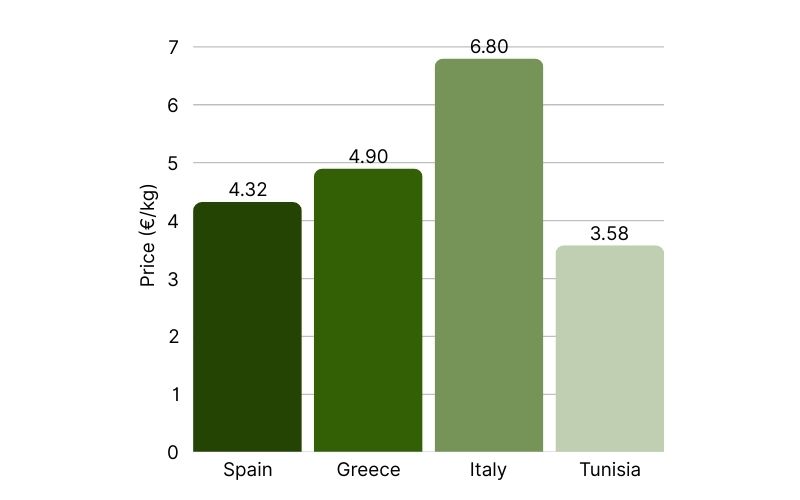
- EVOO: ~€6.80/kg (dependent on quality)
Early signs suggest a moderate rebound in production, though volumes remain vulnerable.
Tunisia: Government measures stabilise export prices
Tunisia is actively supporting export prices by encouraging producers to withhold supply and by enforcing minimum selling levels.
Current pricing:
- Two weeks ago: €3.40–€3.45/kg
- Now: €3.55–€3.60/kg
- Near-term expectation: €3.70–€3.90/kg
These policies support domestic margins but limit arbitrage opportunities for international buyers.
Standard EVOO average price comparison by country
Market outlook: What to expect heading into 2026
Country by country expectations:
- Spain: Large harvest likely to push prices down, though premium-quality EVOO may remain scarce
- Greece: Logistics issues and high prices continue to constrain supply
- Italy: Stable, elevated pricing with strong demand for premium oils
- Tunisia: Government support will keep upward pressure on prices
Key trends to watch:
- Mid-market oils remain attractive: Pomace and refined oils continue to offer stable, affordable options for buyers impacted by high EVOO costs.
- Blending strategies gain importance: Blending Spanish and Greek oils may help bottlers maintain consistent quality, predictable pricing, and supply security.
- Recommendation for traders: Monitoring harvest data, weather impacts, and quality analyses will be crucial. Proactive sampling and strategic blending will remain key tools for navigating a volatile global market.
Source olive oil with confidence on Wikifarmer's Marketplace:
Disclaimer: The information provided on this website, including market prices, insights, and projections, is for general informational purposes only. While we strive to ensure accuracy and timeliness, we make no guarantees regarding the completeness, reliability, or suitability of the information presented. Users are solely responsible for independently verifying the data and assessing its relevance to their specific circumstances before making any decisions. Wikifarmer and its operators shall not be held liable for any losses, damages, or consequences arising from the use of the information provided herein.