
Spanish prices dominate, old stock runs out; Greece faces mounting quality challenges
In the olive oil market this week, Spanish prices remain strong as old stocks are depleted, while Greece struggles with severe quality issues. With new harvests setting the tone, blending and imports are increasingly strategic tools for buyers trying to meet demand.
Stay up to date with our Weekly Olive Oil Digest
Spain: Old stock gone, new crop sets the tone
Spanish olive oil activity remains high as the last of the old-crop inventories are cleared. Current prices now reflect new-crop EVOO and VOO oil levels, with lampante oils showing temporary downward pressure.
Price trends
.jpg)
Farmers hold firm
Producers are reluctant to lower prices, citing:
- Crop uncertainty due to potential rain shortages
- Fear of selling too cheaply
- Expectations of higher consumption if prices remain favourable
This has created a high price floor, with sellers holding back volume.
Packers bet on a drop
Packers anticipate EVOO prices could fall below €4/kg, potentially reaching as low as €3/kg, prompting minimal forward buying. Supermarkets are delaying contracts, leaving packers with shrinking stocks, forced to buy small quantities daily to fulfil immediate needs.
Greece: Quality crisis deepens, prices surge
Early-season Greek olive oil is experiencing significant quality deterioration, prompting buyers to turn to blending and imports to maintain supply.
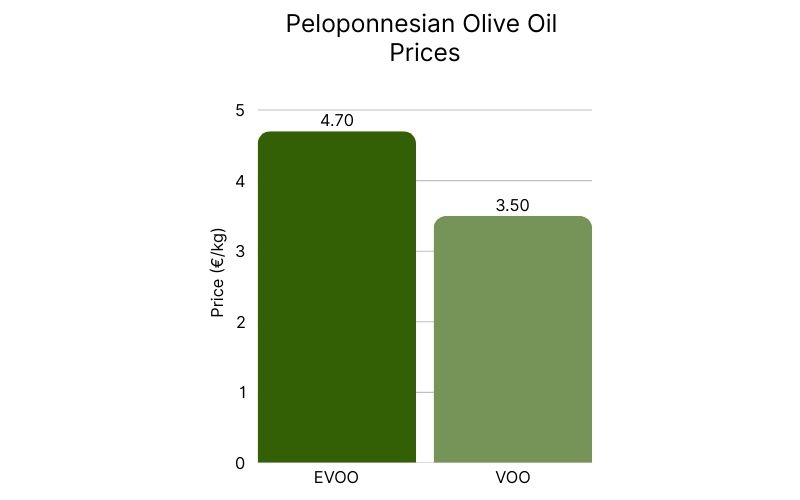
Peloponnese: Prices surge amid low quality
After initial drops due to poor quality, prices for good EVOO in the Peloponnese have surged. Limited high-quality volume has led major buyers to purchase at over €5/kg to secure premium oil. Lower-grade virgin and lampante oils are available, but in insufficient bulk quantities for industrial buyers.
Price trends
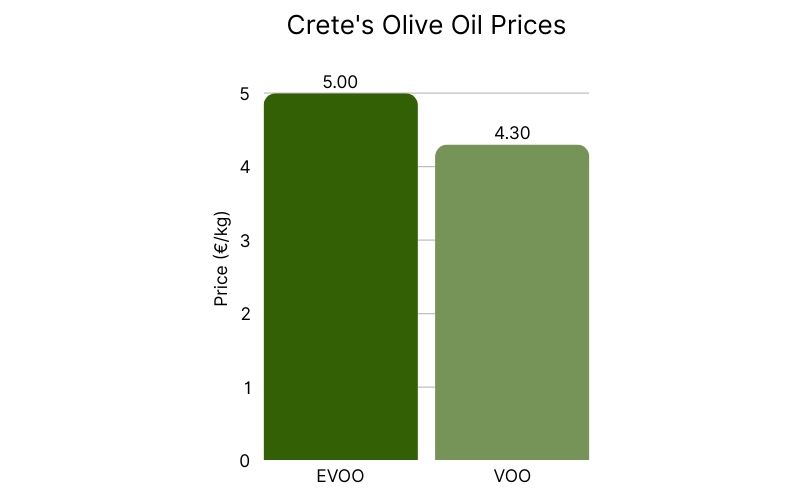
Crete: Rain offers hope, but acidity levels alarming
While recent rains may stabilise quality, chemical indicators remain poor: K232 values are exceeding 1.8, outside the acceptable EVOO parameters. Mills are paying farmers €5.20–€5.50/kg for olives, prices many cannot sustain. Tunisian olive oil is also entering Crete as a bulk alternative.
Price trends
Blending strategies and alternative sourcing
Given quality issues in Greece, buyers are increasingly seeking:
- Spanish EVOO with low bitterness for blending, to improve taste and acidity
- Representative samples linked to large volumes (up to 1,000 tons)
- Lampante oil for refining, though availability is limited
Industry insiders note that buyers are prioritising order fulfilment over purist sourcing, blending whatever oils are available to meet contracts.
Italy: Stable high prices, strong premium demand
Italian EVOO prices remain elevated and stable, easing only gradually. Demand is firm domestically and internationally, particularly for high-quality, premium oils. The gap between premium and standard EVOO remains wide. Early signs indicate a potential rebound in the new harvest, though overall volume remains vulnerable.
Price trends
- EVOO: ~€6.80/kg (varies by quality)
Bulk EVOO price comparison by country
.jpg)
Outlook: Key indicators for December
The next few weeks will be decisive for the olive oil market. Key factors to watch:
- Spanish price barrier: Will EVOO prices break the €4/kg threshold? Packer hedging strategies hinge on this.
- Greek crop stability: Will oil quality improve after recent rains? If not, imports and blending could surge.
- Italian production: Will production rebound this season? A stronger harvest could ease pressure on premium supply and prices.
- Tunisian oil: Will low-cost Tunisian bulk oil enter Europe at scale, thereby pressuring EU pricing?
- Supermarket commitments: Will retailers finalise 2024 contracts, ending current buying freeze?
The olive oil market remains volatile, navigating tight stocks, diverging price expectations, and increasing reliance on blended and imported solutions to meet global demand.
Source olive oil with confidence on Wikifarmer's Marketplace:
Disclaimer: The information provided on this website, including market prices, insights, and projections, is for general informational purposes only. While we strive to ensure accuracy and timeliness, we make no guarantees regarding the completeness, reliability, or suitability of the information presented. Users are solely responsible for independently verifying the data and assessing its relevance to their specific circumstances before making any decisions. Wikifarmer and its operators shall not be held liable for any losses, damages, or consequences arising from the use of the information provided herein.