
A buyer who asks an AI tool for the price of Spanish extra virgin olive oil today gets one figure back, while the market publishes several. The column has already set out the four kinds of price that can answer that question, and why price reliability depends on knowing which one came back. This article takes the figures published for one week at the start of the 2026/27 harvest, sets them side by side, and looks at what EU and Spanish rules say a price paid to producers has to rest on.
Three sources gave six figures for Spanish extra virgin in the same days
For the last week of October and the first days of November, the regional price observatory of Andalusia put extra virgin olive oil at Andalusian mills at €3.03/kg for 26 October to 1 November. The European Commission's weekly national average for Spain, which member states report to it, was €3.17/kg for the same week, and the Commission's figure for the Jaén market alone was €3.11/kg. Spain's transaction-price system, which records completed bulk sales and is open to subscribers, gave three more figures between €3.10 and €3.17/kg for overlapping periods.
All six describe the same grade in the same country within a fortnight, and they span €0.14/kg. On a 20-tonne lot that is €2,800, enough to matter in a negotiation. The gap comes from what each source measures: prices reported at mills in one region, a national average built from representative markets, or the volume-weighted average of the sales that closed in a given window.
The same transaction system gives a different figure depending on the day it is read
The transaction-price figures are rolling seven-day averages, and they reach the public through farmers' organisations that publish them on different days. One published on the morning of 3 November covered 28 October to 3 November and gave €3.152/kg from 29 trades across all grades, before that window had closed. Another, for 31 October to 6 November, gave €3.10/kg from 14 trades, and a third, for 3 to 9 November, gave €3.17/kg from 53 trades and 2,596 tonnes.
A weekly olive oil digest that tracks these figures does not calculate a weekly change from two snapshots published before their weeks closed, for this reason. A tool asked for "this week's price" may return any of the three, and the number of trades behind each one, between 14 and 53, says how much weight it can carry.
National averages show a wider gap between producing countries
The Commission's weekly series gives one national average per country and grade. For 26 October to 1 November, extra virgin averaged €3.17/kg in Spain, €3.47/kg in Portugal and €5.18/kg in Italy. Greece's latest figure in the file published on 9 November was €3.43/kg, for 19 to 25 October. Both Spanish series fell through October: the Andalusian observatory's figure from €3.36/kg in week 40 to €3.03/kg in week 44, and the Commission's average for Spain from €3.43/kg in the week to 4 October to €3.17/kg.
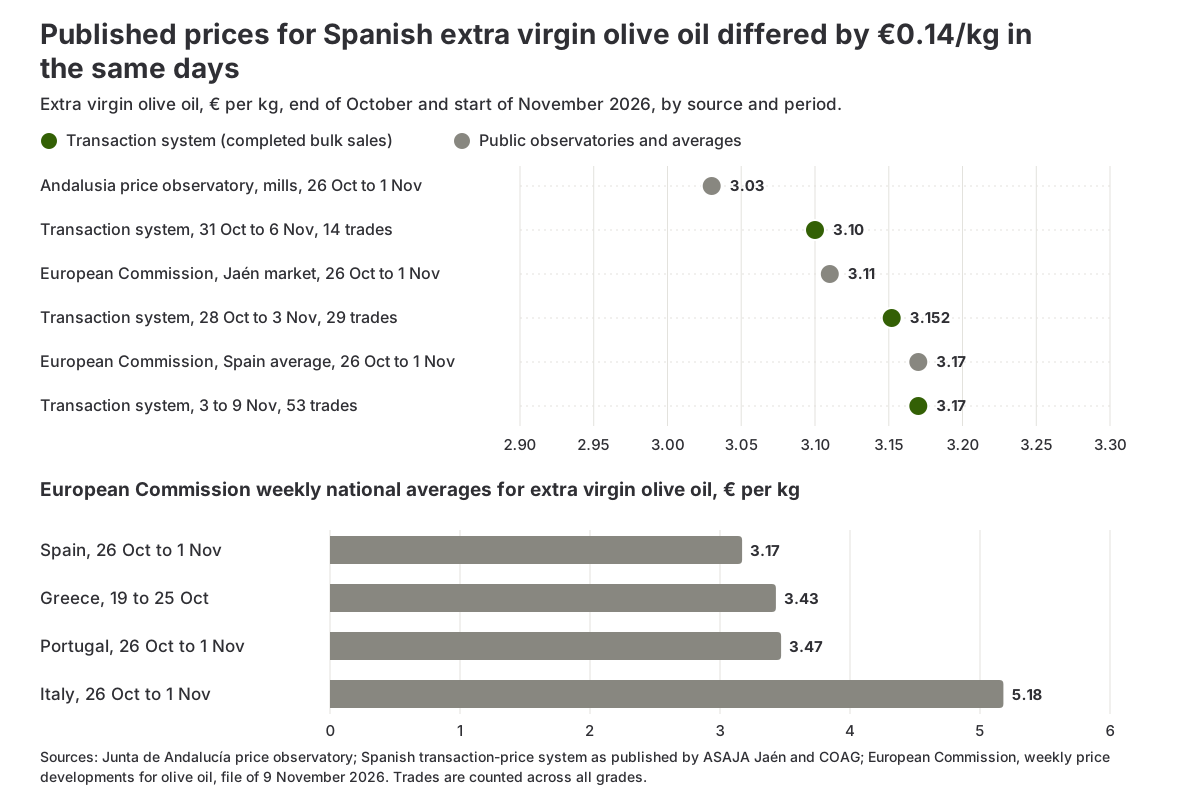
Published prices for Spanish extra virgin olive oil by source, and weekly national averages by country, end of October 2026. Sources: Junta de Andalucía price observatory; Spanish transaction-price system as published by farmers' organisations; European Commission, weekly olive oil prices.
Some official olive oil prices are not market prices
On 22 September Greece's tax authority set €1,524 per tonne, or €1.524/kg, as the minimum reference price of olive oil for the 2026/27 season. The figure is the base for the olive fly control levy, which is 2% of the value of the oil produced, and it refers to lampante oil with 2 degrees of acidity. It is published by a public body, carries the word "price" and turned up in a search for this autumn's Greek olive oil prices, yet it says nothing about what extra virgin oil sells for. A software tool that reads official documents needs to tell a tax base from a market price before it puts either in front of a buyer.
EU contracts will have to state how the price is set from August 2028
Regulation (EU) 2026/1739, adopted on 8 July 2026 to strengthen farmers' position in the food supply chain, makes written contracts the rule for deliveries by farmers, their cooperatives and producer organisations to processors, distributors and retailers. The price has to be either fixed in the contract or calculated from factors set out in it, including objective indicators that reflect changes in market conditions and in production costs, and member states may publish indicators for use in contracts. Deliveries by members to their own cooperative are among the exceptions.
The same regulation allows terms such as "fair" or "equitable" on labels and commercial documents only where the arrangement behind them aims, among other things, at a price that the participating farmers consider equitable and remunerative, which may take production cost data into account. Both parts apply from 19 August 2028.
Spanish law already ties the producer's price to its costs
Spain went further in 2021. Under its food chain law, the price in a contract has to be set by objective, verifiable factors, and the price paid to a primary producer has to be higher than the total costs the producer bears, including seeds, fertilisers, energy, machinery, financing and labour, whether hired or the producer's own. The producer determines that cost over the production cycle, and each operator in the chain has to pay the one before it at least the cost of production that operator actually incurred.
Because the rule sets no public figure, what counts as a fair price for one mill's oil depends on that mill's own costs, which a buyer, or a tool working for a buyer, cannot read off a price series.
Six points to check before calling a price fair
- Source: a regional observatory, a national average, completed sales or one seller's offer.
- Period and publication day: the week the figure covers and whether it was published before that week closed.
- Depth: the number of trades and tonnes behind a transaction average.
- Grade and place: extra virgin, virgin or lampante, at mill or delivered, and the delivery terms that apply.
- Purpose: whether the figure is a market price at all, or a tax base or support threshold.
- Costs and contract: in Spain, whether the price covers the producer's costs, and from August 2028 in the EU, whether the contract states the indicators the price follows.
Sources
- Junta de Andalucía. (2026). Observatorio de Precios y Mercados: aceite de oliva, últimos precios. Consejería de Agricultura, Pesca, Agua y Desarrollo Rural.
- European Commission. (2026). Weekly price developments: olive oil. DG Agriculture and Rural Development, file of 9 November 2026.
- ASAJA Jaén. (2026). Ligero incremento en el virgen extra y de las salidas. 9 November 2026.
- AgroCLM. (2026). Precios medios en origen del aceite de oliva (6 noviembre 2026). Compiled by COAG, 6 November 2026.
- Independent Authority for Public Revenue (AADE). (2026). Circular E.2050 of 22 September 2026 on the olive oil price for the 2026/27 olive fly levy. AADE.
- European Parliament and Council of the European Union. (2026). Regulation (EU) 2026/1739 amending Regulations (EU) No 1308/2013, (EU) 2021/2115 and (EU) 2021/2116 as regards the strengthening of the position of farmers in the food supply chain. Official Journal of the European Union, 29 July 2026.
- Spain. (2013). Ley 12/2013, de 2 de agosto, de medidas para mejorar el funcionamiento de la cadena alimentaria. Boletín Oficial del Estado, consolidated text.