Sunken, brown, corky spots on green olives in summer and a soft brown rot on fruit ripening in autumn are the two forms of the disease Greek growers call voula, known elsewhere as Dalmatian disease. In Greece the dry form on green fruit is called xerovoula and the rotting form on ripe fruit sapiovoula. The disease appears only on fruit already attacked by the olive fly, because infection starts at the fly's oviposition sting, so protecting the fruit from this rot starts with controlling the olive fly.
How to recognise the two forms
The dry form attacks unripe fruit in summer and early autumn, and the rotting form attacks ripe fruit in autumn and early winter. On green fruit the spots are sunken, brown, dry and corky, while on ripe fruit the whole olive softens and rots, then dries out and shrivels.
In both forms black dots, the fruiting bodies of the fungus, are visible on the lesions, and affected fruit drops early. The lesion starts at the sting, so on an olive with fruit rot the fly's mark usually sits inside or at the edge of the spot.
Olive leaf spot caused by Pseudocercospora also produces irregular, slightly sunken brown spots on green fruit and rot on ripe fruit, but it comes with leaf symptoms, yellow spots on the upper surface and a dark discoloration underneath. With no sting and leaves showing those symptoms, a fruit spot is most likely leaf spot rather than fruit rot.
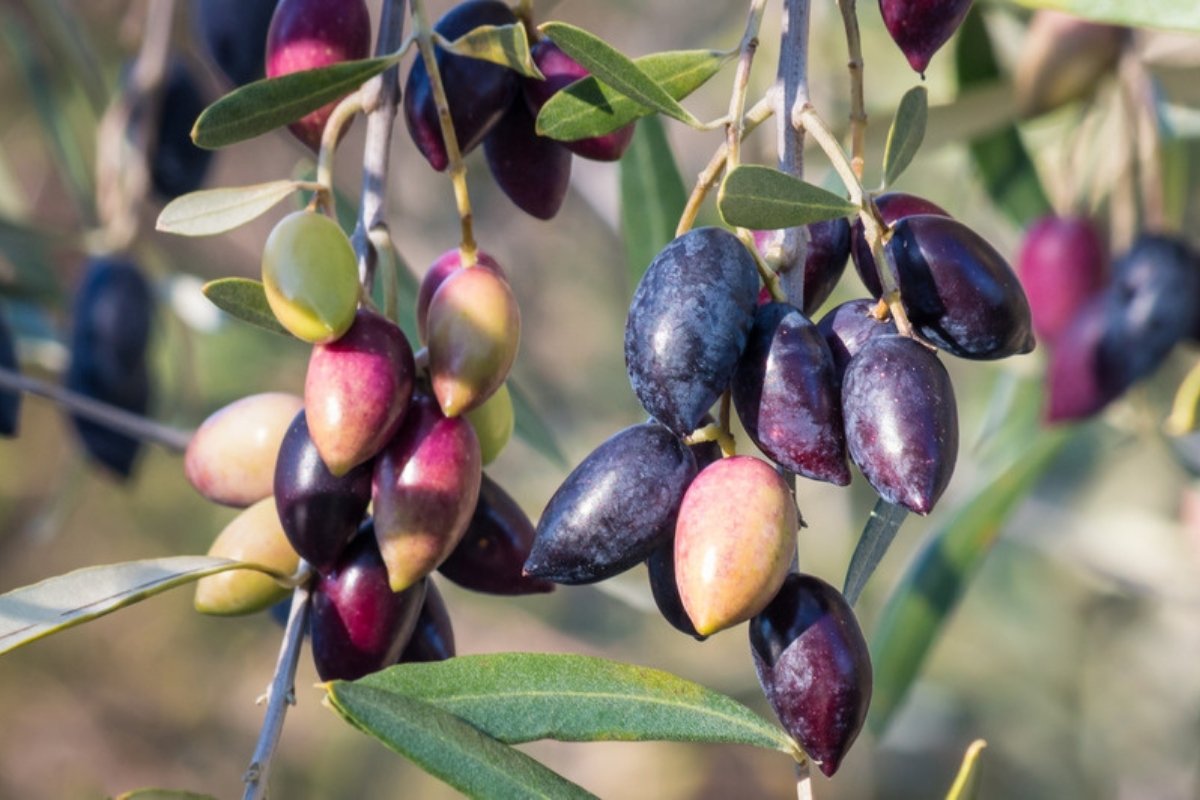
The rotting form attacks olives as they ripen in autumn and early winter, after the dry form has appeared on green fruit in summer.
Which fungus causes it
Greek bulletins still name the fungus Camarosporium dalmaticum, which international literature has reclassified as Botryosphaeria dothidea on genetic and morphological evidence. In Spain, B. dothidea causes Dalmatian disease of unripe olives, while related species of the same family cause rot of ripe fruit.
Damage is most serious in table olives, because the spots spoil the appearance of fruit grown for the table. In oil olives the loss comes mainly from early fruit drop and rot, on top of the damage the olive fly itself does to oil quality.
How the fungus reaches the fruit
Infection takes place in olive fly oviposition stings, where the fungus is carried by a parasite of the olive fly itself, Prolasioptera berlesiana. This small gall midge seeks out olive fly stings to lay its eggs and occasionally feeds on the fly's eggs and larvae, carrying fungal spores into the wound at the same time.
In a Spanish study, however, 77.5% of olives with Dalmatian disease had no larvae of this midge, so the olive fly sting alone is enough for the fungus to enter. Sources therefore disagree on how much the midge is needed, but they agree that without a sting there is no fruit rot.
When and where it appears
The fungus needs weather similar to olive peacock spot and anthracnose, meaning humidity and rain, so the first autumn rains favour its spread. The presence and severity of the disease depend on how heavily the grove is infested by the olive fly, so a year with high fly populations is usually also a year with more fruit rot.
How to limit fruit rot
Because the fungus is a wound parasite that enters through stings, protection depends first of all on systematic olive fly control. With fewer stings there are fewer places for the fungus to enter, so bait sprays, traps and the rest of the fly control programme reduce fruit rot at the same time.
Correct, regular pruning lets air and sunlight move through the grove and so lowers humidity and the severity of infection. Being able to identify the olive fly in the grove helps start fly control on time, before stings multiply.
Insecticides for the olive fly are chosen among products authorised for olive, which in Greece are listed in the ΥΠΑΑΤ plant protection database, rotating mode-of-action groups.
Frequently asked questions
What are the dry sunken spots on green olives
Usually the dry form of olive fruit rot, with sunken, brown, corky, dry spots that start at an olive fly sting.
What is the difference between the dry and the rotting form
The dry form attacks unripe fruit in summer and early autumn, the rotting form ripe fruit in autumn and early winter. It is the same disease at a different stage of the fruit.
Should olives be sprayed with fungicide for fruit rot
Protection relies first on systematic olive fly control, because the fungus enters through the stings. Pruning for airflow also lowers the humidity that favours it.
What are the black dots on rotten olives
They are the fruiting bodies of the fungus, which appear on the lesions in both the dry and the rotting form.
How is olive fruit rot linked to the olive fly
The disease appears only on fruit attacked by the olive fly, since the fungus enters through oviposition stings. The heavier the fly infestation, the more fruit rot.
How to tell fruit rot from leaf spot on the fruit
Fruit rot starts at an olive fly sting and shows black dots on the lesion. Leaf spot comes with yellow spots and dark discoloration on the leaves.
Important notes
Conditions vary by region, variety, olive fly pressure and year, so the above is a general guide and a starting point for checking the grove. For diagnosing symptoms, an agronomist gives the safest answer.
Cultural measures come first, meaning pruning for airflow and monitoring the olive fly with traps. When chemical control is needed, use only products authorised for olive and follow the label instructions.
Sources
- Regional Centre for Plant Protection, Quality and Phytosanitary Control of Volos, Olive diseases, Bulletin No 8, 1 October 2026 (in Greek).
- Regional Centre for Plant Protection, Quality and Phytosanitary Control of Heraklion, Olive plant protection, autumn and winter, Bulletin No 11, 28 September 2026 (in Greek).
- Moral J. et al., Characterization and pathogenicity of Botryosphaeriaceae species collected from olive and other hosts in Spain and California, Phytopathology, 2010.
- Resistance of olive cultivars to Botryosphaeria dothidea, causal agent of olive fruit rot in Montenegro, Crop Protection, 2013.
- Use of micro-computed tomography to monitor olive fruit damage caused by three insect pests, Scientific Reports, 2024.
- Iannotta N. et al., Correlation between Bactrocera oleae infestation and Camarosporium dalmaticum infection in an olive area of southern Italy, Acta Horticulturae 949.