Cercospora leaf spot produces the same defoliation as peacock spot, appears in the same seasons, and is treated with the same products, which is why, for decades, it was quietly credited to the other disease. The cause is the fungus Pseudocercospora cladosporioides, and its defining feature sits where nobody looks, on the underside of the leaf, which takes on a lead-grey, dusty appearance. Unlike peacock spot, cercospora also attacks the fruit, directly downgrading oil quality. This guide covers how to recognise it, why it stays invisible for so long, how it differs from peacock spot, and how the spray programme is organised.
What is cercospora leaf spot
Cercospora leaf spot, or cercosporiosis, is caused by Pseudocercospora cladosporioides, formerly known as Cercospora cladosporioides, a fungus in the family Mycosphaerellaceae that reproduces strictly asexually. It is recognised as a common and economically significant disease in most olive-growing regions worldwide. In recent years, with wetter, less predictable weather, its presence in Mediterranean groves has intensified.
Symptoms on the leaves
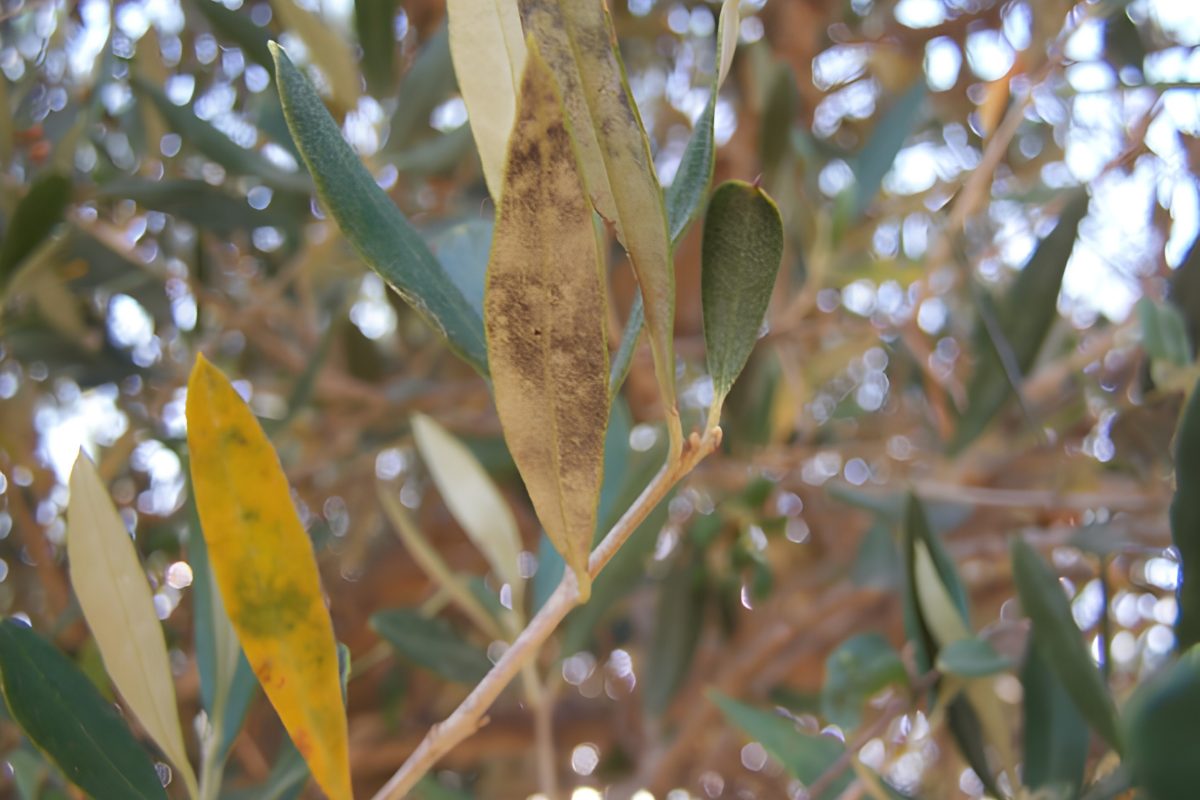
The decisive symptom is on the underside of the leaf, where a dark discolouration develops with a lead-grey or dusty appearance. This is the sporulation of the fungus itself, and it is often mistaken for sooty mould, with the difference that sooty mould washes off and sits on the surface, while cercospora discolouration is in the tissue.
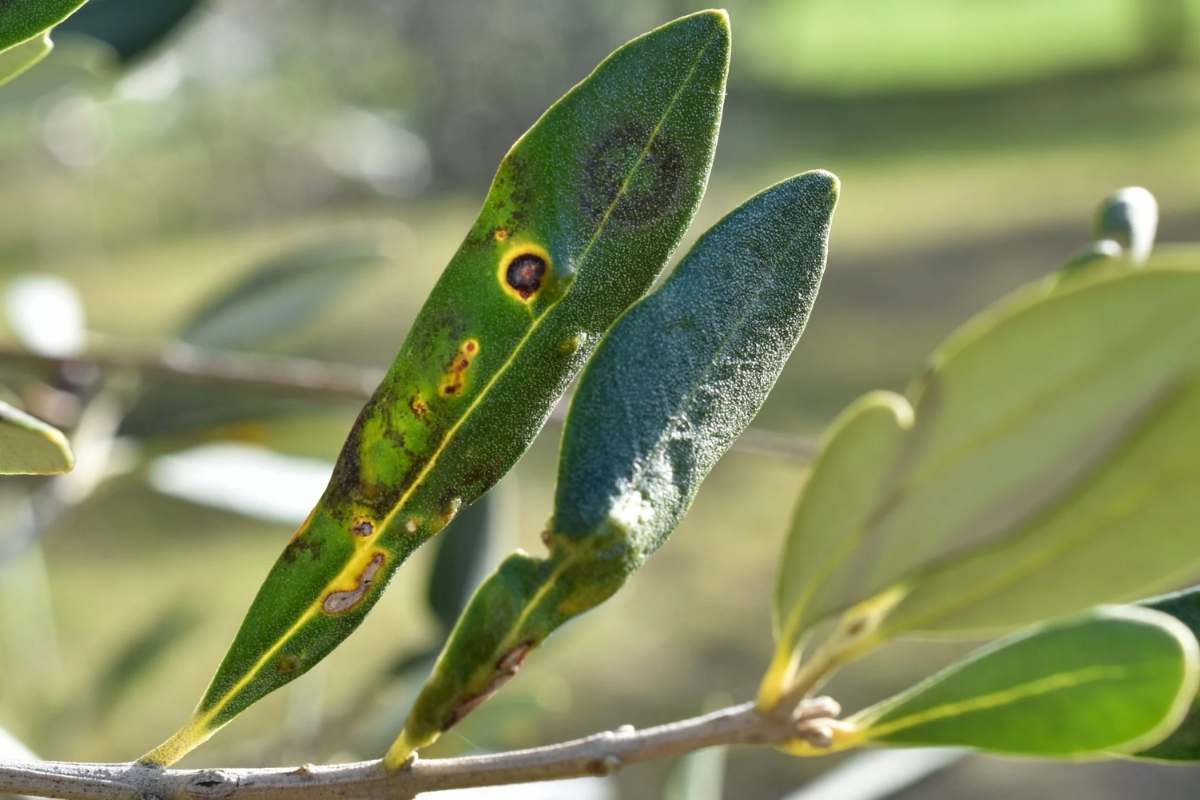
On the upper surface, yellow or chlorotic blotches appear, irregular and without the concentric rings of peacock spot, which gradually turn necrotic and brown. The result is heavy defoliation, mainly late in the season, and a weakened tree.
Cercospora leaf spot of olive
Symptoms of the fruit
Here lies the real difference from peacock spot. Green fruit develops brown, slightly sunken lesions in the flesh, while on ripening, the infection turns into rot. Affected fruit shrivels and drops early. The damage does not stop at quantity alone, since infected fruit reaching the mill degrades the oil's quality characteristics.
How does it differ from the peacock spot
| Feature | Cercospora leaf spot | Peacock spot |
|---|---|---|
| Leaf underside | Lead-grey or dusty, from fungal sporulation | No particular symptoms |
| Leaf upper surface | Irregular yellow blotches that turn necrotic | Circular lesions with concentric rings and a yellow halo |
| Fruit infection | Common, with sunken lesions and early drop | Rare, only under heavy pressure |
| Pattern in the tree | Heavy defoliation late in the season | Defoliation starting from low, inner leaves and moving up |
The practical rule in the grove is a single one. Turn the leaf over. If the underside is grey and dusty, it is cercospora. If the lesions are circular with rings on the upper surface, it is peacock spot. The two diseases frequently occur together on the same tree.
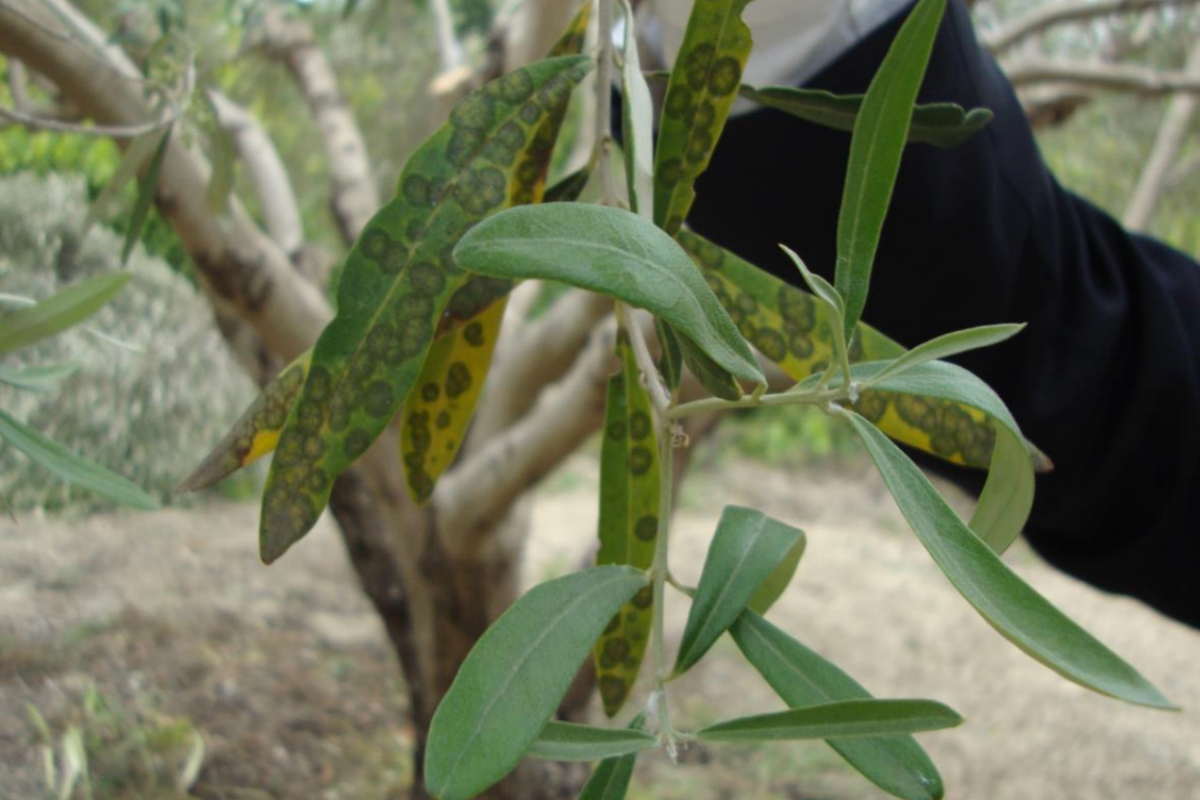
Peacock leaf spot of olive tree symptoms
Why does it stay invisible for so long
The fungus is hemibiotrophic, meaning it lives for a period inside living tissue without killing it, and its asymptomatic phase is unusually long. Recent scientific work reports that it can exceed 18 months. That explains two things growers puzzle over. First, why does a grove that looked clean suddenly shed its leaves? Second, why the disease was underestimated for decades, since the late-season defoliation it causes is practically indistinguishable from that of peacock spot, particularly in humid regions where cultivars susceptible to both pathogens dominate.
Infection conditions and cycle
The fungus overwinters in infected leaves and fruit, both on the tree and in fallen litter on the ground. Conidia are carried by rain, and infection requires free water on the tissue, at temperatures between 7 and 25°C.
Infections begin with the first autumn rains and continue through winter, with a further wave in spring. Field data from two consecutive seasons identified two periods of substantially higher spore production within the year, one in late spring to early summer and the other in autumn, both favoured by temperatures of 20 to 25°C and relative humidity between 80 and 95%.
Cultural measures
- Pruning for airflow: opening the canopy dries the foliage quickly and breaks the cycle of the fungus, as covered in the guide to olive tree pruning
- Wider spacing: densely planted groves hold humidity and carry the heaviest infections
- Managing ground cover: clean ground beneath the trees improves air circulation
- Removing infected leaves and fruit: reduces the initial inoculum, particularly in groves with a history of the disease
The spray programme
Control is preventive and largely identical to that for peacock spot, which simplifies the work considerably. The same application covers cercospora, peacock spot and anthracnose at once.
- Autumn spray: the key treatment of the year, applied before or immediately after the first rains, and considered necessary even where infection appears light
- Spring spray: under wet conditions and in groves with a history of the disease, to protect the new growth
- Interval between applications: at least 21 days, repeated where wet weather persists
Copper products remain the backbone, meaning copper hydroxide and copper oxychloride, which work protectively by forming a film on the leaf. In groves with high inoculum, registered systemic fungicides are also used, with strobilurins among the most effective groups in experimental trials. Rotating active ingredients is necessary to avoid resistance, as is respecting the maximum number of applications per season.
Frequently asked questions
How do I tell cercospora from peacock spot?
Turn the leaf over. Cercospora gives a lead-grey or dusty underside, while peacock spot gives circular lesions with concentric rings on the upper surface. Cercospora also attacks the fruit.
When should I spray for cercospora
In autumn, before or immediately after the first rains, and again in spring when conditions are wet. The interval between two applications should be no shorter than 21 days.
Does it need a separate spray from the peacock spot
No. Copper applications aimed at peacock spot also control cercospora and anthracnose.
Does Cercospora affect the fruit?
Yes, and that is its main difference from peacock spots. Green fruit develops brown, sunken lesions, and ripening fruit rots, resulting in early drop and a decline in oil quality.
Why did it appear in my grove so suddenly?
Because the fungus can remain asymptomatic for more than 18 months, the infection occurred much earlier, and symptoms only appeared later, usually after a wet spell.
At what temperatures does infection occur
Between 7 and 25°C, always on condition that free water is present on the plant tissue. Without leaf wetness, there is no infection.
Important notes
Disease pressure varies by region, variety and year, so build the spray programme with a local agronomist and follow regional plant protection guidance.
Use only products registered for olive in your country, follow the label and the maximum number of applications per season, and give priority to cultural measures.
References
- Estudillo C. et al., The genome of Pseudocercospora cladosporioides, a step toward understanding olive cercosporiosis, Plant Pathology, 2026.
- Cercospora leaf spot of olive, inoculum production and infection timing throughout the year, International Journal of Pest Management, 2025.
- Ávila A. et al., Phenotypic and pathogenic characterization of Pseudocercospora cladosporioides, European Journal of Plant Pathology, 2020.