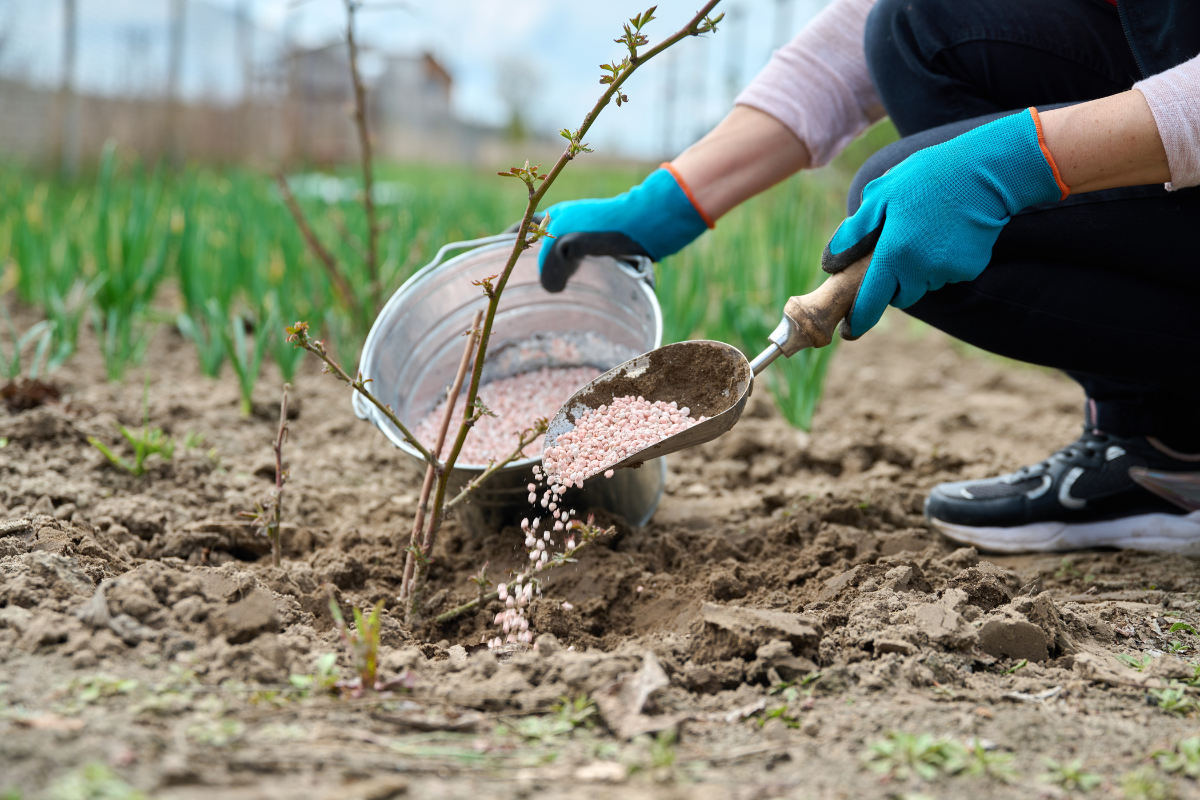
How to fertilize Blackberries
It is essential to highlight that no two fields are the same, nor can anyone advise a farmer on fertilization methods without considering the soil test data, tissue analysis, and crop history of a specific field. However, below, some common schemes and fertilization strategies used by many farmers are presented.
Regular soil analysis is recommended to test your pH and make necessary arrangements to keep it slightly acidic. Add lime if needed to decrease the pH and bring it to the desired levels. To test the need for or efficiency of fertilization, the farmer should perform a plant tissue analysis (every other year, starting a year after planting) and determine the sufficient range of each important nutrient.
|
Nutrient |
Acceptable range in plant tissue |
|
Nitrogen |
2.4–2.9% |
|
Phosphorus |
>0.15% |
|
Potassium |
1.0–2.0% |
|
Calcium |
>0.5% |
|
Magnesium |
>0.3% |
|
Sulfur |
>0.13% |
|
Iron |
>50 ppm |
|
Manganese |
>50 ppm |
|
Zinc |
>20 ppm |
|
Copper |
>7 ppm |
|
Boron |
30–50 ppm |
What nutrients do blackberries need, and when to apply them
Nitrogen is the most important nutrient for plant and leaf growth and should be added yearly. If compost or manure has been added before planting the blackberries, minimum to zero complementary applications of fertilizers are needed during the first year. Suppose the soil analysis shows that fertilization is needed during the establishment year. In that case, the farmer can add 5-5.5 pounds (2.4 kg) per 100 feet (30.5 m) row of a balanced, complex fertilizer in early summer (late June for the North Hemisphere).
A young blackberry plant (2-3 years old) needs around 0.8 oz (22.7 grams) of nitrogen. To cover these needs, the farmer can use Ammonium Sulfate (preferred for blackberries), Ammonium Nitrate, Sulfur-Coated Urea, Urea, or/and Cottonseed Meal. Usually, the total amount is added in two applications: at the start of the flowering stage (at bud break) and after bloom or after harvest. As the plants grow, the added nitrogen increases, reaching 3.3 oz (0.09 kg) per plant of Ammonium Sulfate (1.5 oz or 42.5 g urea) when the plants are older than 7-8 years old.
Generally, ammonium sulfate makes the soil more acidic, so it is preferred for alkaline soils. If you use well-rotted manure or compost, it is good to be applied in the late fall or early winter to allow the leaching of excess salts by rain. In organic cultivation or to reduce the use of synthetic fertilizers, the farmer can use 5-15 lb (2.3-6.8 kg) of compost or manure per 10 feet (3 m) row in late fall. When using poultry manure (rich in N), you can use less amount to avoid “burning” your plants.
Phosphorus, Potassium, Sulfur, and Boron are also essential for blackberries, but fertilization applications with such nutrients are usually not needed yearly (soil and foliar analysis needed). Farmers commonly use potassium sulfate in blackberries. Alternatively, 5 ounces of gypsum along a 10-foot row (175 pounds per acre - or in 3m row to add 196 kg per hectare) can be used to enrich the soil with boron and sulfur.
To simplify fertilization, most farmers apply 1 pound (0.5 kg) of 10-10-10 (N-P-K) fertilizer per 18 feet (5.5 m) of row in mid-spring and 1 pound per 36 feet (11 m) of row in early summer. A complementary application every 2 years may be needed with 1 pound of 10-10-10 fertilizer per 9 feet of row at the end of winter. Other complex fertilizers like 12-12-12 or 10-20-10 can be used. Both well-soluble and slow-release fertilizers can be used for soil application. Alternatively, when a drip irrigation system has been established in the field, part of the whole fertilization can be performed as fertigation.
Blackberries may suffer from iron deficiency in alkalic soils. If the tissue analysis is below the acceptable limits (see the table), the farmer can fix the problem with soil applications of Fe 138 Iron Chelate or foliar sprays every 3-4 weeks. Always consult your local agronomist before using any fertilizers.
Attention: These amounts are general guidelines and should be adjusted for the specific characteristics and needs of each field.
Mulch can be applied from late autumn to late winter (Nov-Feb for the North Hemisphere) to provide frost protection, suppress the growth of weeds, decrease water losses, and enrich the soil's organic matter content. Apply a 7-15 cm (3-6 in) layer of mulch annually, and make sure the mulch is placed 5 cm (2 in) away from the new canes and the crown, to prevent rotting and cane emergence. Well-rotted manure, compost, chipped bark, straws, gravel, grit, and slate chippings can be used.
References
- Rubus Production – Ncsu
- Blackberry and Raspberry Culture for the Home Garden – Oklahoma State University Extension
- Spring Fertilization of Garden Fruits – Michigan State University Extension
- Blackberry Patch – University of Georgia
- Viewcontent Cgi – usu.edu.
- University of Georgia Agricultural & Environmental Services Laboratories — presentation
- https://aggie-horticulture.tamu.edu/extension/fruit/Blackberries/blackberries.html
- Commercial Blackberry Production – Oklahoma State University Extension
- Fruit and Nut Review Blackberries – Msstate Extension
- Growing Blackberries in Missouri
Further reading
- Blackberry Nutritional Value and Health Benefits
- Blackberry vs Black Raspberry - Similarities and Differences
- Blackberry Plant Information - How to Identify Blackberries
- Site Selection, Soil Preparation, and Planting of Blackberries
- Blackberries Propagation and Pollination
- How to Prune and Train Blackberries
- Water Needs and Irrigation of Blackberries
- Nutrient Needs and Fertilization of Blackberries
- Blackberry Pests, Diseases and Weed Management
- Blackberry Yield, Harvest, and Storage