
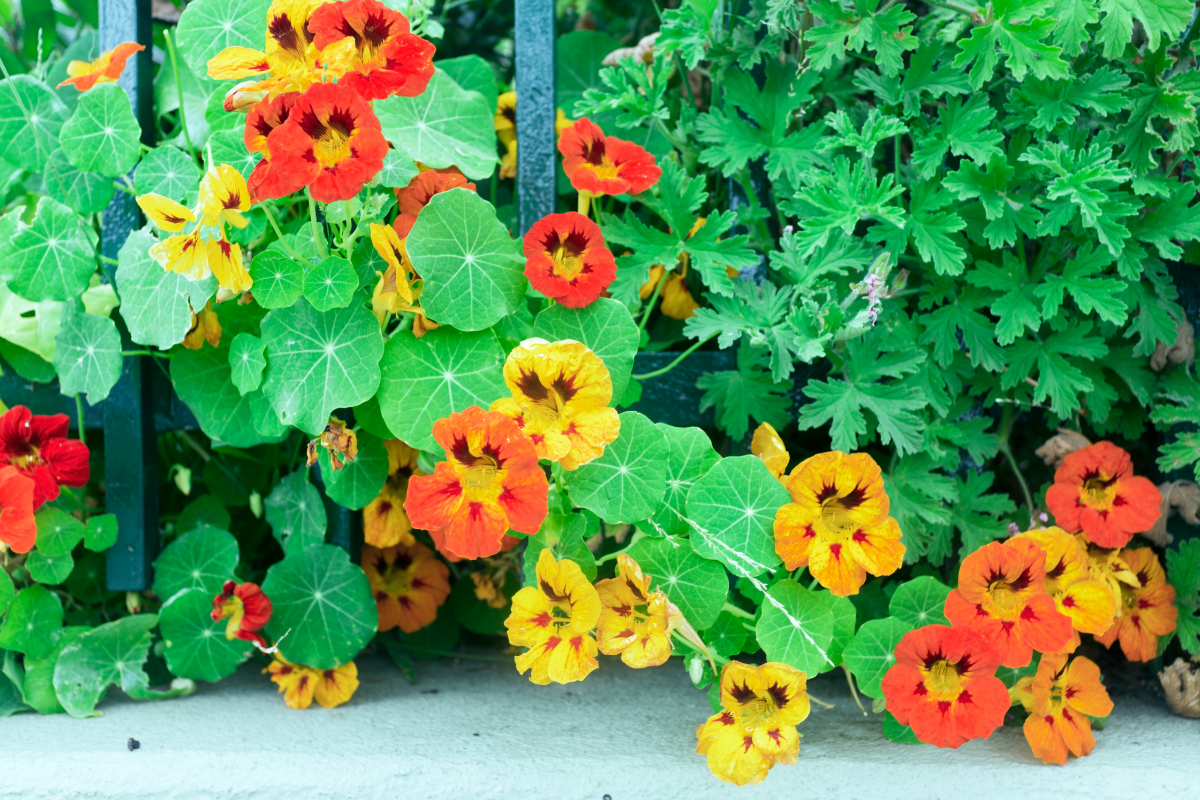
Nasturtiums are one of the easiest and most rewarding annuals you can grow, quick from a large seed, a child can handle, generous with bright red, orange and yellow flowers, and edible from petal to leaf to seed pod. They ask for almost nothing; in fact, they flower best in poor soil, and they earn their place in the vegetable patch as a companion and trap crop as much as in the flower border. This guide covers how to grow and care for nasturtiums, from sowing seed to eating the flowers and using them to protect other crops.
Nasturtiums are usually grown as annuals and come in trailing, climbing and compact bush forms, so a quick look at the plant and its types helps before sowing.
What is a nasturtium
The garden nasturtium is Tropaeolum majus, a fast-growing annual native to South and Central America, with round, shield-like leaves and open, spurred flowers in warm shades of red, orange, yellow and cream. Despite the name, it is not related to watercress, whose botanical genus is Nasturtium; the shared name refers to the peppery, nose-tingling taste both plants share. It is also sometimes called Indian cress or monk's cress.
Nasturtiums come in two main growth habits. Trailing and climbing types send out long stems that scramble over walls, tumble from hanging baskets or climb up a support with a little help, while bush or dwarf types such as the Tom Thumb and variegated Alaska strains stay compact and mounded at around 30 cm, better for edging, containers and the front of a bed. Climbing types can reach 1.5 to 2 m, given something to scramble up.
How to grow nasturtiums from seed
Nasturtiums are among the simplest of all plants to grow from seed. The seeds are large and easy to handle, and soaking them in water overnight before sowing softens the hard coat and speeds up germination. Sow them about 1.5 cm deep, either where they are to flower or in individual pots, and they usually come up within one to two weeks.
Nasturtiums dislike having their roots disturbed, so direct sowing where they are to grow is the most reliable approach. If you start them in pots, use individual modules so the rootball stays intact at planting time.
When to plant nasturtium seeds
Nasturtiums are frost-tender, so sow outdoors only after the last frost has passed and the soil has warmed, usually in mid to late spring. Sowing into cold, wet soil leads to poor germination and slow, sulky seedlings. For an earlier start, sow in pots indoors a few weeks before the last frost and plant out once the weather has settled.
Sun, soil and why poor soil means more flowers
Nasturtiums flower best in full sun, with at least six hours a day, though they tolerate part shade with fewer blooms. The key thing to understand is their soil preference, because it runs counter to that of most plants. Nasturtiums flower most freely in poor, free-draining soil, and rich soil or feeding pushes them into producing masses of large leaves with very few flowers. For a sheet of colour, plant them in unimproved soil and do not fertilise.
Watering and growing in containers
Once established, nasturtiums are fairly drought-tolerant and need only moderate watering, though plants in pots and hanging baskets dry out faster and need more regular attention. They are superb container plants, with trailing types spilling over the edge of a pot or basket and climbers quickly covering a fence or trellis throughout the summer. Even in containers, resist the urge to use rich, fertiliser-heavy compost if you want plenty of flowers.
Deadheading and pinching for more flowers
Two simple jobs keep nasturtiums flowering hard all season. Deadheading, which means picking off the faded flowers before they set seed, keeps new blooms coming rather than letting the plant put its energy into seed. Pinching out the growing tips of young plants encourages them to branch and grow bushier instead of running to a few long, bare stems. Neither is essential with such an easy plant, but both noticeably improve the display.
Are nasturtiums perennial or annual
Nasturtiums are grown as annuals in most climates, completing their life in a single season and dying at the first frost. In frost-free areas they can behave as short-lived perennials, but the more useful trait is that they self-seed freely, dropping seed that comes up on its own the following spring, so a patch often returns year after year without any effort.
Edible flowers, leaves and seeds
The whole plant is edible and has a peppery, watercress-like kick. The flowers make a colourful, edible garnish and add bite to salads, the young leaves can be used like a peppery salad green, and the green seed pods can be pickled as a substitute for capers, sometimes called poor man's capers. Pick flowers and leaves young and fresh, and only eat plants you have grown without pesticides.
Nasturtiums as companion plants
This is where nasturtiums prove most useful in the vegetable garden. They are a classic trap crop for aphids, especially blackfly, which flock to the nasturtiums and leave nearby beans, tomatoes and brassicas comparatively alone, letting you deal with the pests in one place. They also draw cabbage white butterflies away from cabbage and kale, and their open flowers bring in pollinators and the predatory insects that keep pests down, which makes them a useful addition to any pollinator-friendly garden. They pair especially well with other easy, useful annuals such as marigolds in a mixed vegetable and flower planting.
Common problems
- Aphids: nasturtiums attract blackfly and other aphids, which is exactly the point of using them as a trap crop, though a heavy infestation can be hosed off or the worst-affected shoots removed. See the guide to controlling aphids for more
- Cabbage white caterpillars: the caterpillars that feed on brassicas will also eat nasturtium leaves, so pick them off by hand if they become a problem
- Too few flowers: almost always a sign of soil that is too rich or too much feeding, so move plants to leaner ground and stop fertilising
Frequently asked questions
How do you grow nasturtiums from seed? Soak the large seeds overnight, sow them about 1.5 cm deep where they are to flower after the last frost, and they will germinate within one to two weeks. They dislike being transplanted, so direct sowing is best.
Do nasturtiums come back every year? They are grown as annuals and die at the first frost, but they self-seed freely, so a patch often reappears on its own the following spring.
Why won't my nasturtiums flower? Almost always because the soil is too rich or they are being fed. Nasturtiums flower best in poor soil, so stop feeding and grow them lean.
Are nasturtiums edible? Yes. The flowers, leaves and green seed pods are all edible, with a peppery, watercress-like flavour, as long as they have been grown without pesticides.
Do nasturtiums keep aphids away? They work as a trap crop, drawing aphids such as blackfly onto themselves and away from nearby vegetables, rather than repelling them outright.
Important notes
Every garden is different, and conditions vary with your climate, soil and sun. The guidance above is a general starting point rather than a strict rule.
Only eat flowers and leaves from plants you have grown yourself without pesticides, and wash them before use. If pests become a persistent problem on nearby crops, try non-chemical methods first, and consult a horticulturist or your local nursery if you are unsure.
References
- Royal Horticultural Society. Nasturtiums.
- The Old Farmer's Almanac. Nasturtiums.