

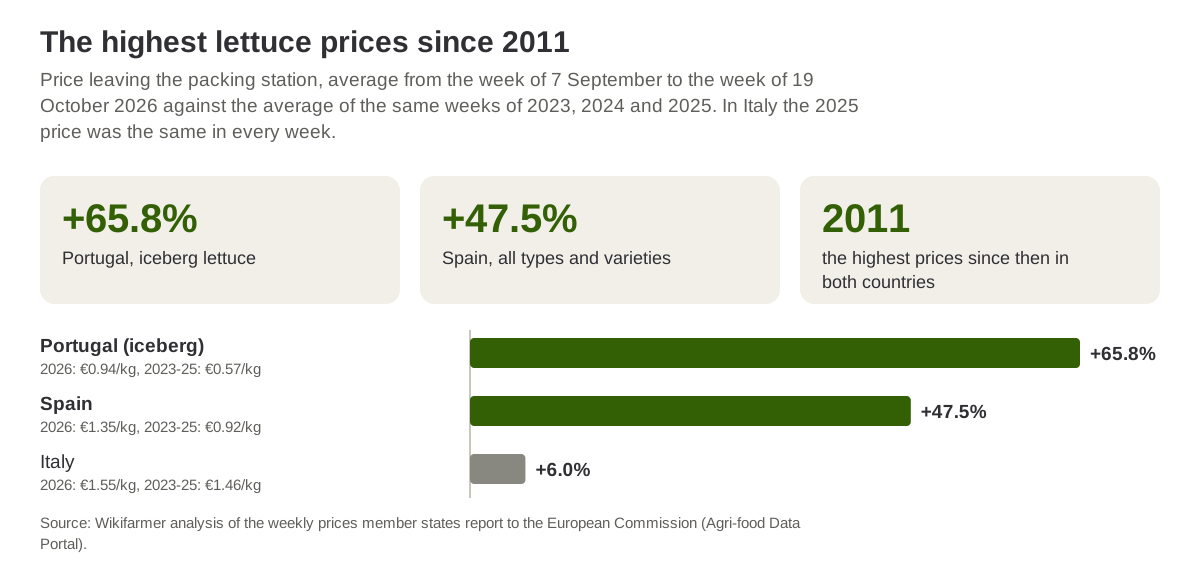
From the week of 7 September to the week of 19 October 2026 the price of lettuce leaving the packing station was 47.5% higher in Spain than the average of the same weeks of 2023, 2024 and 2025, and 65.8% higher in Portugal, according to a Wikifarmer analysis of the weekly prices member states report to the European Commission. In both countries this year's price was the highest for these weeks since 2011, while in Italy, the third EU country with lettuce prices for these weeks of 2026, the price was 6.0% above the average, in a series with many repeated values in earlier years.
In Portugal the iceberg lettuce price was double last year's
The Portuguese price is in practice the price of iceberg lettuce, since from 2015 the price Portugal reports for all types and varieties has been identical to its iceberg price in every week where both exist. The average price over the seven weeks was €0.94/kg, exactly double the €0.47/kg of the same weeks of 2025 and 65.8% above the 2023 to 2025 average of €0.57/kg (European Commission, Agri-food Data Portal). The previous high for these weeks was in 2022, at €0.81/kg. The price peaked at €1.14/kg in the week of 21 September and in the weeks of 12 and 19 October eased to €0.73 and €0.77/kg, far above the €0.45 and €0.44/kg of the same weeks of 2025, but in the latest week roughly at the 2023 to 2025 average for that week, €0.78/kg.
Source: Wikifarmer analysis of the weekly prices member states report to the European Commission (Agri-food Data Portal).
In Spain the price was 47.5% above the three-year average
In Spain, where the price covers all types and varieties of lettuce, the average over the seven weeks was €1.35/kg, against an average of €0.92/kg in the same weeks of 2023 to 2025, and 53.9% higher than in 2025. This year's price was also higher than each of the three previous years taken separately and than every year with comparable data since 2011, the closest being 2015, when the price for the same weeks was €1.26/kg. All comparisons are in current prices, without removing the inflation of recent years.
In Spain the gap with last year narrowed in the latest week
The Spanish price was highest at the start of the period, €1.62/kg in the week of 7 September, then moved between €1.31 and €1.46/kg up to the week of 12 October and fell to €0.91/kg in the week of 19 October. In the week of 12 October the price was still 70.9% above the same week of 2025, while in the latest week the gap narrowed to 13.8%, against €0.80/kg a year earlier, and the price was below the 2023 to 2025 average for that week, €0.96/kg. The coming weekly prices will show whether the fall continues.
In Italy the price was 6.0% above the average
In Italy the seven-week average was €1.55/kg against an average of €1.46/kg in 2023 to 2025, and the price rose from €1.37/kg in the week of 7 September to €1.75/kg in the week of 19 October without a single weekly fall. Compared year by year, the Italian price was also the highest for these weeks since 2011, but the Italian series has many repeated values, since in 2025 Italy reported the same price, €1.53/kg, for nine consecutive weeks, from 1 September to early November, and in 2024 the same price, €1.45/kg, for three consecutive weeks, so the Italian comparison is less reliable than the Spanish and Portuguese ones.
At the Madrid wholesale market all six varieties had higher prices
At Madrid's central wholesale market, Mercamadrid, the most frequent selling price of iceberg lettuce was €1.97/kg in September 2026, about the same as in August, and 60.8% above the September average of 2023 to 2025 (Ayuntamiento de Madrid, Mercamadrid). All six lettuce varieties Mercamadrid records had a September price above the average of the three previous Septembers, by 6.4% to 60.8%. The wholesale price is a different stage of the market from the packing station price, so it shows the direction without being directly comparable.
The comparison matters to those who grow and buy lettuce
The packing station price is the price of lettuce sorted and packed, ready for the wholesale trade or the buyer, as each country's national average, so it is neither the price the grower receives nor the shelf price. It matters to those growing lettuce from seeding to harvest who sell to packing stations or cooperatives, and to traders and retail chains that buy lettuce from Spain and Portugal. Because each country reports a different mix of types, percentage changes within each country compare more reliably than price levels between countries.
The picture for lettuce resembles that for tomatoes, since in September and October tomato prices were above their 2023 to 2025 average in most EU countries with data. The data show how prices moved, not what caused the movement, and they are not a forecast. The Commission's next weekly prices will show whether the rise holds as the northern hemisphere winter begins.
Only Spain, Portugal and Italy have reported lettuce prices to the Commission for these weeks of 2026. France has prices up to the end of 2024, the Netherlands up to 2021, Germany and Greece up to the end of 2020 and Austria only for 2011 and 2012, while Poland has isolated weeks, two of them in 2026. In the week of 19 October the Spanish price was 13.8% above the same week of 2025 and the Portuguese 75.0% above, both below their September levels. The analysis uses the weekly packing station (ex-packaging station) prices of lettuce, all types and varieties, that member states report to the European Commission as national averages in euros per 100 kg, retrieved on 2 November 2026. For each country it uses weeks 37 to 43, the weeks of 7 September to 19 October 2026, which have a price in all four years from 2023 to 2026. The 2023 to 2025 average is the simple average of the three yearly averages, and changes are simple percentage changes in current prices. For the comparison with every year since 2011, each year is compared with 2026 over the weeks that have a price in both years, provided there are at least four, so 2012 is not included for Spain, nor 2017 and 2018 for Portugal. Up to 2014 Portugal's price for all types was not identical to its iceberg price, while from 2015 it is identical in every week where both exist. The Mercamadrid data are monthly, by variety, as the most frequent selling price weighted by the quantities of each origin, and their lettuce prices change level abruptly during 2021 in every variety, in January for some and in August for others, which points to a change in how they are recorded, so only years from 2021 are compared. The Commission's latest prices may be revised. All figures were recomputed independently from the original files.
Sources
- European Commission. (2026). Agri-food Data Portal, API guide and fruit and vegetable supply chain prices. Directorate-General for Agriculture and Rural Development.
- Ayuntamiento de Madrid. (2026). Mercamadrid, volume and price of products traded. Portal de Datos Abiertos.