


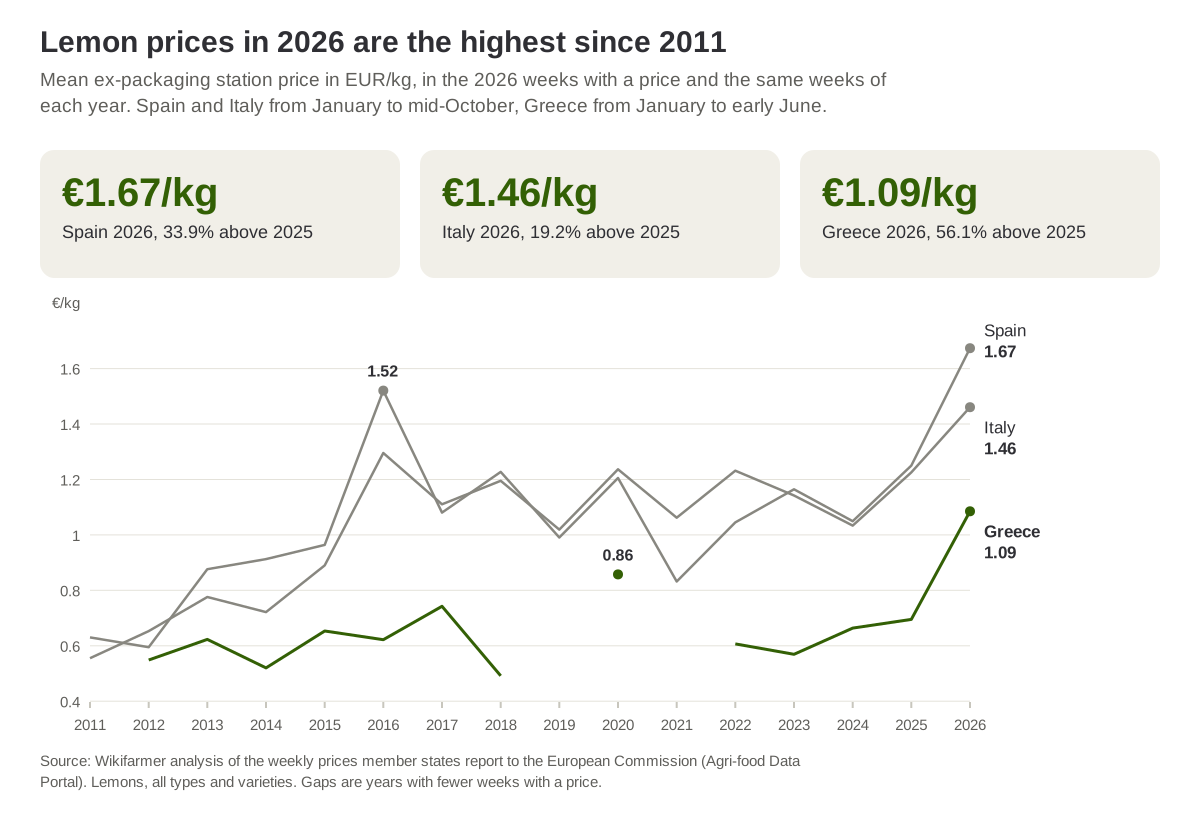
From January to mid-October 2026 the average ex-packaging station price of lemons was €1.67 per kilogram in Spain and €1.46 per kilogram in Italy, the highest for the same weeks since 2011, according to a Wikifarmer analysis of the weekly prices member states report to the European Commission. In Greece, where data run to early June, the price was €1.09 per kilogram, also the highest since data for the same months began. The high prices started in autumn 2025 and lasted until June, while from July prices in Spain and Italy were the second highest after 2016. In the first weeks of October the Spanish price was 22.4% below last year, and for the new season Spain's agriculture ministry forecasts 21.1% more lemons.
The 2026 price is above every earlier year in all three countries
In Spain the average ex-packaging station price of lemons from early January to 18 October 2026 was 33.9% higher than in the same weeks of 2025 (€1.25 per kilogram) and 10.1% above the previous high of 2016 (€1.52), and in 27 of the 37 weeks with a price this year's was the highest for that week since 2011 (European Commission, Agri-food Data Portal). In Italy the price was 19.2% above 2025 (€1.23) and 12.7% above 2016 (€1.30), and it was the highest for that week in 28 of 42 weeks. In Greece, from 29 December 2025 to 7 June 2026, the price was 56.1% higher than in the same weeks of 2025 (€0.70) and 26.6% above the previous high of 2020 (€0.86), and it was the highest for that week in all 23 weeks.
Source: Wikifarmer analysis of the weekly prices member states report to the European Commission.
The 2025/26 season had the highest prices since 2011 in all three countries
From early October 2025 to late June 2026 the average ex-packaging station price of lemons was €1.75 per kilogram in Spain, against €1.38 in 2015/16, the previous highest season, €1.40 in Italy, against €1.27 in 2019/20, and €1.05 in Greece, against €0.86, also in 2019/20. Over the winter the price fell much less than usual, as from October 2025 to the first quarter of 2026 it eased 9.8% in Greece, the smallest fall since 2011, 8.3% in Spain, the second smallest, and 9.3% in Italy. In the same season Spanish production was small, at 818,870 tonnes of lemons according to provisional figures from Spain's Ministry of Agriculture, Fisheries and Food (MAPA), 15% below the average of the 2021/22 to 2025/26 seasons, and already in autumn 2025 the 2025/26 season started with lower yields in Spain, Italy and Greece.
At Mercamadrid, Madrid's central wholesale market, the average lemon price from January to May 2026 was €1.48 per kilogram, 24.3% higher than in the same months of 2025 and the highest since 2019, the first year of the data, while the 13,914 tonnes traded were the smallest quantity since 2019 (Ayuntamiento de Madrid, Mercamadrid). Over the same period, in late April lemon prices were rising at wholesale markets in Athens, Paris and Germany.
From July prices in Spain and Italy were the second highest after 2016
In the weeks from July to mid-October 2026 the ex-packaging station price of lemons averaged €1.46 per kilogram in Spain and €1.61 in Italy, the second highest since 2011 in both countries after 2016, when it was €1.79 in both, but still above 2025 (€1.18 and €1.44 respectively). In Spain the new season opened with one week at €2.40 per kilogram (21 to 27 September), after which the price was €1.37 for three weeks, 22.4% below the same weeks of 2025, while in Italy the price from 7 September to 18 October was €1.62. In Madrid the average lemon price from July to September was €1.23 per kilogram, 32.7% lower than in 2025. Greece has not yet reported prices for the new season, and from 2021 to 2025 its first prices after the summer were for weeks between mid-September and early October.
In summer 2026 most lemons sold in Madrid came from the southern hemisphere
From June to September 2026 only 41.8% of the lemons sold at Mercamadrid were of Spanish origin, the lowest share for those months since 2019, against 54.4% in 2025. South Africa supplied 33.7% of the lemons and Argentina 23.5%. From November to April, by contrast, almost all lemons sold in Madrid were Spanish in every year since 2019, with a share of 99.8% or more in every month.
Lemon prices are usually lowest from December to April
In Italy, from 2011 to 2025, the month with the lowest price fell between January and April in 13 of 15 years, and the month with the highest price between August and October in 12 of 15. In the median year the March price was 17% below the annual average and the September price 21% above, and 2026 followed the same pattern, with the lowest price in March (€1.29 per kilogram) and a rise to September (€1.64). In Spain the month with the lowest price fell between December and April in 11 of 15 years, while in the median year the price has two peaks, in May and October, 13% and 14% above the annual average, and is 19% below it in January. In Greece, in the 8 years with data for 11 or 12 months, the lowest price was always in a month between December and April and the highest in a month between July and September, with the February price in the median year 24% below the annual average and the September price 48% above.
Spain forecasts 21.1% more lemons for the 2026/27 season
According to MAPA's first production forecast for the 2026/27 season, Spain is expected to produce 991,800 tonnes of lemons, 21.1% more than the provisional 2025/26 statistics and 3.0% above the average of the last five seasons, but 13.4% below the record 2023/24 season (MAPA, Aforo nacional de cítricos 2026/27). Against the regions' own estimates for 2025/26, of 853,848 tonnes, the increase is 16.2%. Of the forecast, 76.6% is Fino lemons, also known as Primofiori, and about 23% Verna lemons, and MAPA expects production of both types to rise.
The January to March price was below October in every season since 2011
Since 2011 the ex-packaging station price of lemons from January to March was lower than the price in early October of the year before in every season in all three countries, that is in 15 of 15 seasons in Spain and Italy and in 13 of 13 seasons with data in Greece. The median fall was 26.6% in Spain, 22.1% in Italy and 31.7% in Greece, but its size varied widely from year to year, from 6.3% to 39.6% in Spain. If this season follows the same pattern, the price in the first quarter of 2027 will be lower than in October, but history gives frequencies, not a forecast, and does not show how far the price will fall this year. In the coming weeks the things to watch are the Commission's weekly prices for Spain and Italy, the first Greek prices of the new season and how quickly Spanish lemons replace imports in wholesale markets.
The prices matter to growers and cooperatives who cultivate lemon trees commercially and sell to packing stations, and to traders and retail chains that buy lemons from different countries at different times of year. They are neither the price the grower receives nor the shelf price.
The analysis uses the weekly ex-packaging station prices of lemons (all types and varieties) that member states report to the European Commission, as national averages in euros per 100 kg, from 2011 to 18 October 2026. The 2026 comparison uses each country's 2026 weeks with a price (37 for Spain, 42 for Italy and 23 for Greece) and the same weeks of each earlier year, provided the year has a price in at least 80% of them. In Spain the week of 21 to 27 September is €2.40 per kilogram, far above the following weeks. Without it the 2026 average is €1.65, still the highest since 2011, and the average from July is €1.37 against €1.11 in 2025, still the second highest after 2016. A season runs from early October to late June (weeks 40 to 26), with at least 30 weeks with a price. For the price calendar each week is assigned to the month of its Thursday, and the years 2011 to 2025 with data for at least 11 months are used, which for Greece means 8 years, usually without August. The fall from October compares weeks 40 to 42 with weeks 1 to 13 of the following year, and a change of more than 2% downwards counts as a fall. The Mercamadrid data are monthly up to September 2026, the price is the average of all lemons weighted by quantity, and origin is set by the province or country code. Greek data start in September 2011, so for January to June the comparison starts in 2012. The MAPA forecast refers to production on the tree, and its changes are calculated against the provisional 2025/26 statistics (818,870 tonnes) or the regions' estimates (853,848 tonnes). Prices are in current euros, not adjusted for inflation, and the latest may be revised. All numbers were recomputed independently from the original files.
Sources
- European Commission. (2026). Agri-food Data Portal, API guide and fruit and vegetable supply chain prices. Directorate-General for Agriculture and Rural Development.
- Ministerio de Agricultura, Pesca y Alimentación. (2026, 14 September). Aforo nacional de cítricos, campaña 2026/27. MAPA.
- Ayuntamiento de Madrid. (2026). Mercamadrid, volume and price of products traded. Portal de Datos Abiertos.