
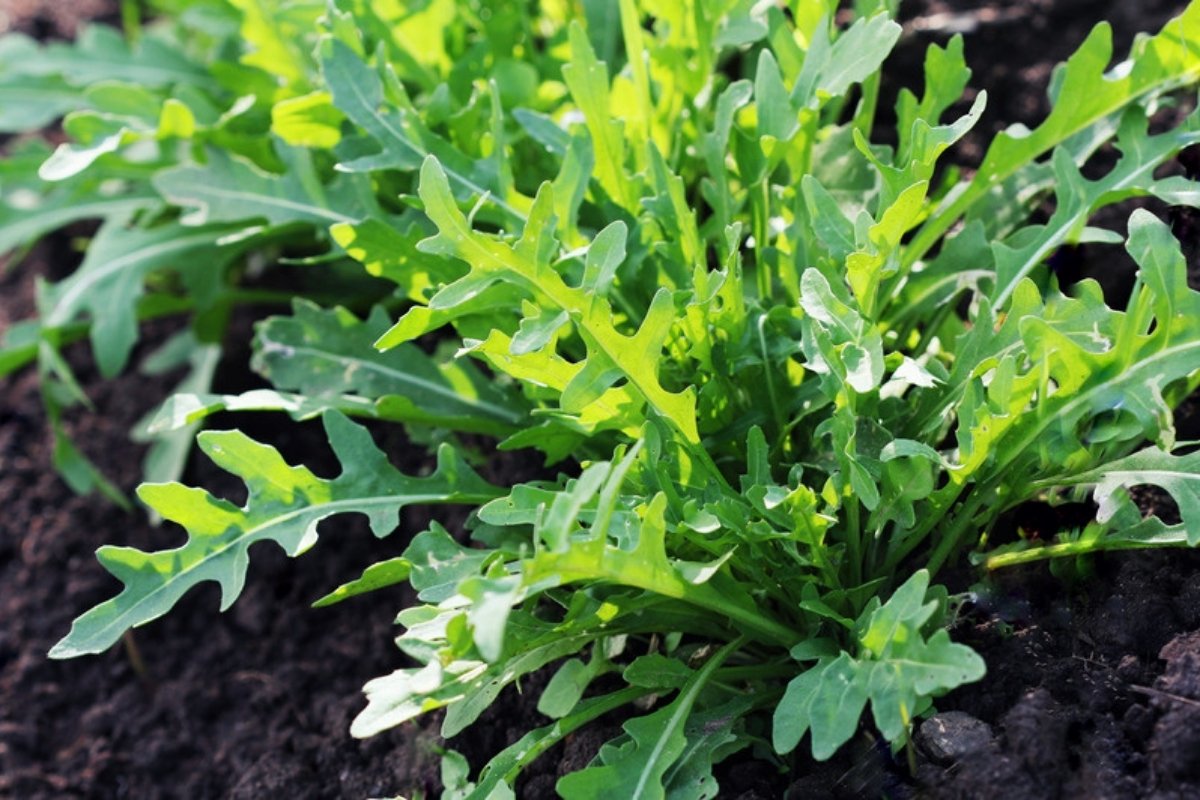
Two different plants are sold as arugula, or rocket. Salad arugula (Eruca vesicaria subsp. sativa) is an annual with broader leaves and white flowers with purple veins, while wild arugula (Diplotaxis tenuifolia) is a perennial with narrow, deeply divided leaves and yellow flowers. Both are sown directly into the soil, mainly from late summer into autumn and in early spring, at a depth of 0.5 to 1 cm. Salad arugula germinates within days, gives tender baby leaves in 3 to 4 weeks and full-sized leaves in 6 to 8 weeks, and is harvested in successive cuts. Heat and long days make it bolt and turn the leaves bitter. This guide covers how to tell the two arugulas apart, when and how to sow them, how to care for them, how to harvest so they keep regrowing, the growth stages, and how to grow arugula in pots and indoors.
Salad arugula and wild arugula
Salad and wild arugula belong to the same family, Brassicaceae, but to different genera, and scientific papers describe them as two distinct baby-leaf salad crops. The name "wild" comes from the old practice of gathering it from nature. Today it is grown as a regular crop, and in several European countries, such as Italy and Germany, it is preferred over salad arugula.
| Trait | Salad arugula | Wild arugula |
|---|---|---|
| Scientific name | Eruca vesicaria subsp. sativa, synonym Eruca sativa | Diplotaxis tenuifolia |
| Life cycle | Annual | Perennial |
| Flowers | White to cream, with purple veins | Bright yellow |
| Leaves | Broader, with rounded lobes | Narrow, deeply divided |
| Flavour | Peppery, milder | Spicier and less bitter |
| Growth | Very fast | Slower, with much smaller seed |
| Heat | Bolts quickly in heat | More heat-tolerant |
The surest way to tell the two apart is the flowers, which are white with purple veins in salad arugula and yellow in wild arugula.
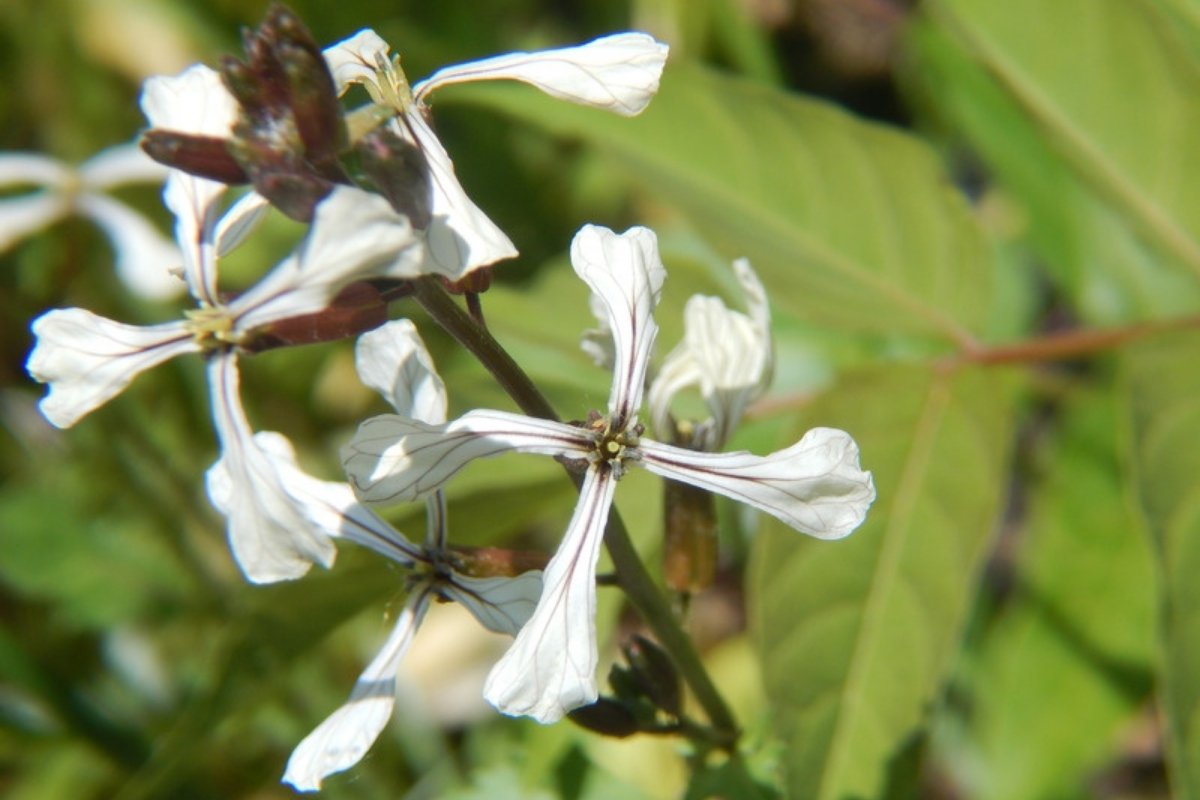
Salad arugula has white flowers with purple veins, while wild arugula has yellow flowers.
When to plant arugula
| Period | What to watch for |
|---|---|
| Late summer and autumn | The ideal season, in a sunny spot |
| Winter | In mild climates, with slower growth |
| Early spring | As soon as the soil can be worked, in partial shade later in the season, because heat brings early flowering |
| Summer | Only in a very cool, shady spot |
Arugula is a cool-weather crop, with an ideal growing temperature of around 14 to 20°C. As days lengthen in spring it forms a flower stalk, and this is the main obstacle to continuous production. Because salad arugula grows so fast, the University of Wisconsin recommends successive sowings every 2 to 3 weeks for a steady supply of young leaves. Autumn sowing goes in alongside the other autumn sowing jobs in the vegetable garden.
Position and soil
In autumn and winter, arugula goes in a sunny spot, while in spring and summer partial shade is preferable. According to the RHS, salad arugula tolerates sun but benefits from some shade in summer. It performs best in fertile soil rich in organic matter, moisture-retentive but free-draining, with a pH of 6 to 6.8. Before sowing, enrich the soil with compost. According to Cornell University, avoid sowing arugula where cabbage, broccoli or other brassicas grew before, because they share pests and diseases.
Sowing
Arugula is sown directly where it will grow, because it does not transplant easily. Transplanting is possible only while seedlings are still very small, and with care for the roots.
- Depth: sow seeds 0.5 to 1 cm deep and cover with a minimal layer of soil
- Method: in rows or broadcast. Because the seeds are tiny, mixing them with a little sand helps to sow thinly
- Spacing: about 2 to 3 cm between seeds and 20 to 30 cm between rows
- Thinning: once seedlings have their first true leaves, thin them to 10 to 15 cm apart. For baby leaf, leave the sowing dense. The thinnings go into salads
- Watering: water gently with a fine rose so the seeds are not washed away
According to Cornell, salad arugula emerges in 5 to 7 days and its seed stays viable for up to 5 years. Wild arugula germinates and grows more slowly.
Growth stages
| Stage | Timing for salad arugula | What to do |
|---|---|---|
| Emergence | 5 to 7 days | Keep the soil evenly moist |
| First true leaves | About 2 weeks | Thin to the final spacing |
| Baby leaf | From about 3 weeks | First cut |
| Full-sized leaves | Within about 6 weeks | Pick outer leaves, repeat cuts |
| Bolting | With heat and long days | Leaves turn bitter, flowers are edible, resow |
Watering
Arugula needs frequent, light watering that keeps the soil evenly moist but never soggy, because its roots rot easily in excess moisture. When the soil dries out, the leaves turn tougher and much hotter, and the plant bolts sooner. A thin layer of mulch helps hold moisture.
Feeding
With a good base of compost or rotted manure, garden arugula needs very little, given its short cycle. Many gardeners add a little organic fertiliser about every 20 days in containers. Heavy nitrogen feeding does not help, because arugula readily accumulates nitrates in its leaves.
Harvesting cut-and-come-again
- Baby leaf: the first tender leaves are ready 3 to 4 weeks after sowing
- Full-sized leaves: in 6 to 8 weeks, when they are 7 to 15 cm long
- Leaf by leaf: pick the outer, larger leaves and leave the heart, so the plant keeps producing new ones
- Whole-plant cut: cut the leaves about 2 to 3 cm above the soil without damaging the centre, and the plant regrows for a second and third cut
Once arugula bolts, the leaves become more bitter and hot, but the flowers are edible and add a pretty, peppery note to salads.
Growing arugula in pots
Arugula is one of the easiest vegetables for pots and window boxes, because it has shallow roots:
- Container: a window box or pot 15 to 20 cm deep, with drainage holes and a layer of gravel or pumice at the bottom
- Growing medium: vegetable potting compost with a little compost or rotted manure
- Sowing: scatter seeds thinly over the surface, cover with a minimal layer of compost and water gently
- Position: sunny in autumn and winter, partial shade in spring and summer, so the leaves do not turn bitter
- Watering: regular and in small amounts, as soon as the surface dries
Growing arugula indoors and as microgreens
Arugula also grows indoors, on a bright, cool windowsill or under grow lights, giving baby leaves in 3 to 4 weeks. For microgreens, sow seeds densely in a shallow tray of moist growing medium and cut the seedlings after 1 to 2 weeks. Arugula seeds form a sticky, gel-like coating when wet, so they are unsuited to jar sprouting and germinate better in a tray.
Arugula is grown from seed, not cuttings. It forms a low rosette rather than stems suited to rooting, and seed is far faster and more reliable.
Common problems
- Flea beetles: small beetles that pepper the leaves with tiny holes, especially on young plants. Fine insect mesh protects them
- Aphids: colonies on the undersides of leaves, controlled by washing off, insecticidal soap and the methods for aphids
- Slugs and snails: eat the leaves, especially in wet weather
- Early bolting: from heat, the long days of spring and drought
- Bitter or very hot leaves: from heat, drought or late harvesting
- Root rot: from overwatering and poor drainage
Arugula and nitrates
Arugula naturally contains high levels of nitrate. That is why the European Union has set a maximum level for rocket of 7,000 mg/kg for produce harvested from October to March and 6,000 mg/kg from April to September, almost double the limit for fresh spinach. In the garden, the simplest way to keep nitrates low is to avoid heavy nitrogen feeding.
Frequently asked questions
When should arugula be planted
Mainly from late summer into autumn, which is the ideal season, and in early spring. In summer heat it bolts quickly, so sow only in a cool, shady spot.
How long does arugula take to germinate
According to Cornell, salad arugula emerges in 5 to 7 days and gives tender baby leaves in 3 to 4 weeks. Wild arugula germinates and grows more slowly.
What is the difference between wild and salad arugula
They are two different plants. Salad arugula (Eruca vesicaria subsp. sativa) is an annual with broader leaves and white flowers, while wild arugula (Diplotaxis tenuifolia) is a perennial with narrow, divided leaves, yellow flowers and a spicier flavour.
Does arugula grow back after cutting
Yes. If you pick the outer leaves, or cut the whole plant 2 to 3 cm above the soil without damaging the centre, arugula regrows for a second and third cut until it bolts.
How deep does a pot need to be for arugula
A depth of 15 to 20 cm is enough, because arugula has shallow roots. Long window boxes with good drainage are ideal.
Can you grow arugula from cuttings
Not in practice. Arugula forms a low rosette rather than rootable stems, so seed is far faster and more reliable.
Important notes
Every garden differs, and sowing dates shift with region, altitude and each year's weather. For persistent pest or disease problems, a local agronomist can help with an accurate diagnosis.
For larger areas, commercial arugula production covers fertilisation, nitrate limits and successive cuts for the salad market.
References
- Assessment of wild rocket (Diplotaxis tenuifolia) germplasm accessions by NGS identified SSR and SNP markers, Plants, 2022.
- Royal Horticultural Society, Eruca vesicaria subsp. sativa, garden rocket.
- NC State Extension, Eruca vesicaria, arugula.
- Cornell Garden-Based Learning, Arugula growing guide.
- University of Wisconsin Extension, Arugula, Eruca sativa.
- Production of rocket (Eruca sativa) on plug trays and on a floating system in relation to reduced nitrate content, Acta Agriculturae Slovenica, 2013.
- Interactive effect of nitrogen and azoxystrobin on yield, quality, nitrogen and water use efficiency of wild rocket in southern Italy, Agronomy, 2020.