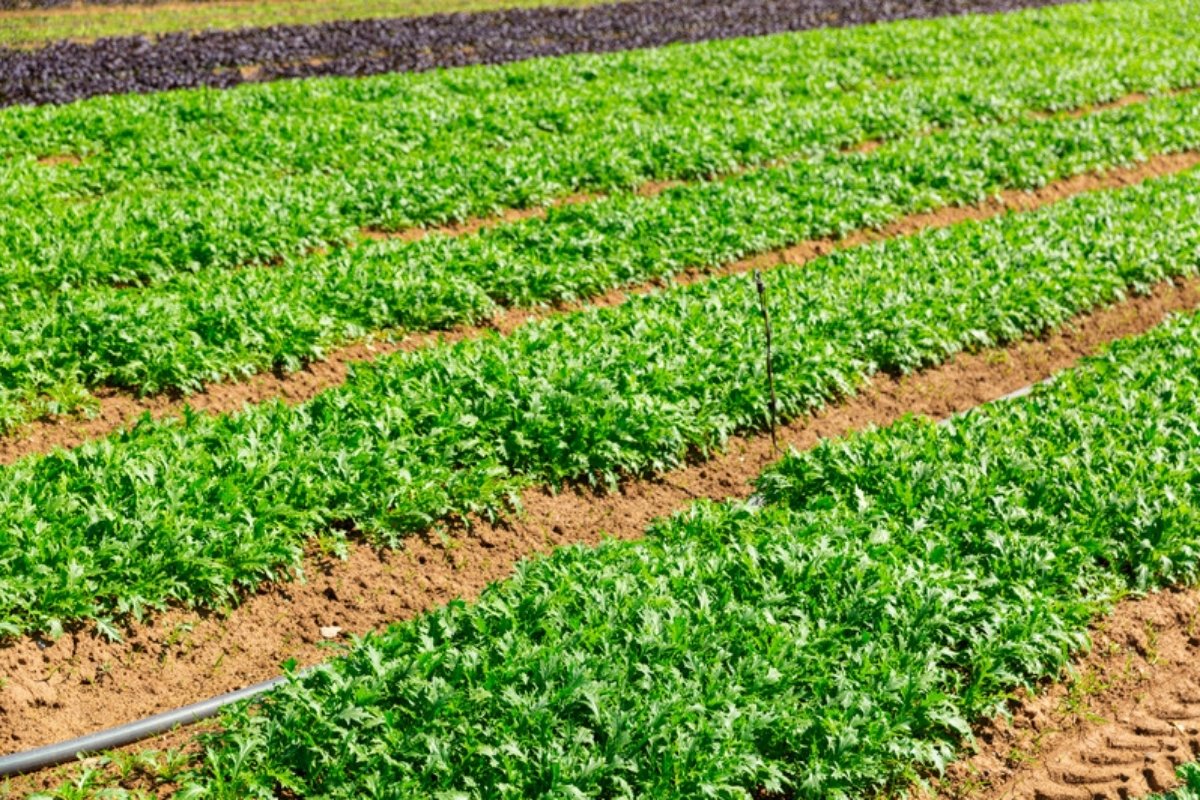
Commercial arugula production relies on two different species, the annual salad rocket (Eruca vesicaria subsp. sativa) and the perennial wild rocket (Diplotaxis tenuifolia), and serves mainly the fresh leaf and ready-to-eat salad market. Salad rocket gives its first cut from about 20 days and regrows for successive cuts, while wild rocket tolerates more cuts in the same cycle. In Italy, wild rocket accounts for about 50% of the area under leafy vegetables for ready-to-eat salads. The most important technical issue is nitrate, because the EU has set limits for rocket of 7,000 mg/kg in winter and 6,000 mg/kg in summer, and research shows that less nitrogen often gives the same yield. This guide covers the difference between the two species for the market, climate and soil, sowing and density, fertilisation and nitrates, irrigation, crop protection, harvest and shelf life.
Salad or wild rocket
| Trait | Salad rocket | Wild rocket |
|---|---|---|
| Species | Eruca vesicaria subsp. sativa | Diplotaxis tenuifolia |
| Cycle | Annual, very fast growth | Perennial, slower establishment |
| Seed | Larger | Much smaller |
| Cuts | Fewer, because of early bolting | More successive cuts |
| Heat | Bolts quickly | More tolerant |
| Market | Bunches and baby leaf | Mainly baby leaf for ready-to-eat salads, preferred in Italy and Germany |
Both species are described in the literature as baby-leaf salad crops of the brassica family, and they are often sold under the same name. Wild rocket was converted from a wild edible plant into a crop only about 25 years ago, and in Italy it is now grown on roughly 4,000 to 4,800 hectares.
Climate and seasons
Arugula is a cool-season crop, with an ideal growing temperature of around 14 to 20°C. The main obstacle to continuous production is early bolting, which appears as day length increases in spring. In Mediterranean regions, the main crops are therefore grown from autumn to spring, in the open field or in unheated greenhouses and tunnels. In Italian trials with wild rocket, marketable yield and mean leaf weight were highest in the winter cycle, compared with the autumn-winter and winter-spring cycles.
Soil
Arugula prefers fertile, well-drained soils rich in organic matter that hold steady moisture, and it is sensitive to soil salinity. To limit soilborne pests and diseases, it does not follow other brassicas, such as cabbage, broccoli or cauliflower, in the rotation.
Sowing and density
Arugula is almost always direct-seeded, because it does not transplant easily, although it germinates and grows very well in plug-tray systems. Density depends on the product:
- For baby leaf: very dense sowing in bands about 5 cm wide, at around 2 seeds per centimetre of row, with rows 5 to 15 cm apart
- For bunching: thinner sowing, about 1 seed per 2 cm of row, with rows 30 to 45 cm apart
- In field trials with wild rocket, densities of 33 to 100 plants per square metre were tested, while in soilless baby-leaf systems densities exceed 1,000 plants per square metre
Because salad rocket grows so fast, growers supplying the market steadily sow in succession, with a new sowing every 2 to 3 weeks.
Fertilisation and nitrates
Rocket, and especially wild rocket, is known for high leaf nitrate levels that can exceed the limits of European legislation. Regulation (EU) No 1258/2011 set two maximum levels for rocket:
- 7,000 mg/kg fresh weight for produce harvested from 1 October to 31 March
- 6,000 mg/kg for produce harvested from 1 April to 30 September
Exceeding them is a real risk. In a study of commercial wild rocket crops in southern England, with an average nitrogen application of about 104 kg per hectare, two of the eight crops exceeded the 6,000 mg/kg limit. By contrast, in a trial with wild rocket on sandy soil, 66 to 82 kg of nitrogen per hectare gave the same yield as the conventional rate of 309 kg. Italian studies also show that higher nitrogen rates raise leaf nitrate, and that under water shortage they can even reduce yield.
The practical conclusion is to apply nitrogen with restraint, based on a soil analysis, preferably in small doses, and not shortly before harvest. Rotted manure or compost in the base dressing covers much of the requirement.
Irrigation
Water shortage reduces yield, because both the number and the size of the leaves fall, and it also makes the leaves tough and very hot. Drip or light, frequent irrigation keeps the soil evenly moist. Excess water, on the other hand, causes root rot and favours fungal diseases, especially under cover.
Crop protection
The main pest is flea beetles, small beetles that pepper the leaves with tiny holes and make the produce unmarketable, mainly on young plants. Aphids follow and, in humid conditions, fungal leaf diseases. Prevention rests on insect mesh, rotation, avoiding excess moisture and regular scouting. Every treatment uses only products registered for rocket, after diagnosis by an agronomist, with strict observance of the pre-harvest interval, which in a crop cut every few weeks also sets the spray schedule.
Harvest
Baby leaves are cut at about 10 to 15 cm tall, above the growing point, so the plant regrows for the next cut. In Italian trials, wild rocket gave four to five successive cuts in the same cycle. Salad rocket can be cut for the first time after about 20 days, and cutting continues until the plant bolts. In a plug-tray system with fertigation, in trials in Slovenia, salad rocket yielded 1.5 to 2.2 kg per square metre.
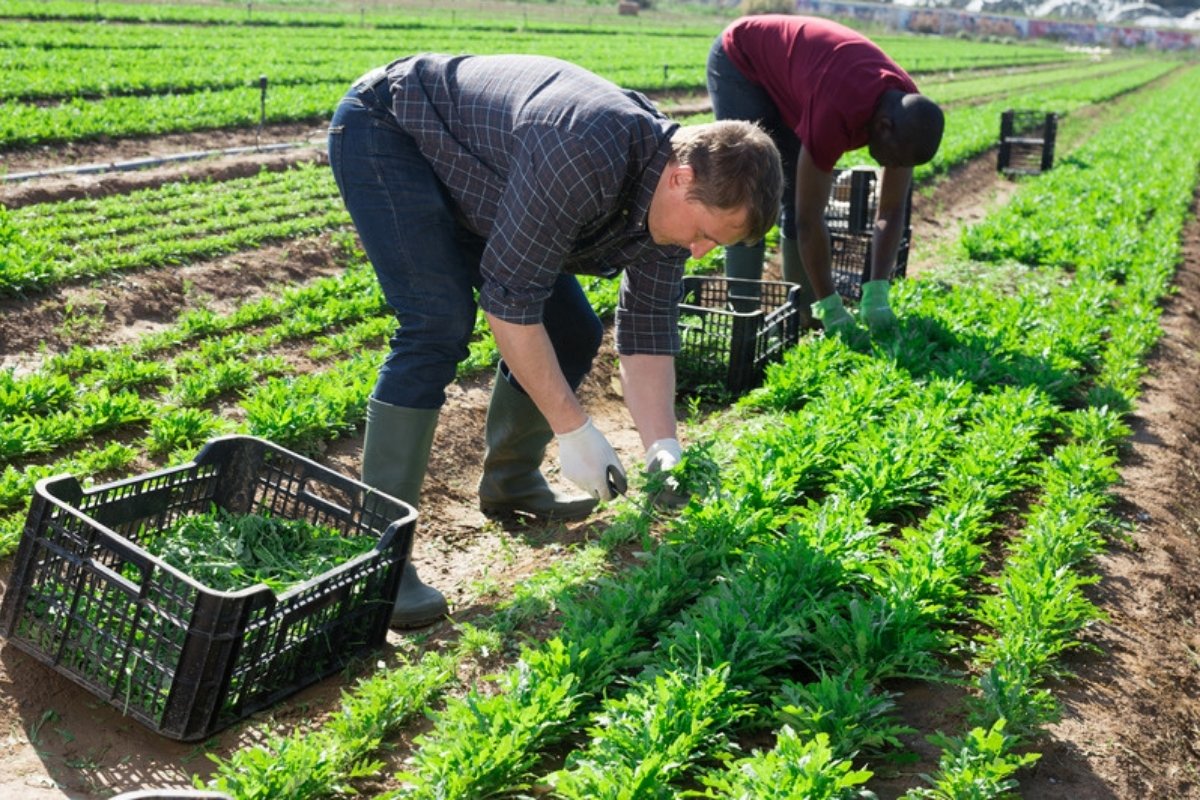
Rocket leaves are highly perishable, so the produce is cooled as quickly as possible after harvest.
Shelf life and post-harvest handling
Rocket leaves are highly perishable because of their high respiration rate, which limits shelf life. Harvest is best done in the cool hours, and the produce is cooled as quickly as possible. For ready-to-eat salads, leaves are washed, dried and packed under controlled conditions, so processors usually require clean produce, free of weeds and of holed or yellow leaves.
Frequently asked questions
What are the nitrate limits for rocket
Under Regulation (EU) No 1258/2011, 7,000 mg/kg for produce harvested from October to March and 6,000 mg/kg from April to September. These are almost double the limit for fresh spinach, but rocket, especially wild rocket, can exceed them with heavy nitrogen feeding.
How much nitrogen does arugula need
Less than is often applied. In a wild rocket trial, 66 to 82 kg of nitrogen per hectare gave the same yield as 309 kg, while higher rates raise leaf nitrate.
How many cuts can rocket give
In Italian trials, wild rocket gave four to five successive cuts in the same cycle. Salad rocket gives fewer, because it bolts sooner, especially with heat and long days.
Which rocket does the market prefer
For ready-to-eat salads, wild rocket is increasingly preferred, especially in Italy and Germany, where it covers a large share of the area. Salad rocket remains central for bunches and fast baby-leaf cycles.
What is the most damaging pest of arugula
Flea beetles, which make small holes in the leaves and render the produce unmarketable. The main protection is insect mesh on young plants.
Why does rocket spoil quickly after harvest
Because its leaves have a high respiration rate. Harvesting in the cool hours and rapid cooling are essential to keep quality.
Important notes
Densities, fertilisation and the number of cuts are adapted to the species, the growing system and the buyer's requirements, and treatment timing follows local plant protection guidance.
Use only products registered for rocket in your country, follow the label and the pre-harvest interval, and apply cultural measures first. For serious or persistent problems, consult a local agronomist for an accurate diagnosis.
For small plots and home use, growing arugula in the garden and in pots follows the same principles in simpler form.
References
- Interactive effect of nitrogen and azoxystrobin on yield, quality, nitrogen and water use efficiency of wild rocket in southern Italy, Agronomy, 2020.
- Annual effects of different organic fertilisers in a baby leaf crops system under tunnel in southern Italy, 2015.
- Factors influencing tissue nitrate concentration in field-grown wild rocket in southern England, Food Additives and Contaminants, 2012.
- Deep root growth and nitrogen uptake by rocket as affected by nitrogen fertilizer, plant density and leaf harvesting, 2017.
- Impact of irrigation regime and nitrogen rate on yield, quality and water use efficiency of wild rocket under greenhouse conditions, Scientia Horticulturae, 2017.
- Diplotaxis tenuifolia yield and quality as influenced by cropping season, protein hydrolysates and Trichoderma, Agronomy, 2020.
- Production of rocket (Eruca sativa) on plug trays and on a floating system in relation to reduced nitrate content, Acta Agriculturae Slovenica, 2013.
- Reduced fertilization to preserve postharvest quality of fresh-cut wild rocket, 2024.
- High Mowing Organic Seeds, Astro arugula, cultural information.