
Choosing tomato seed for a crop rests on three things: the growth habit of the plant, the fruit type and the disease resistances. These decide how much space and support you will need, when and how much the crop will produce, and how easily it will handle the pressures of the field. The seed should be certified, from a legitimate supplier, so that it has high germination and varietal purity.
Determinate or indeterminate varieties
Growth habit splits varieties into two broad groups and is the first decision when choosing seed.
| Type | Growth | Yield pattern | Suited to |
|---|---|---|---|
| Determinate | Bush type, 3 to 4 feet, stops growing | Concentrated ripening over a few weeks | Processing, sauce, small space |
| Indeterminate | Vining, keeps growing, needs support | Continuous through the season | Fresh market, extended harvest |
Determinate varieties form a bush around a metre tall, set their fruit over a fairly short window and need no pruning, which is why they are preferred for processing and wherever harvest happens in a single pass. Indeterminate varieties keep growing and fruiting throughout the crop, need staking and regular pruning, and suit situations where fresh fruit is wanted over a long period.
Fruit type according to use
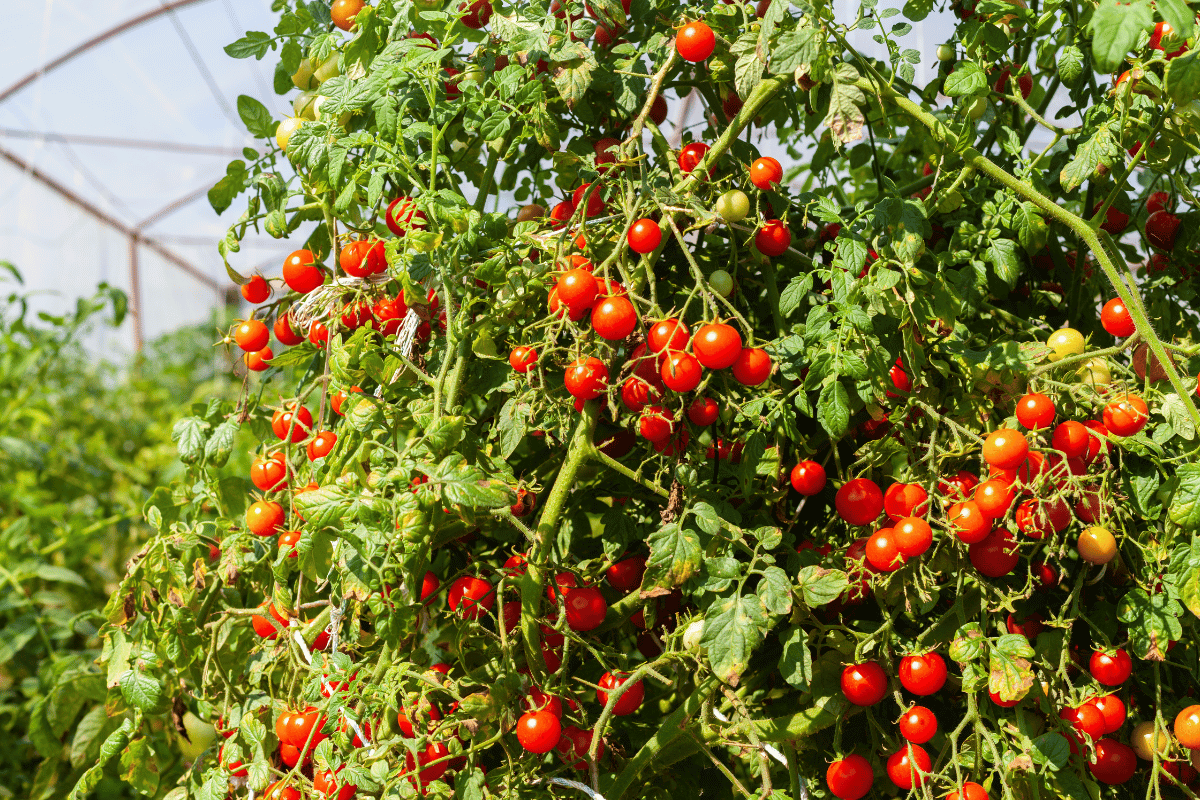
Fruit type ties directly to the purpose of the crop. Slicing varieties give large, fleshy fruit for fresh eating. Elongated Roma and San Marzano types have dense flesh with few seeds and low moisture, so they are meant for sauce, paste and canning. Cherry tomatoes, borne in clusters, give small sweet fruit for fresh eating and the early market. In the kitchen, each type suits a different use, from salads and sandwiches to sauces and canning.
What the resistance codes on the packet mean
Capital letters often appear next to the variety name, showing which diseases the plant resists. Choosing resistant varieties reduces losses and the need for intervention, especially in soils with a history of a given problem.
<table style="border-collapse:collapse;width:100%;margin:1.4em 0;font-family:Arial,sans-serif;font-size:0.9em;"> <tr> <th style="border:1px solid #c0ceb2;padding:9px 12px;background:#ebefe6;color:#2e5705;text-align:left;">Code</th> <th style="border:1px solid #c0ceb2;padding:9px 12px;background:#ebefe6;color:#2e5705;text-align:left;">Disease</th> </tr> <tr> <td style="border:1px solid #c0ceb2;padding:9px 12px;font-weight:600;color:#2f2f34;">V</td> <td style="border:1px solid #c0ceb2;padding:9px 12px;color:#2f2f34;">Verticillium wilt</td> </tr> <tr> <td style="border:1px solid #c0ceb2;padding:9px 12px;font-weight:600;color:#2f2f34;">F, FF</td> <td style="border:1px solid #c0ceb2;padding:9px 12px;color:#2f2f34;">Fusarium wilt, races 1 and 2</td> </tr> <tr> <td style="border:1px solid #c0ceb2;padding:9px 12px;font-weight:600;color:#2f2f34;">N</td> <td style="border:1px solid #c0ceb2;padding:9px 12px;color:#2f2f34;">Nematodes</td> </tr> <tr> <td style="border:1px solid #c0ceb2;padding:9px 12px;font-weight:600;color:#2f2f34;">T, TMV</td> <td style="border:1px solid #c0ceb2;padding:9px 12px;color:#2f2f34;">Tobacco mosaic virus</td> </tr> <tr> <td style="border:1px solid #c0ceb2;padding:9px 12px;font-weight:600;color:#2f2f34;">A</td> <td style="border:1px solid #c0ceb2;padding:9px 12px;color:#2f2f34;">Alternaria (early blight)</td> </tr> <tr> <td style="border:1px solid #c0ceb2;padding:9px 12px;font-weight:600;color:#2f2f34;">TSWV</td> <td style="border:1px solid #c0ceb2;padding:9px 12px;color:#2f2f34;">Tomato spotted wilt virus</td> </tr> </table>
The more letters a variety carries, the broader its protection. In practice growers pick the resistances that match the problems of their area, always alongside good cultural practices such as crop rotation and correct irrigation.
F1 hybrids or traditional varieties
Seed comes either as an F1 hybrid, with uniform plants and built-in resistances, or as an open-pollinated variety, from which the grower can save their own seed. Cost, uniformity and the ability to save seed change depending on what you pick, a decision that sets F1 hybrids apart from heirloom varieties.
Traditional Greek varieties
Greece also grows local open-pollinated varieties adapted to Mediterranean conditions. The Agios Petros tomato is a well-known traditional variety, transplanted late, around the end of June in several areas. The Santorini cherry tomato is a small-fruited variety adapted to dry-farmed conditions, with an intense flavour. These varieties hold stable characteristics from one generation to the next and allow seed saving.
How the crop starts after the choice
Once the seed is chosen, the crop usually starts in a nursery bed and the seedlings move to the field, following the same steps as growing tomatoes in the backyard, from sowing through transplanting and care.
Frequently asked questions
What is the difference between determinate and indeterminate tomatoes
Determinate types form a bush, stop growing and ripen over a short window, so they suit processing and small spaces. Indeterminate types keep growing, need support and produce fruit throughout the season.
What do the letters next to the variety mean
They show disease resistance, for example V for verticillium wilt, F for fusarium wilt, N for nematodes, T for tobacco mosaic virus and A for alternaria.
Which tomato type do I choose for sauce
For sauce and canning, elongated Roma and San Marzano types are preferred, with dense flesh and few seeds.
Can I save seed from my own crop
Yes, if it is an open-pollinated or traditional variety. Seed from an F1 hybrid does not reliably reproduce the characteristics of the parent plant.
Sources
- University of Georgia Extension, Read the plant label when choosing tomato varieties.
- Mississippi State University Extension, Use label information to select tomatoes.