

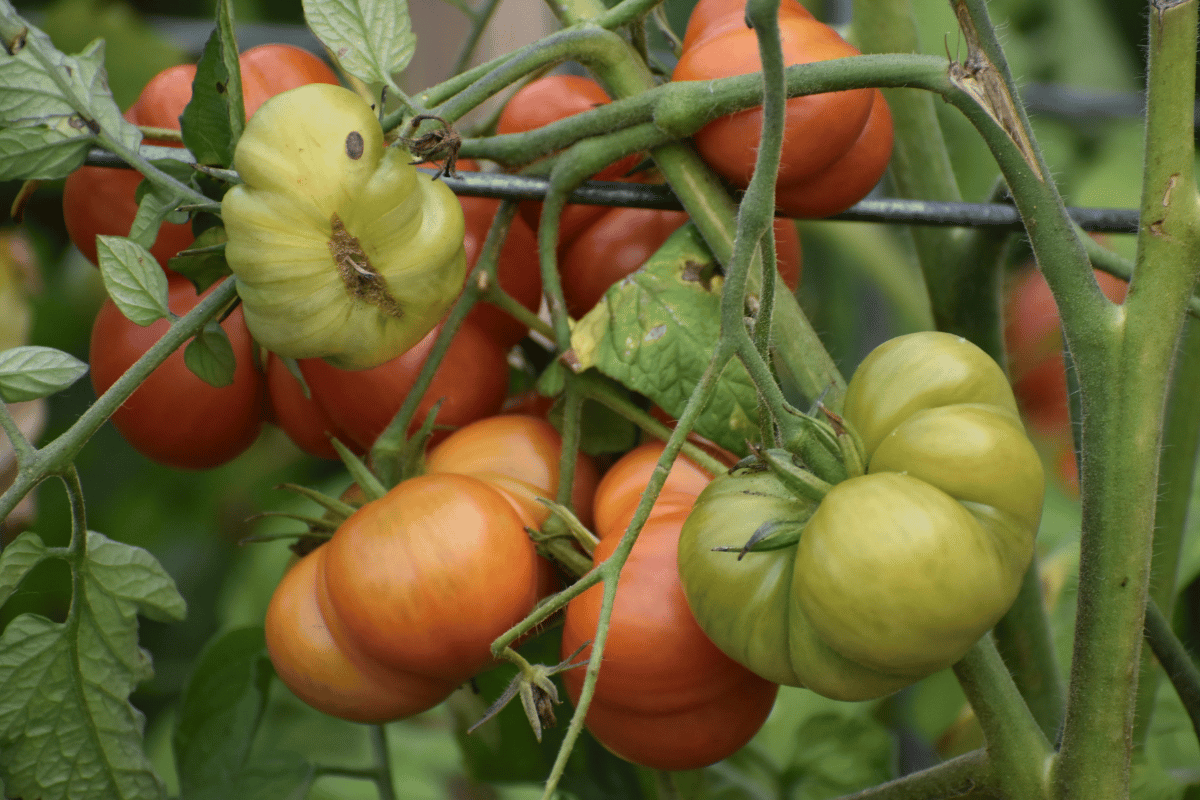
Tomato seed comes in two main forms: as an F1 hybrid and as an open-pollinated variety, the group that heirlooms belong to. The choice between them shapes the uniformity of the crop, the cost of the seed, the disease resistance, and whether you can save your own seed for the next year. The difference lies in how the seed is produced.
What an F1 hybrid is
An F1 hybrid comes from the controlled cross of two carefully selected parent plants of the same species, each bred for specific traits such as disease resistance, fruit size or quality. The letter F and the number 1 mark the first generation of offspring from that cross. F1 plants stand out for their uniformity, with fruit of similar size that ripens almost at once, and for hybrid vigour, the faster and more even growth of the seedlings.
An F1 hybrid is not a genetically modified organism. It comes from traditional breeding through natural crossing, without any transfer of genes between different species. Its cost is higher, because the seed is produced by hand pollination and is labour-intensive. Seed saved from an F1 plant does not give the same characteristics reliably in the next generation, so seed saving is not worthwhile.
What open-pollinated and heirloom varieties are
Open-pollinated varieties are fertilised by natural means, by wind, insects or self-pollination, and are genetically stable, meaning they give offspring with the same characteristics when pollinated by the same variety. Heirloom varieties are a subset of open-pollinated ones with a documented history passed down from generation to generation, often for more than fifty years. They are valued for their flavour, genetic diversity, and adaptation to local conditions, though they can be more susceptible to certain diseases. Every heirloom is open-pollinated, but not every open-pollinated variety is an heirloom.
How they compare
| Characteristic | F1 hybrid | Heirloom / open-pollinated |
|---|---|---|
| Uniformity | High, fruit of even size | Lower, natural variation |
| Resistances | Often built in | Vary, often fewer |
| Seed saving | Does not breed true | You save your own seed |
| Seed cost | Higher | Lower |
| Flavour | Good, depends on variety | Often intense, prized |
When to choose each
An F1 hybrid suits situations where the priority is high yield, uniformity, simultaneous ripening for a single-pass harvest, and disease resistance, especially in fields with a history of a given problem. A traditional variety suits situations where flavour, local adaptation and the ability to save seed from the crop matter, qualities valued in family and small-scale growing. Many growers combine the two, with hybrids for the main crop and traditional varieties for flavour and diversity. The growth habit and the resistances printed on the packet feed into the final choice of seed.
How to save seed from a traditional variety
Seed saving only makes sense with open-pollinated varieties. You choose a healthy, ripe fruit from a vigorous plant, remove the seeds together with the gel around them and leave them in water for a few days to ferment, which removes the protective coating. You then rinse and dry them well in a shaded spot. To keep the variety stable, the plants meant for seed should be isolated from other varieties, so cross-pollination is avoided. In Greece, traditional varieties such as the Agios Petros tomato and the Santorini cherry tomato have been kept this way for generations.
Frequently asked questions
Are F1 hybrids genetically modified?
No. An F1 hybrid comes from a natural, controlled cross of two varieties and is not a genetically modified organism, since there is no transfer of genes between different species.
Why is the F1 seed more expensive?
It is produced by hand-pollinating two selected parent plants, a labour-intensive process, so its cost is higher than open-pollinated varieties.
Can I save seed from an F1 hybrid?
It is not recommended. Seed from an F1 plant does not give the same characteristics reliably, so the offspring differ from the parent plant. For seed saving, choose open-pollinated varieties.
Which one tastes better
Traditional varieties are especially valued for their flavour, though there are hybrids with very good flavour too. Flavour ultimately depends on the specific variety and the growing conditions.
Sources
- University of Arizona Cooperative Extension, Heirloom vs. Hybrid.
- University of Illinois Extension, F1 hybrid vs. heirloom vegetable seed.
- University of California ANR, Tomatoes, heirloom, open pollinated or hybrid.