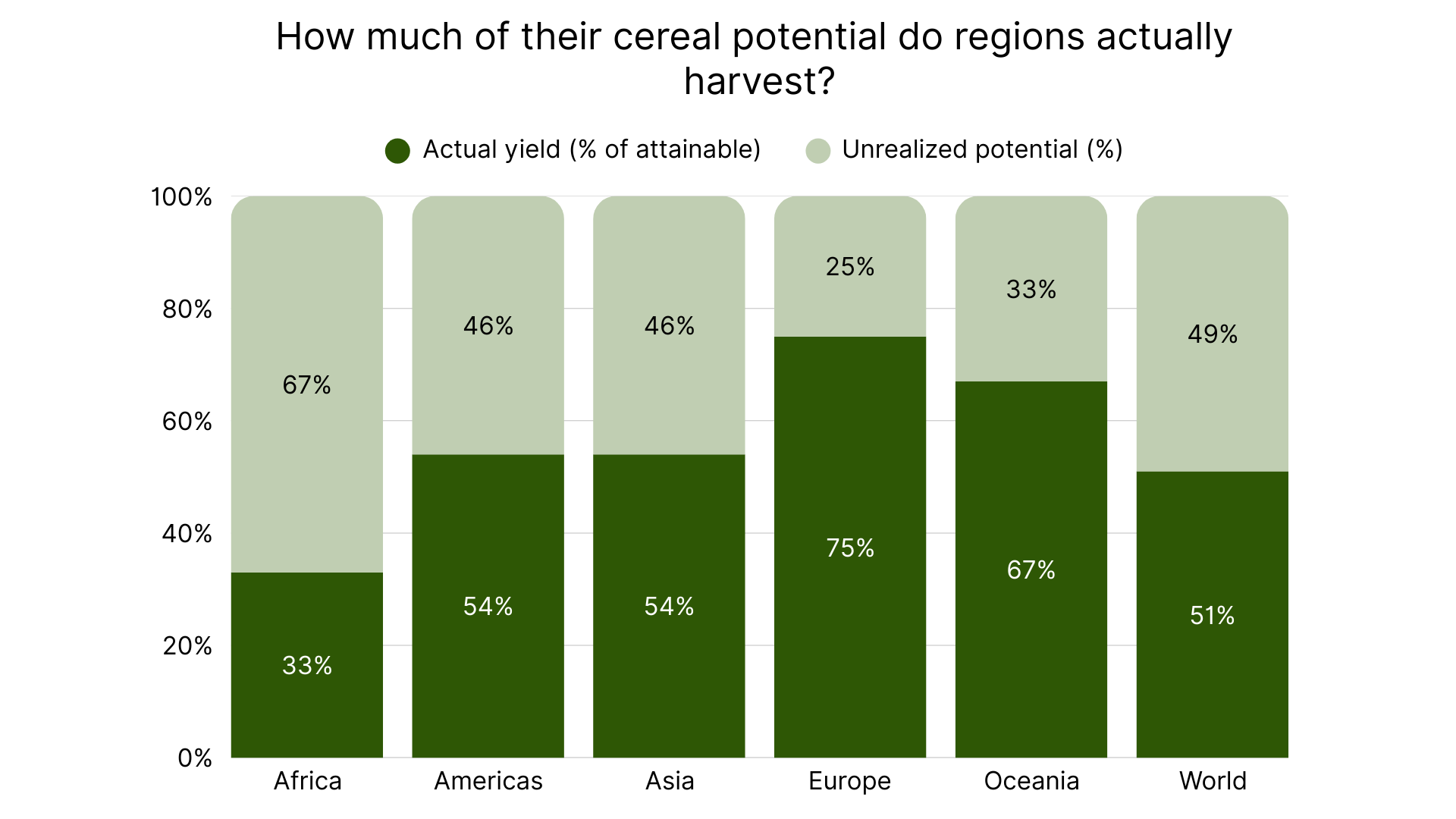
Across 52 crops and every major agricultural region, the world's existing farmland produces roughly half of what it could under appropriate management. In Africa, that figure drops to a third for cereals. The numbers come from FAO and IIASA's Global Agro-Ecological Zoning assessment (GAEZ v5, published 2025), which matches local climate, soil and terrain conditions against crop-specific requirements to calculate what each piece of land can realistically yield.
The distance between the attainable yield and the yield actually harvested is called the yield gap. For anyone growing crops, managing farmland or making investment decisions in agriculture, understanding where the gap sits and what drives it is the difference between working against the land and working with it.
How the yield gap is measured
GAEZ combines georeferenced climate data (temperature, rainfall, solar radiation, growing season length) with soil and terrain characteristics (nutrient levels, depth, slope, drainage, salinity) for every grid cell on Earth. It then models the attainable yield for each of 52 crops under different management levels.
When GAEZ flags a wide gap, it means the biophysical conditions of the land support higher production than what is being achieved. When the gap is narrow, the land is performing close to its ceiling. Both pieces of information are useful: one points to opportunity, the other confirms that current practices are well-matched to the conditions.
Where the gap is widest
African cereal growers harvest about 33% of what their land could produce. European growers reach 75%. The global average sits at roughly 51%.
The regional breakdown
Africa has the widest gaps across all three crop groups measured: cereals (gap of ~2,800 kg/ha), oil crops (gap of ~2,900 kg/ha) and roots and tubers (actual yields at 43% of potential). In sub-Saharan Africa specifically, rainfed crop yields reach only 24% of what the same land could produce under appropriate management. More than two-fifths of Africa's cropland sits on land classified as marginally suitable. The climate in most of these areas can support higher yields. Soil constraints under current management practices pull the classification down.
The Americas and Asia both achieve about 54% of attainable cereal yields. Their oil crop production is much tighter, above 75% of potential. Commercial scale and high investment in oil crops across both regions likely explain the narrower gap. Asia has 45% of its cropland irrigated. The Americas have large-scale commercial operations with high input use.
Europe, at 75% of attainable cereal yields, is the strongest performer. Roots and tubers there exceed 80% of their potential. Centuries of infrastructure development, stable input supply chains and accessible extension services built that performance over time.
Oceania reaches about 67% for cereals (gap of 1,600 kg/ha), but has a wider oil crop gap at 2,400 kg/ha.
The 3 biggest factors holding yields back
1. Soil nutrients
Across every region and every suitability class in the GAEZ assessment, soil nutrient availability is the single most important soil and terrain factor limiting yields. This constraint shows up in two opposite forms.
In sub-Saharan Africa and parts of South Asia, farmers remove more nutrients from the soil through harvesting than they return through any combination of fertilizer or organic amendment. Crop residue removal and burning accelerate the loss. The soil gets poorer each season, and yields decline with it.
In East Asia and parts of Western Europe, the opposite problem exists: nitrogen applied beyond what crops can absorb pollutes groundwater and acidifies soils. Global fertilizer use in 2022 was 35% higher than in 2001, though rates have been declining since 2020 as prices rose and supply chains tightened.
Both problems have known solutions. In depleted soils, rotating crops with legumes rebuilds nitrogen naturally. Combining organic amendments with targeted mineral fertilizer closes the gap more affordably than relying on either alone. In over-fertilized areas, precision application based on regular soil testing cuts waste without cutting yields. The technical knowledge exists. The bottleneck is access to inputs, testing services and advisory support.
2. Water access
Irrigated land covers 22.5% of the world's cropland but produces 48% of all crop value. On average, irrigated yields are 76% higher than rainfed yields for the same crops. Irrigation-equipped area more than doubled between 1964 and 2023, from 168 million hectares to 355 million hectares.
The regional imbalance is stark. In Asia, 45% of cropland has access to irrigation. In Africa, 6%. In the semi-arid zones where Africa's yield gaps are widest, erratic rainfall is a primary production constraint, and irrigation would directly address it. But agriculture already accounts for 72% of global freshwater withdrawals, and about 1.2 billion people live in agricultural areas with severe water constraints. In many basins across North Africa, the Near East and Central Asia, withdrawal already exceeds what is sustainable.
The practical path forward differs by location. In regions with available water but limited infrastructure (much of sub-Saharan Africa, parts of Latin America), expanding irrigation access directly narrows yield gaps. Where irrigation already exists at scale, improving efficiency through better scheduling, drip systems and reduced conveyance losses produces more per cubic meter.
3. Management level
Management level connects the other two constraints, and the GAEZ data on Africa makes the scale of its impact concrete.
Under low-input conditions (subsistence farming, local cultivars, no fertilizer, no chemical pest control), Africa has 55 million hectares of prime farmland. Under high-input conditions (improved varieties, mechanization, balanced nutrient application, pest and weed control), the same continent has 360 million hectares of prime farmland. Seven times more. No new land converted. No forests cleared. Simply improving soil management and addressing existing constraints unlocks the land’s full potential.
The GAEZ model treats "prime land" as land where a crop can produce more than 80% of its attainable yield. Much of Africa's soil has adequate temperature, rainfall and sunlight. But low nutrient availability, poor drainage or acidity push it into lower suitability categories when no management corrects those conditions. Improved inputs and practices change the classification. The soil stays the same. The management upgrades it.
Less than 5% of Africa's total land area qualifies as prime under current low-input management. With improved practices, that share rises to match or exceed what other continents achieve. For comparison, Europe has about 250 Mha of prime land under low-input conditions and gains only modestly under high-input scenarios, because its soils already perform well with existing practices.
Rice proves the gap can be closed
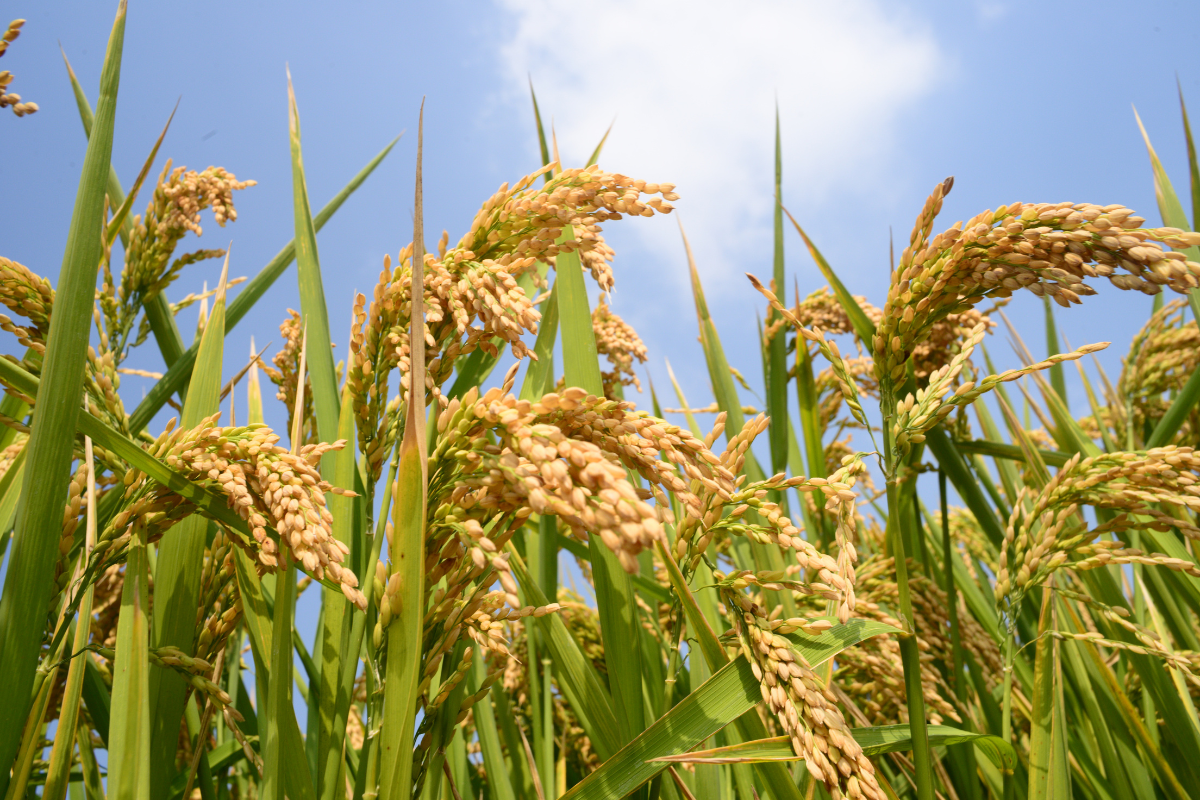
Rice is the clearest proof that yield gaps can be closed at scale. About half of all rice-producing countries now fall into the limited yield gap category (under 20%), meaning actual yields approach what the land can attain. Overall, more than 84% of global rice areas are now near their attainable yields.
That result took decades of coordinated effort. Targeted breeding produced varieties matched to local conditions. Irrigation expanded across Asia's rice belts. Extension services put improved practices in farmers' hands. Public investment in research stations and seed distribution networks sustained the effort across multiple crop cycles.
Maize tells the opposite story. Despite being grown in 159 countries, severe and very severe yield gaps (above 60%) remain common. No African country reaches the best-performing band. Wheat sits somewhere in between: 50 countries have severe gaps, but Africa's wheat performance is actually better than its maize performance, likely because wheat occupies more favourable agroecological niches on the continent.
Rice and maize tell two very different stories about what investment does to yield gaps. Rice received sustained, coordinated investment over decades. Maize in Africa received a fraction of that breeding, extension and irrigation support over the same period.
Practical approaches that have moved the needle
Conservation agriculture (minimum tillage, permanent soil cover, crop rotation) covered 205 million hectares globally by 2018 to 2019, about 14.7% of total cropland. That figure has been growing at over 10 million hectares per year since 2008 to 2009. In Southern Africa, where adoption has been widespread, yields increased by 15 to 25% and soil erosion dropped by 50%.
Drought-tolerant crop varieties are another piece. In Africa, the introduction of drought-tolerant maize varieties has measurably raised yields and reduced crop failure rates in drier zones. Ethiopia has documented yield gains from rainwater harvesting during dry seasons. Diversified cropping systems spread risk and rebuild soil biology where monoculture has depleted it.
None of these practices require imported technology or large capital outlays at the individual farm level. They do require access to the right seed, knowledge of local soil conditions, functioning input markets and, in many places, extension services that actually reach small-scale producers.
Feeding 9.7 billion without burning through the land
Agriculture needs to produce roughly 50% more food, feed and fibre by 2050 compared with 2012 levels. The global population is projected to reach 9.7 billion by 2050 and peak at about 10.3 billion in the mid-2080s.
Meeting that demand by expanding cropland would mean converting forests and grasslands. Over 1,660 million hectares of land are already degraded by unsustainable practices, with more than 60% of that degradation on agricultural land. More expansion along the same lines would accelerate that degradation.
The yield gap data points to the alternative. Globally, cereals are running at about half their potential. Africa's farmland could support seven times more prime agriculture with improved management. Rice already showed that sustained, targeted investment can close most of the gap for a major crop. The biophysical ceiling is well above the levels at which most of the world currently produces.
The barriers sit outside the field: finance for inputs and infrastructure, market access that makes investment in better practices worthwhile, extension networks that reach beyond the largest commercial operations, and tenure security that gives farmers a reason to invest in the long-term health of their soil. Rice's trajectory shows what happens when those pieces align. Most of the world's farmland is still waiting for them.
References
- FAO. 2025. The State of the World's Land and Water Resources for Food and Agriculture 2025. Rome.
- FAO & IIASA. 2025. Global Agro-ecological Zoning version 5 (GAEZ v5) Model Documentation. Rome.
- Gerber, N. et al. 2024. Global analysis of rice yield gaps (cited in FAO SOLAW 2025).