
Soil management is worsening across most of the world, and the trend has hardened over the past decade. In the global assessment published in the Status of the World's Soil Resources 2026, the FAO and its Intergovernmental Technical Panel on Soils rate 52.5% of regional assessments as poor or very poor, and find the trend deteriorating in 58% of cases. Only 10% show improvement, down from 13% when the same exercise was run in 2015.
The report draws on 290 experts from 75 countries, who scored the state of soil management and its direction of travel across seven threats and every world region. The result is the closest thing the sector has to a global soil scorecard, and it reads as a decade of lost ground.
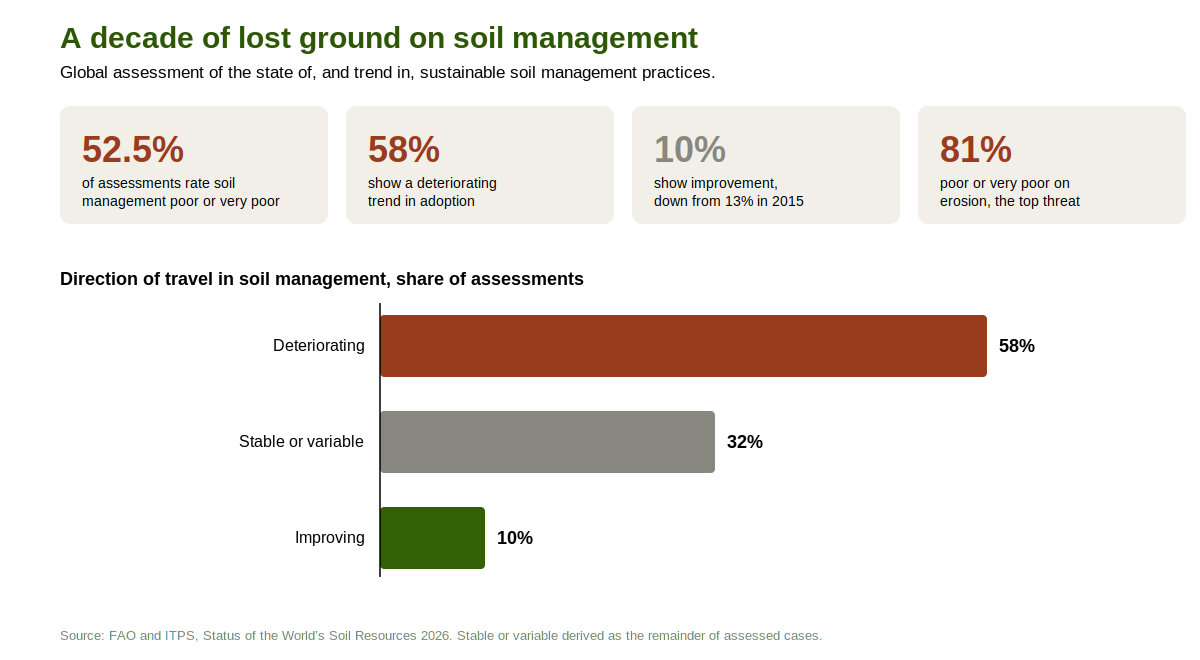
Deteriorating assessments outnumber improving ones by almost six to one. The share of regions improving their soil management fell from 13% in 2015 to 10% in 2026.
Erosion remains the worst problem and it is spreading
Soil erosion remains at the top of the list, as it was in 2015. 81% of assessments rate the state of erosion management as poor or very poor, and 65% report a deteriorating trend. No region is in a good state for erosion, and the panel identifies it as the threat most closely connected to the others, since losing topsoil takes carbon, nutrients, and biology with it.
The scale of the imbalance is what makes erosion difficult to reverse. Current rates of soil loss on farmland run orders of magnitude above the rate at which new soil forms, which means the deficit compounds every season it continues. The responses the panel recommends are long-established, from vegetative cover and contour work to reduced disturbance, and they line up with the standard causes and prevention strategies for soil erosion. What the assessment records show is a failure to apply them widely enough.
Soil biodiversity has climbed the ranking of concerns
Loss of soil biodiversity has risen from sixth place among threats in 2015 to fourth in this assessment, the sharpest move in the ranking. No region reports a favourable state, and the panel attaches low confidence to much of the data, because monitoring of soil organisms remains thin almost everywhere.
That combination, a rising threat measured with weak data, is a recurring pattern in the report. Soils hold roughly 59% of all species on the planet, which makes them the single most biodiverse habitat on Earth, yet the biological component of soil is the part that countries track least. Where trends can be measured in managed land, they vary with the presence or absence of conservation practices.
The carbon numbers behind the soil story
Mineral soils store about 1,700 gigatonnes of organic carbon, rising to roughly 2,900 gigatonnes when permafrost and peat are included. That is several times the carbon held in the atmosphere, which is why soil management has become as much a climate question as an agricultural one.
Around 133 gigatonnes of soil carbon have been lost since agriculture began, most of it from the topsoil layer that farming disturbs. Loss of soil organic carbon sits third in the threat ranking, and the regional picture splits. North America is the one region where carbon is increasing, helped by higher crop residue production, land abandonment and reforestation. Europe, by contrast, records a deteriorating trend, and much of the continent lacks the monitoring data to say by how much. The practical lever is the same everywhere, namely, returning more organic material to the soil than is removed from it, which is the balance calculation behind soil organic matter management.
More land is being farmed and more is being covered over
Harvested cropland expanded 24% between 2000 and 2022, reaching 1.47 billion hectares, with 80 million hectares added since the previous soil report alone. Production has grown by working more land and working it harder, and the expansion has come largely at the expense of natural habitat.
At the other end, soil sealing has risen more than 150% since 1990. Urban land is projected to expand from 213 million hectares in 2000 to 621 million hectares by 2040, displacing an estimated 65 million tonnes of crop production because cities have historically grown on the best farmland. Salt-affected soils now cover 1,381 million hectares, or 10.7% of the global land surface, with a further billion hectares at risk, and roughly 10% of irrigated land already affected. Nitrogen use efficiency worldwide is 45% to 50%, meaning more than half of the nitrogen applied to fields never reaches a crop.
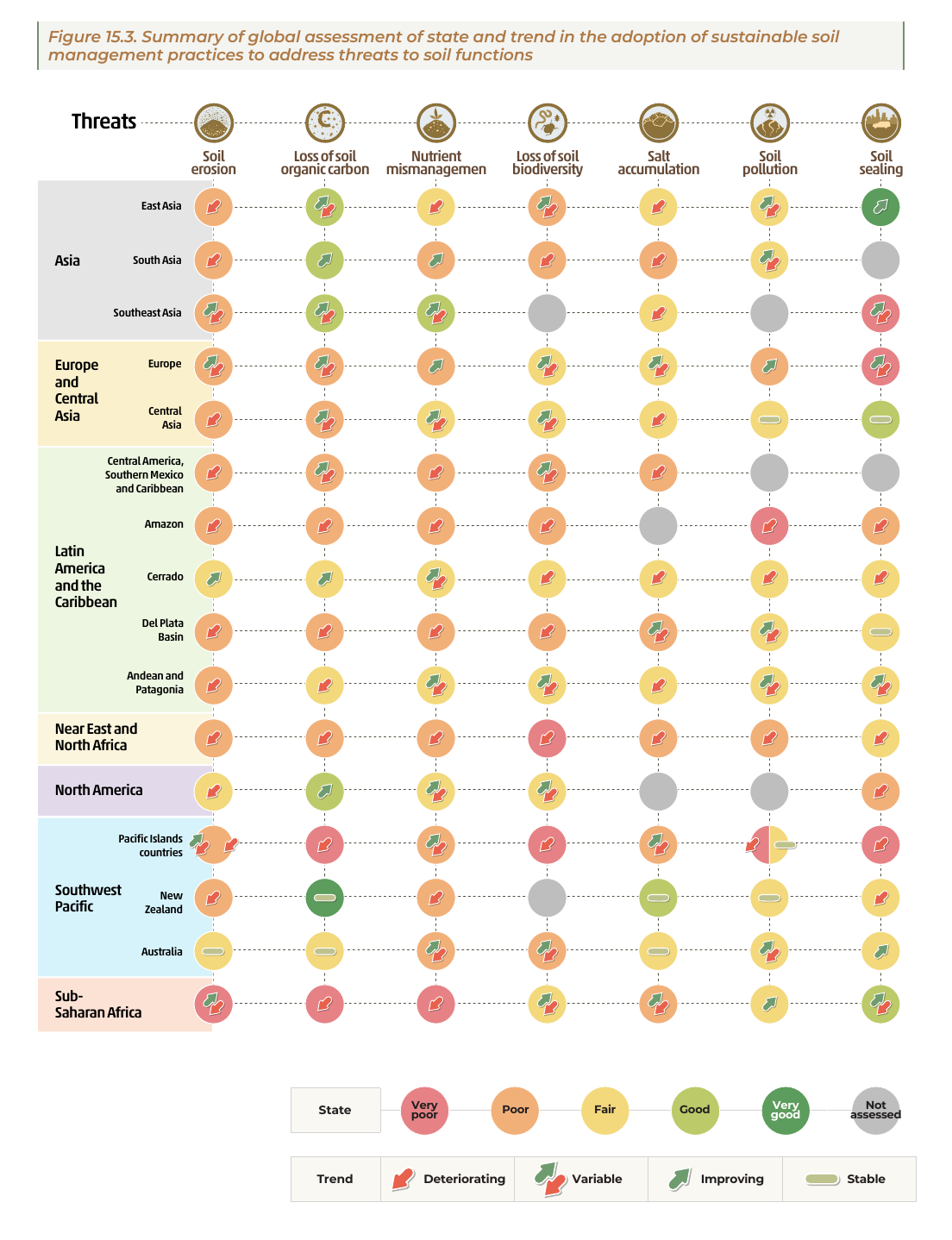
Each circle scores one region against one soil threat, with colour showing the state of management and the arrow showing the trend. Green cells appear only for soil organic carbon in North America and East and South Asia, and for soil sealing in East Asia.
Practices exist but adoption stays narrow
Conservation agriculture covers about 205 million hectares, equal to 14.7% of global cropland, providing the clearest measure of how far this proven practice has spread. The panel's conclusion is that the constraint is implementation rather than science, since the practices that protect soil are documented, tested, and in many cases profitable within a few seasons.
What holds adoption back is a familiar list. Insecure land tenure removes the incentive to invest in a resource that a farmer may not hold for ten years. Upfront costs land on the farmer while many of the benefits arrive later or accrue to society through cleaner water and stored carbon. Advisory services are thin where they are needed most, and monitoring data is missing in exactly the places where soil is degrading fastest. The report's recommendations concentrate on those four points, and on the same underlying argument that soil health determines what a farming system can sustain over the long term.
Soils supply the base for roughly 95% of food production, 94% of protein and 98.8% of the calories people consume. Against that dependence, a decade in which the share of regions improving their soil management fell from 13% to 10% is the finding the report asks governments to sit with.
Sources
- FAO and ITPS. (2026). Status of the world's soil resources 2026. Rome, FAO.