



Your weekly food recall & compliance tracker w50/2025
We have analysed the latest food recall data from across the European Union over the last week (December 8-14, 2025) to bring farmers, exporters, and wholesale buyers the critical market intelligence they need. This week’s data reveals a sophisticated landscape of risks: while familiar issues like mycotoxins in dried fruit persist, we are seeing an uptick in complex chemical contaminants, from mineral oils in rice to banned legacy pesticides, suggesting that EU border controls are digging deeper than ever before.
Highlights at a glance
- A total of 125 notifications were issued across the EU food and feed safety network this week.
- Fresh-produce-related categories (fruits & vegetables, nuts, cereals, herbs) accounted for 50 alerts, representing 40% of the total volume.
- Fruits and vegetables remain the most impacted category with 34 alerts (27% of the total).
- Turkey continues to be the primary country of origin with 17 alerts, dominated largely by dried fig consignments.
- Chemical complexity is rising. Beyond standard pesticide residues, this week saw significant alerts for MOSH/MOAH (mineral oils), heavy metals (Tin, Cadmium), and even DDT (a banned legacy pollutant), indicating a widening scope of laboratory testing.
- Dietetic foods and supplements surged to second place with 25 alerts, a reminder that processed plant-based ingredients (like botanical extracts) are facing intense scrutiny.
Top product categories affected
Looking at all 125 notifications, the distribution across product categories reveals clear risk concentrations:
Fruits and vegetables dominated with 34 alerts (27.2% of the total), followed by dietetic foods and food supplements at 25 (20.0%), poultry meat products at 9 (7.2%), and nuts, nut products, and seeds at 7 (5.6%).
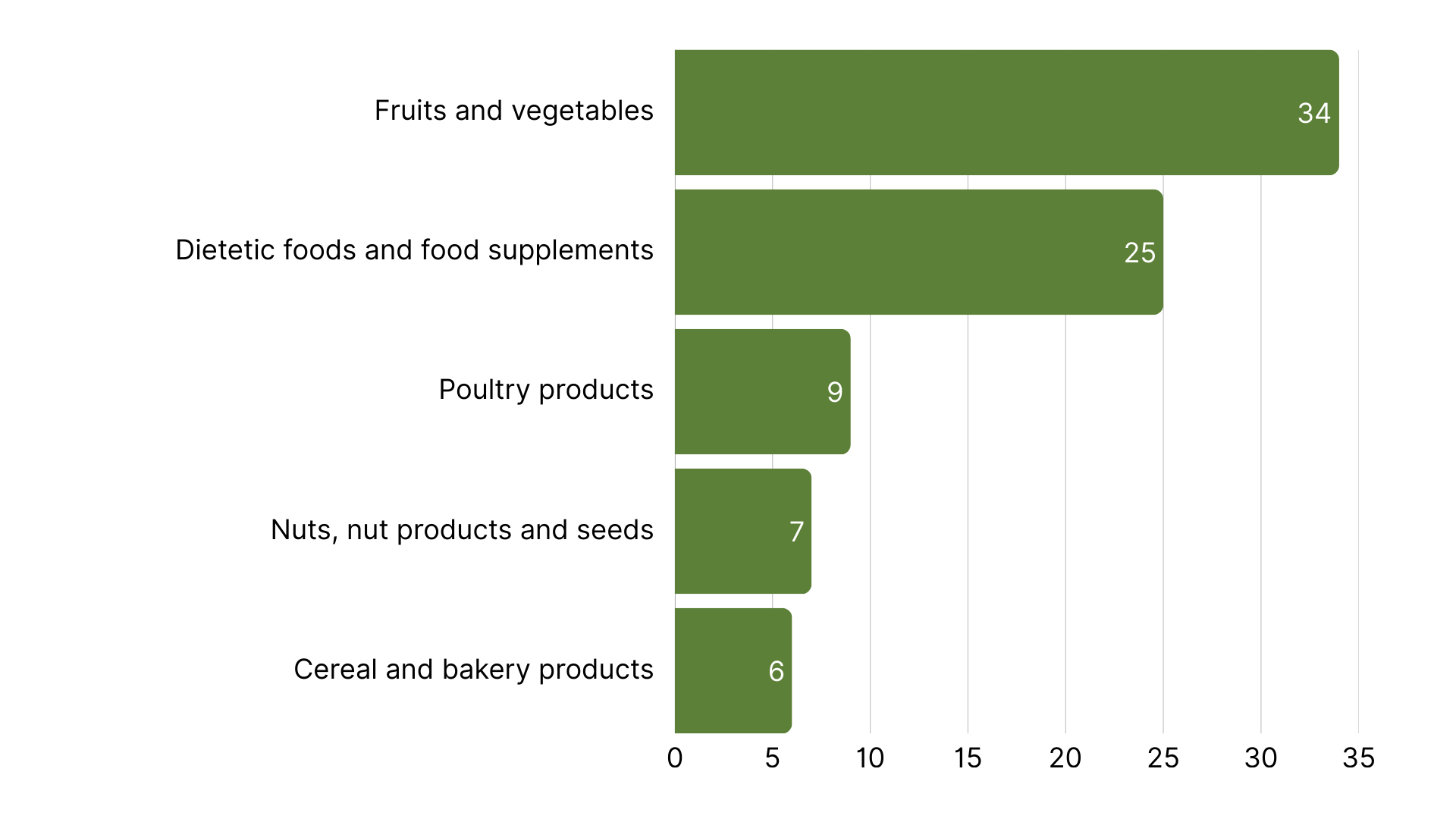
Graph 1: Top 5 Product Categories with the Most RASFF Alerts (Week 50)
The continued dominance of fresh produce reflects multiple factors: high import volumes during Europe's winter off-season, complex multi-country supply chains, diverse growing conditions across origins, and intensive border control testing at EU entry points. The substantial share of food supplements, largely from the United States, continues a 2025 trend of increased scrutiny for unauthorized novel food ingredients.
Fresh produce focus
Turkish dried figs face mycotoxin pressure
The situation with dried figs from Turkey has become a structural market pattern rather than a temporary spike. This week alone saw multiple alerts for Ochratoxin A and Aflatoxins. For buyers, this signals that reliance on standard certificates is insufficient; lot-by-lot testing for mycotoxins remains the only safe procurement strategy. The persistence of this issue suggests that environmental conditions or post-harvest storage practices in the region are currently under severe pressure.
Rice and complex chemistry
Rice imports from India faced serious challenges this week, and not just from typical pests. Notifications included Mineral Oil Saturated/Aromatic Hydrocarbons (MOSH/MOAH), contaminants often migrating from packaging or lubricants, and DDT, a persistent organic pollutant banned decades ago in most of the world. This serves as a critical warning: EU compliance is no longer just about "sprayed" pesticides; it now covers the entire history of the soil and the processing chain.
European origin risks
Greece generated three fresh produce alerts, all involving pesticide residues: acetamiprid in white grapes, and two separate clementine notifications for chlorpyrifos and cyprodinil. Italy, meanwhile, recorded four fresh produce alerts. Two tomato batches with Salmonella spp., one with acetamiprid residues in cherry tomatoes, and one spinach alert for spinosad. This reminds European growers that short supply chains are not immune to food safety failures, particularly regarding harvest intervals (MRLs) and hygiene (microbial).
Complete list of recalled fresh produce
Below is the detailed breakdown of this week's recalls in fresh produce categories.
Fruits and vegetables
- Dried figs (Turkey): Ochratoxin A, Aflatoxins (multiple alerts)
- Tomatoes (Italy): Salmonella spp.
- Cherry tomatoes (Italy): Acetamiprid
- Grapes/clementines (Greece): Cyprodinil, Chlorpyrifos-ethyl
- White grapes (Greece): Acetamiprid
- Grapes (Peru): Methomyl
- Spinach (Italy): Spinosad
- Peppers (Egypt): Triadimenol, Lambda-cyhalothrin, Acetamiprid
- Pineapples (Thailand): Tin (heavy metal)
- Pineapple (Costa Rica): Propiconazole
- Avocado (Colombia): Cadmium
- Mango (Thailand): Buprofezin
- Limes (Brazil): Chlorpyrifos
- Green celery (Belgium): Acetamiprid, Tebuconazole
- Green beans (preserved) (Belgium): Foreign body (glass shards)
- Semi-dried prunes (Chile): Sorbic acid (E 200) too high
- Apricots (dried) (Uzbekistan): Ochratoxin A
- Raisins (Iran/Croatia): Thiodicarb
Cereals and bakery products
- Rice (India): Mineral oil residues (MOSH/MOAH)
- Basmati rice (India): Chlorpyrifos (unauthorized)
- Rice (India): Chlorpyrifos, DDT
- Sorghum flour (Rwanda): Tropane alkaloids (Scopolamine)
- Tortillas (Serbia): Calcium sorbate (unauthorised additive)
- Wafers (Turkey): Undeclared peanuts (Allergen)
Nuts, nut products and seeds
- Pistachios (USA via Turkey): Aflatoxins
- Peanuts (USA): Aflatoxins
- Groundnuts (Brazil): Aflatoxins
- Hazelnuts (Georgia): Aflatoxins
- Poppy seeds (Czech Republic): Morphine and codeine (Opium alkaloids)
- Poppy seeds (Turkey): Opium alkaloids
- Sesame seeds (India): Chlorpyrifos
Herbs and spices
- Black pepper (Turkey): Foreign body (metal wire)
- Masala spice (India): Chlorpyrifos
- Porcini mushroom powder (Unknown origin): Salmonella spp.
Geographic risk patterns

Graph 2: Top 5 Countries with the Most RASFF Alerts (Week 50)
Turkey (17 alerts, 13.6% of total): Dominated by dried fig mycotoxin issues, but also included ground black pepper with foreign bodies and soft apricots with excess sorbic acid. The concentration of Turkish alerts in dried fruit categories underscores persistent post-harvest handling challenges.
India (8 alerts, 6.4% of total): Showed a concerning pattern of chlorpyrifos contamination across multiple product categories—cereals (rice), herbs (masala spice), and nuts (sesame seeds). Additional alerts involved mineral oil contamination in rice and novel food issues related to food supplements. The cross-category chlorpyrifos pattern suggests widespread unauthorised use.
Italy (7 alerts, 5.6% of total): Fresh produce alerts concentrated in leafy greens and tomatoes, revealing both microbiological (Salmonella) and chemical (acetamiprid, spinosad) control gaps in domestic production.
Non-EU vs EU Origins: For fresh produce specifically, 70.6% of alerts involved non-EU origins, while 29.4% concerned EU member states. This distribution reflects both high import volumes and intensive border testing, but also indicates that EU domestic production is not immune to compliance failures.
Why compliance is getting more complicated
Look closely at the recalls and a clear shift appears. Food safety today has less to do with spray records and more to do with everything that happens around the crop.
For decades, compliance revolved around spray records, pre-harvest intervals, and residue limits. Farmers learned to work the calendar. Buyers learned to read pesticide tables. That logic still matters, but it is no longer enough.
What increasingly appears in EU alerts are contaminants that cannot be traced back to a single spray decision. Cadmium in avocados or tin in pineapples does not come from misuse in the orchard. These metals enter through soil composition, irrigation water, processing equipment, or even packaging. They accumulate quietly, without warning signs in the field.
The same applies to MOSH and MOAH in rice. These hydrocarbons are rarely agricultural in origin. They migrate from packaging inks, recycled cardboard, conveyor belts, or milling machinery. A perfectly grown crop can fail a border check because of what happens after harvest.
Even opium alkaloids in poppy seeds tell the same story. These are natural plant compounds, not contaminants added by error. Yet they are tightly regulated, and a variety of choice or harvest methods can determine whether a lot is marketable or rejected.
For modern farmers and wholesale buyers, this marks a turning point. Compliance is no longer only a biological or agronomic exercise. It is a chemistry problem, stretching from soil mineral balance and water sources to dryers, storage silos, transport, and packaging lines.
Those who will keep smooth access to European markets over the next seasons will be the ones who understand their production system as a whole. Not just what they apply, but where their crop grows, how it is handled, and what it touches on its way to the shelf.