
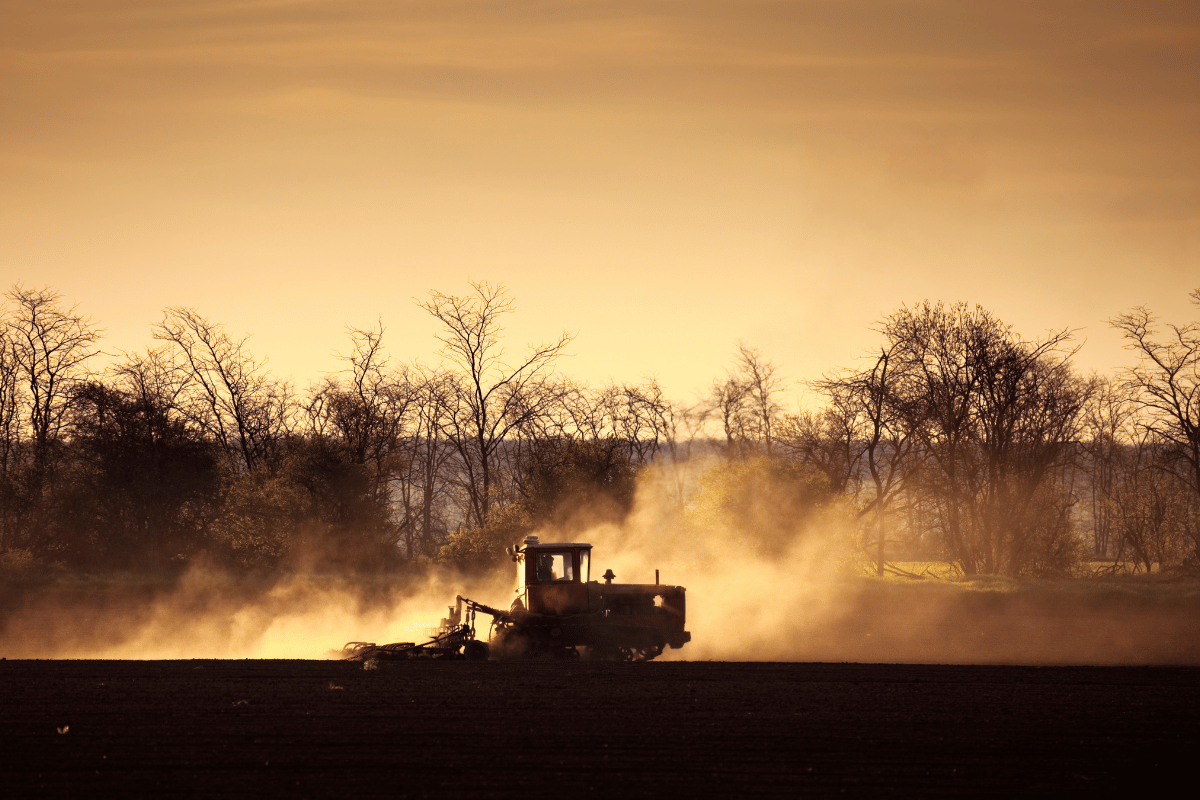
Earth Day 2026 arrives with a warning, and this one comes straight from the farm gate. On April 22, the Food and Agriculture Organization of the United Nations and the World Meteorological Organization published a joint assessment of what extreme heat is doing to global agriculture. The finding is blunt. Heat has become one of the most serious and acute hazards facing farming worldwide, and the 1.23 billion people whose livelihoods depend on it are already on the receiving end. The 2026 Earth Day theme, "Our Power, Our Planet," asks what local action can do at global scale. Food is where that answer gets tested.
Heat is cutting yields for every degree of warming
Staple crops provide most of the calories the world eats, and their yields are falling as temperatures rise. Based on a meta-analysis of observational data, the damage per 1 °C of warming is already measurable across the big four:
- Maize: down 7.5%
- Soybean: down 6.8%
- Wheat: down 6.0%
- Rice: down 1.2%
Projected losses for every additional 1 °C of future warming reach up to 10% for maize and wheat. These are global averages, and they hide an important geography. Tropical yields fall harder because the crops grown there already sit close to their thermal damage thresholds, leaving a narrow safety margin before damage begins. The same degree of warming that trims a midlatitude field takes a much bigger bite out of a tropical one.
When heat and drought arrive together, losses above 30% are common in affected areas. Farmers across southern Europe lived through a version of this during the July 2025 heatwave, when temperatures above 40 °C pushed crops past the point of recovery in Spain, France and Italy.
A feedback loop no one should want
Heat damage does not stay in the field. Between 1992 and 2020, farmers across 110 countries brought an extra 88 million hectares into production to compensate for yield losses driven by heat and related stresses. Clearing that land released 21.8 billion tonnes of CO2 equivalent, roughly 19% of the total land-use emissions from those countries over the period.
More emissions mean more warming. More warming means more heat damage. More heat damage means more pressure to clear more land.
Meanwhile, total factor productivity in global agriculture has fallen 21% since 1961 due to heat stress, the equivalent of erasing seven years of productivity gains. Research covering the past 50 years finds no statistically significant evidence of net adaptation in grain crops at the global scale. Breeding, irrigation and agronomy have all moved forward, yet crops are nearly as sensitive to heat today as they were half a century ago. Temperature extremes now explain more national crop yield anomalies than drought does.
Livestock pushed past their thermal limits
Heat thresholds for livestock are low. Cattle, goats and sheep go into heat stress at 25 °C. Pigs and chickens, which cannot sweat, hit their limit at 24 °C. For every additional degree above 30 °C, these animals cut feed intake by 3 to 5%, and the knock-on effects roll through milk yields, reproduction rates, and meat quality.
The rest of the century splits sharply depending on which emissions path the world takes:
- Under a high-emission pathway (SSP5-8.5), global cattle losses reach around USD 40 billion a year by 2100 (in 2005 dollars), 9.8% of the value of meat and milk from cattle.
- Under a low-emission pathway (SSP1-2.6), those losses fall by nearly two-thirds to USD 15 billion.
- Pig production in China, the world's largest producer, is projected to decline 5.6% under current trajectories, and 10% in the hotter regions.
The gap between scenarios is the story. The same planet, two very different outcomes, determined by decisions being taken now.
Oceans, forests and a cascade of fires
The water side is no better:
- Global marine heatwave frequency has doubled since the 1980s
- Under the high-emission RCP8.5 scenario, it could rise 4,900% by 2100
- Sustainable yields of several wild fish populations already fell 4.1% between 1930 and 2010 because of warming seas, with some regions losing 15 to 35%
On land, heatwaves cut forest gross primary productivity by 30 to 50% and dry vegetation into fuel. Extreme fire weather days could rise 400% under 3 °C of warming. The fire season itself could lengthen by up to 1,400% at the same level of warming.
What Brazil showed in 2023 and 2024
Brazil offered the clearest preview of what this looks like when it all hits at once. From late 2023 through 2024, large parts of the country endured daytime temperatures more than 5 °C above average for months on end. Initial forecasts from CONAB, Brazil's national supply company, projected a record soy harvest of 162 million tonnes. By May 2024 the estimate had been cut to 147.7 million. Nearly 10% of the expected crop was gone. In São Paulo state, soy losses exceeded 20%.
The heat did not stop at the fields. Pigs in the Central-West region were under severe heat stress for 20 or more days each month. Wildfires devastated an area the size of Italy. Then a heat dome to the north blocked an atmospheric cold front over the south, triggering catastrophic rainfall in Rio Grande do Sul. The floods killed 183 people, displaced more than 600,000, and destroyed up to 2 million tonnes of soybeans still in the ground.
One weather pattern. Cascading impacts across crops, livestock, forests and human lives.
The human cost in the fields
The people working in the heat pay the steepest price:
- In the United States, agricultural workers are 35 times more likely to die from occupational heat exposure than workers in other sectors
- Global agricultural labour productivity is projected to fall 18% by 2100 under current trajectories, with the steepest declines in Africa, South Asia and Southeast Asia
- An additional 3 °C of warming could cost USD 136 billion a year and push crop prices up 5%
Farmers feel this pressure well before it shows up in the statistics. Farah Baroudy, Ph.D., a Mediterranean agricultural specialist, puts the shift plainly:
"Before, the Mediterranean climate was relatively mild and predictable. Severe weather events did occur, but they were neither as sudden nor as frequent as they are today. Farmers could plan seasons, inputs, and marketing with a reasonable level of confidence. Now, adapting to climate change looks less like a long-term plan and more like a series of rapid decisions made under pressure, often with high costs and trade-offs."
Crop specialist Gitai Segal describes the same reality from the operations side:
"Frequent heat/cold waves, erratic rainfall, and extreme wind events are forcing farmers and growers to take a proactive approach. Fast decision making and execution are crucial for the crop's success."
Adaptation is hitting its limits
The gap between what adaptation can do and what is being asked of it keeps widening. Most agricultural systems still rely on minor modifications to current practice, while climate extremes are already pushing them past their adaptive limits. Agrifood systems received only 4% of total climate-related development finance in 2023. That is the entire financial envelope being asked to carry crops, livestock, fisheries, forests and the people who work them through a hotter century.
The most promising near-term tool is anticipatory action. Agrometeorological advisories and early-warning systems linked to pre-planned responses, triggered before a heatwave hits, give farmers enough lead time to shift irrigation, move livestock, or protect workers. These work at the farm level. What they cannot do is close the finance gap, repair weak extension services, or fix fragmented institutional mandates, all of which continue to slow real change.
What Our Power, Our Planet asks of food systems
The 2026 Earth Day theme calls for local effort that scales globally. The findings here arrive at the same place from the opposite direction. Farm-level adaptation is necessary but cannot carry the weight alone. The assessment's conclusion pushes hardest on three commitments:
- Close the climate finance gap for agriculture
- Integrate agricultural resilience into national heat action plans
- Treat mitigation as the only durable solution
In the authors' own words: "The only durable solution to protect the future of global agrifood systems from the escalating threat of extreme heat lies in ambitious, multilateral climate change mitigation."
For the 1.23 billion people who work the land, and the rest of us who eat what they produce, one thing is clear. A hotter planet is the operating condition farmers are already managing. The open question is how fast, and how fairly, the rest of the food system is willing to catch up.
References
- FAO and WMO. (2026). Extreme heat and agriculture, FAO and WMO joint report. Rome and Geneva.
- Burke, M. et al. (2024). Are we adapting to climate change? National Bureau of Economic Research.
- De Lima, C.Z. et al. (2021). Heat stress on agricultural workers exacerbates crop impacts of climate change. Environmental Research Letters.
- Gubernot, D.M. et al. (2015). Characterizing occupational heat-related mortality in the United States, 2000 to 2010. American Journal of Industrial Medicine.
- Quilcaille, Y. et al. (2023). Fire weather index data under historical and shared socioeconomic pathway projections in the 6th phase of the Coupled Model Intercomparison Project. Earth System Science Data.