



Global Melon Production (2023-2024)
Non-European Production
In 2023, global melon production (excluding watermelons) remained heavily concentrated in Asia, with non-European countries accounting for the vast majority of output. According to the latest FAOSTAT data, global melon production reached approximately 28.6 million metric tons, with China dominating the market at 14.45 million metric tons—about 49% of the global total. Other key non-European producers included Turkey, India, Kazakhstan, Afghanistan, Iran, and Brazil, each contributing significantly to the global supply.
European Production
In 2024, European melon production continued to be dominated by Southern European countries, with Italy and Spain leading the sector. According to the most recent EUROSTAT data, Italy produced approximately 11,544 metric tons, closely followed by Spain with 11,412 metric tons. Together, these two countries represented the bulk of the European Union’s melon output, supported by their favorable Mediterranean climates and strong agricultural infrastructure.
Other notable European producers included Poland (4,595 metric tons), France (4,110 metric tons), and Greece (3,717 metric tons), each contributing meaningfully to the regional market, albeit at less than half the volume of Italy or Spain. Additional contributors such as the Netherlands, Portugal, Germany, and Romania recorded production levels ranging from approximately 1,000 to 1,500 metric tons.
Overall, the 2024 season reinforced the stronghold of Southern Europe in EU melon production, while also highlighting the resilience and diversity of cultivation across the continent. Despite weather-related challenges in certain areas, the sector remained stable, with Italy and Spain maintaining their roles as the EU’s leading producers and key suppliers for both domestic consumption and export markets.
Discover more about the Global Fresh Market Pricing and Trends
Melon Varieties
Muskmelons and related melon types represent a diverse and globally traded category, each with unique characteristics and preferred markets. Below are some of the most recognized varieties:
- Cantaloupe: The most widely traded muskmelon variety globally, cantaloupe enjoys strong demand in North America, Europe, and Asia. It is favored for its sweet orange flesh and distinctive netted rind, making it a staple in fresh fruit markets worldwide.
- Galia: Recognized by its round shape, netted rind, and green flesh, Galia melons are particularly popular in European and Middle Eastern markets. Their aromatic profile and high sweetness levels make them a consumer favorite.
- Honeydew (Yellow Honeydew): Known for its smooth, pale rind and green to white flesh, the Honeydew melon is widely traded due to its long shelf life and refreshing flavor. It remains a reliable export variety for many producing countries.
- Piel de Sapo (Santa Claus Melon): With its oblong shape, green-mottled rind, and crisp white flesh, Piel de Sapo—also known as the Santa Claus Melon—is a staple in Spanish and Brazilian exports, particularly targeting the European market.
- Charentais: A small, round variety with a smooth rind and vibrant orange flesh, the Charentais melon is highly prized in France and has seen increasing export activity in recent years due to its rich aroma and flavor.
- Kirkagac: A traditional Turkish specialty, the Kirkagac melon is gaining popularity, especially in Germany and other parts of Europe. It is valued for its distinct taste and regional heritage.
- Torpedo (Obi-Navvot): An iconic Central Asian export, the Torpedo melon—also known as Obi-Navvot—is noted for its elongated shape and sweet, dense flesh. It has recently made its way into premium segments of the European market, reflecting growing consumer interest in specialty varieties.
How Global Melon Seasonality Drives Prices
Seasonal Supply Patterns
The annual price dynamics of melons worldwide are closely tied to the staggered harvest periods in major producing regions, creating distinct cycles of abundance and scarcity. In the Northern Hemisphere, peak melon supply aligns with local harvest windows—May to September in Southern Europe (Spain, Italy, France, Greece) and June to September in China and the United States. During this period, the markets experience high volumes, which typically exert downward pressure on prices as supply outpaces demand.
Off-Season Premiums
From October to March, melon supply for key markets like Europe and North America heavily relies on Southern Hemisphere and tropical producers, particularly Brazil, Central American countries (Costa Rica, Honduras, Guatemala), and Northern Africa (Morocco, Egypt). Since production volumes are lower and exporters must also cover higher logistics costs (shipping, cold storage), melons become less abundant. This off-season scarcity translates to elevated wholesale and retail prices, especially for premium-quality imports. Out-of-season fruit can command prices up to two to three times higher than during surplus months, and small supply shocks—such as shipping delays—can result in rapid price spikes.
Greenhouse and Transitional Production
Greenhouse and early-season cultivation—most notably in Spain, Italy, and parts of China—partly mitigates extreme seasonal swings, providing smoother supply transitions between major harvests. Nevertheless, these melons often carry a price premium as they require greater inputs and logistical coordination, so the overall pattern of lower prices during peak season and higher prices in the off-season remains stable.
Price Analysis by Market Level
Farmgate prices (2024/2025)
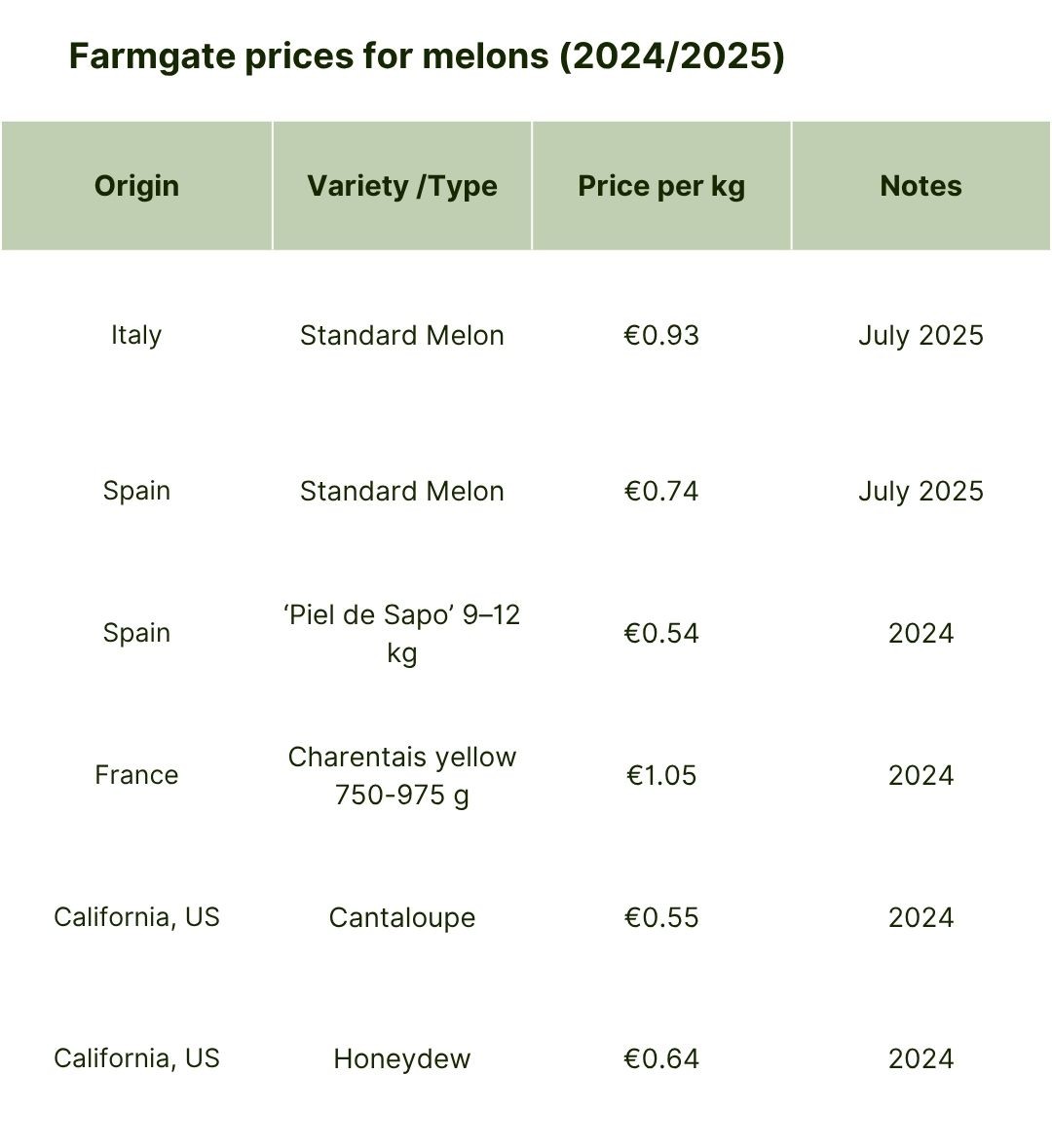
Farmgate prices for melons in 2024/2025 show significant regional variations, ranging from €0.54 to €1.05 per kilogram across major producing countries. European producers command the highest prices, with France leading at €1.05/kg for premium Charentais yellow melons, followed by Italy at €0.93/kg and Spain at €0.74/kg for general varieties. Spanish 'Piel de Sapo' melons fetch €0.54/kg, reflecting their bulk, export-oriented nature. US producers receive moderate prices, with California honeydew at €0.64/kg and cantaloupe at €0.55/kg, based on converted USDA data. These price differentials reflect varying production costs, with European melons commanding premiums due to higher labor costs, regulatory compliance, and quality positioning. French Charentais represents the premium segment due to its reputation and limited growing areas, while Spanish and US prices reflect more mechanized, large-scale production systems.
Note: The analysis reveals data scarcity issues severely limiting comprehensive market assessment across the global melon sector.
Wholesale market prices
Wholesale melon prices in 2025 demonstrate pronounced regional differences, driven by a combination of product type, origin, and market dynamics. Western European markets—particularly France, Germany, and Italy—reveal the highest price points for premium melon varieties such as Charentais. In France, Charentais yellow from Martinique and Senegal reach exceptional premiums (€5.91–7.02 and €4.35 per kg, respectively), reflecting limited supply and high import costs. Domestic and nearby European Charentais sources (France, Spain, Italy) consistently range from just under €2 to about €4.50 per kg, indicating strong regional demand for this specialty variety, with Germany closely aligned at €2.30–2.60 per kg for similar Charentais types.
Southern European markets like Spain and Italy display lower price bands, particularly for volume-grown varieties tied to local consumption. In Spain, staples such as Cantaloup, Galia, and Piel de Sapo melons are priced in a tight range of €1.76 to €1.85 per kg, while Italian Lisci (smooth-skinned) and Retatii (netted) melons command €1.35–1.50 per kg. These stable, moderate price points reflect abundant supply, short transport chains, and minimal import premiums during peak harvest season. The Greek market in Athens further supports this trend with Galia and Loutrakiou melons trading at lower wholesale ranges (€0.40–1.70 per kg), highlighting both varietal preference and strong local production.
.jpg)
Outside Europe, world prices are more polarized. The United States and Mexico, major exporters to the global market, report cantaloupe and honeydew wholesaling between €1.30 and €1.60 per kg—competitive but typically below premium European Charentais. Morocco—an important seasonal supplier to Europe—posts a highly competitive €0.80 per kg for general melons, cementing its status as a price-setter for early-season imports. At the opposite end, Brazil and Thailand stand out among non-European countries for higher-priced melons, with Brazilian white-fleshed types quoted at €3.93–4.37 per kg and Thai muskmelons at €3.23 per kg, both serving specialized and urban markets with high-quality offerings.
The global price landscape is rounded out by Uzbekistan and India, where wholesale prices for general melons range dramatically lower—€0.16–0.47 per kg in Uzbekistan and €0.11–0.22 per kg in India. These low prices are the result of substantial seasonal gluts, vast production intended for domestic and regional markets, and lower logistical costs. The wide gap between European premium segments, mid-range American and Mediterranean suppliers, and budget-friendly Central Asian and Indian markets underscores how climate, seasonality, demand, and product differentiation all converge to shape the remarkable diversity in world wholesale melon pricing.
Discover more about the Global Fresh Market Pricing and Trends
Retail Prices
Global retail prices for melons in 2025 show substantial regional diversity driven by variety, consumer demand, and supply dynamics. Across Europe, melon prices in top supermarket chains generally range from €1.50 to €3.50 per kilogram, with Charentais, Galia, and Cantaloupe leading the offer. French and German chains typically price standard Charentais and Cantaloupe melons between €1.80 and €2.60 per kilogram. In Greece, supermarket pricing spans €1.49–€3.53 per kilogram, with common varieties such as Galia available at the lower end and imported or specialty melons at the upper end. Spanish retailers present Cantaloup, Galia, and Piel de Sapo varieties at €1.70–€2.10 per kilogram, with seasonal sales occasionally reducing prices, though top-quality lots remain above €2 per kilogram.
In North America, supermarkets most often sell cantaloupe and honeydew at €1.40–€2.10 per kilogram; organic and pre-packaged melon cubes can reach over €8–€10 per kilogram due to higher preparation and packaging costs. Off-season or more specialized products trend even higher. South American markets, such as Brazil, reflect city supermarket averages of €2.80–€3.40 per kilogram for standard melons.
Meanwhile, Asian premium remains led by Japan, where everyday supermarket prices for high-quality muskmelons can run from €3.50 up to €11.70 per kilogram; imported Galia or Cantaloupe run lower but still above €3.50 per kilogram. South Korea’s major grocery stores price domestic melon at €6.50–€8.50 per kilogram, showing year-on-year inflation due to weather and logistical costs. Thailand's supermarkets position muskmelons in the €3.23–€4.00 per kilogram range, with higher specialty imports.
-1.jpg)
Retailing trends in India position melon prices among the lowest globally, at €1.13–€2.05 per kilogram in urban chains, reflecting stable local supply and smaller margins from farm to consumer. Morocco, serving both domestic and export demand, keeps retail prices near €1.20 per kilogram during peak season. In the Middle East, supermarkets provide Galia and Cantaloupe melons at €3.20–€4.90 per kilogram. Across all these markets, organic, pre-cut, and branded premium melons consistently draw a significant price premium, especially in affluent urban regions or during periods of short supply. The variation in global retail prices for melons thus underscores the importance of regional production costs, supply chain complexity, seasonal windows, and evolving consumer demand for specialty and higher-value options.
**Note: for non-European markets, prices were converted into euros with the average rates
Trade Flows
In 2025, the principal exporters of muskmelons will remain Spain, the United States, Brazil, Costa Rica, and Morocco. Spain dominates European supply from May to September, while Central America (Costa Rica, Guatemala) fills the EU and U.S. markets from January to April. Brazil has steadily increased its presence, exporting primarily to Europe during the Northern Hemisphere's off-season.
On the other hand, the United States and European Union continue as the main import markets, with the U.S. favoring Central American supply during its winter and the EU increasingly sourcing from Morocco and Brazil outside the main Spanish season.
Morocco and Panama have expanded their muskmelon exports, targeting European and Middle Eastern demand as new logistical routes open up and quality standards improve. Uzbekistan and other Central Asian countries have begun accessing Russian and regional markets with high-sugar specialty varieties.
Market Forecast for 2025
The global muskmelon market is forecast to grow moderately in 2025, following a volume recovery from adverse weather events in 2024. Global volume is expected to increase by approximately 1.4% year-on-year, with value growth from increased sales and price premiums for specialties and off-season imports.
The European market volume is projected to expand by 1.6% with value growth at 2.7% (CAGR) through 2035 as consumption upticks in Western and Eastern Europe. Spain and Morocco will continue to dominate EU sourcing, while Brazil's off-season share grows.
In addition, the U.S. muskmelon market (cantaloupe, honeydew) is expected to see steady demand, with the market value reaching around $2.02 billion by 2033 (from $1.25 billion in 2024)—a CAGR of about 5.5% for melon types other than watermelon, with increased consumer emphasis on convenience and healthy snacks.
China, India, and Central Asian countries will continue to lead global production, but most of their output will remain for domestic and regional markets, with only specialty varieties moving into international trade circuits.
Key Consumer Trends in the Melon Market (2025)
1. Health and Wellness Demand
- Melons as Healthy Snacks: Consumers increasingly view muskmelons (cantaloupe, Galia, Charentais, honeydew) as hydrating, low-calorie, vitamin-rich fruit, aligning with the global trend toward functional and nutritious snacking.
- Dietary Preferences: Demand is up for melons among health-focused shoppers, with sales often benefiting from campaigns highlighting their vitamin C, fiber, and antioxidant content.
2. Convenience and Ready-to-Eat Products
- Pre-cut and Packaged Melons: Retailers report significant growth in sales of cut, ready-to-eat melon portions, wedges, and snack packs. Pre-packed melon bowls and mixed fruit trays are especially popular in urban supermarkets and for on-the-go consumption.
- Mini and Seedless Varieties: Mini melons sized for single servings and seedless types are favored for convenience, reducing waste and preparation time.
3. Premiumization and Specialty Varieties
- Organic and Branded Melons: There is a notable shift toward organic melons, with premium price segments growing, especially in Europe and affluent Asian markets. Branding, origin labeling (e.g., “Charentais de Provence”), and certifications (organic, GlobalG.A.P., GRASP) help drive consumer trust and willingness to pay more.
- Niche and Exotic Varieties: Markets are seeing more specialty melons, such as aromatic Charentais, Asian Hami, and regional types like Galia and Kirkagac, responding to consumers interested in novel flavors and heritage fruits.
4. Sustainability and Ethical Sourcing
- Eco-friendly Packaging: Increasing numbers of consumers demand recyclable, compostable, or minimal packaging in both whole and cut melon formats.
- Sustainable Production: Shoppers in Western Europe and North America show growing interest in melons produced with fewer pesticides, drip irrigation, and verifiable social/labor standards.
5. Year-Round Availability and Imports
- Off-Season Consumption: Thanks to international trade from the Southern Hemisphere and tropical suppliers, consumers now expect fresh melons year-round. Off-season imports (e.g., from Brazil, Morocco, and Central America) consistently find retail success, despite higher prices.
6. Digital Shopping and Transparency
- Online Grocery Growth: There is a rising online sales of melons, particularly through digital supermarkets and direct-to-consumer produce boxes. Consumers expect clear information about variety, origin, and farming methods.
- Price Sensitivity: Online platforms have also fostered more price comparisons and value-driven buying, especially for bulk and family packs.
7. Consumer Education and Promotion
- In-store Tastings and Promotions: Supermarkets regularly use melon tastings, recipe cards, and cross-promotions (e.g., with prosciutto or yogurt) to increase trial, especially for unfamiliar or premium types.
- Recipe Sharing and Social Media: Influencers and food blogs have elevated the profile of melons in summer salads, smoothies, and desserts, further driving seasonal demand.
Conclusion
In summary, the global muskmelon market (excluding watermelons) remains robustly anchored by Asian and Southern European production, with China accounting for nearly half of world supply and Italy and Spain leading in Europe. Market pricing across farmgate, wholesale, and retail levels shows high regional variability, reflecting input costs, product differentiation, and seasonal dynamics. Consumers continue to drive demand for health-focused, convenient, and premium melon offerings, while year-round availability is ensured by coordinated international trade and greenhouse production. Global trade is dominated by Spain, Brazil, Morocco, and Central American exporters meeting off-season demand in key markets. Despite data scarcity in some regions, the 2025 outlook is moderately optimistic, with projected growth in both volume and value, supported by rising consumption in established and emerging markets and an increasing shift toward organics, sustainability, and innovative product formats.
Further Reading:
3 common reasons melons are rejected
Growing Melons Outdoors for Profit - Complete Growing Guide from Start to Finish
Sources:
USDA National Agricultural Statistics Service
Spanish Ministry of Agriculture, Fisheries and Food (MAPA)
FAOSTAT: Crops and livestock products
Stone Fruit: World Markets and Trade — USDA Foreign Agricultural Service
Stone Fruit Statistics — European Commission, Agriculture