

More than 300 mm of rain fell between 14 and 20 October 2026 on the southern coast of the province of Valencia and in northern Alicante, with point totals above 600 mm in northern Alicante, according to Spain's State Meteorological Agency (AEMET), which attributes the rain to DANA Adam. The floods reached these areas as the harvest of Navelina oranges was starting and while buyers were already purchasing early mandarins, in the region that produced 44.3% of Spain's citrus in 2025/26 according to the regional government (Generalitat Valenciana). The European Centre for Medium-Range Weather Forecasts (ECMWF) forecast of 26 October gives almost dry weather on the coast until 4 November.
AEMET recorded more than 300 mm on the southern coast of Valencia
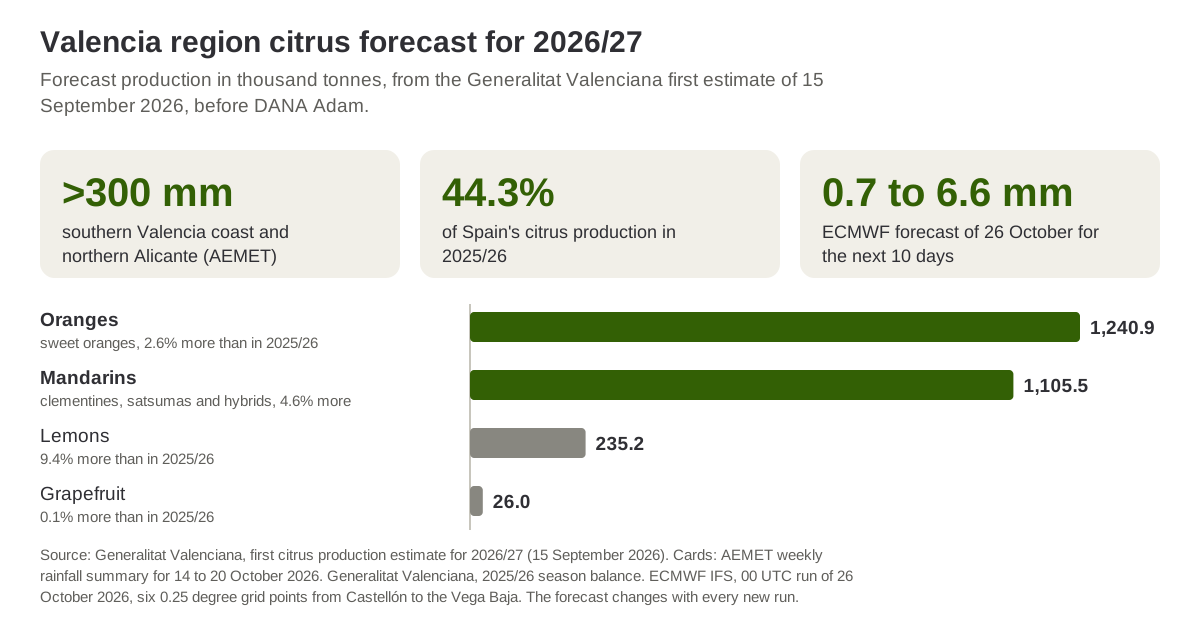
AEMET uses the name DANA, from the Spanish depresión aislada en niveles altos, for a cut-off low in the upper atmosphere. In its weekly summary prepared on 22 October, the agency reports more than 20 mm of rain over much of the eastern third of the country, with the highest totals, linked to DANA Adam, on the southern coast of the province of Valencia and in northern Alicante, where they were well above 300 mm. AEMET's main stations recorded much less, 78 mm at Castellón-Almazora and Alicante and 72 mm at Valencia airport, while Ibiza reached 234 mm, so the totals above 300 mm describe the coast from southern Valencia to northern Alicante and not the city stations.
From 1 to 20 October, average rainfall across Spain reached 51 mm, about 9% above the 47 mm of the 1991 to 2020 reference period. Totals were locally more than three times normal in the Levante, while the western half of the country, especially Galicia, Extremadura and western Andalusia, had a deficit. Andalusia, which produced 53.3% of Spain's oranges in 2025/26 according to the Generalitat Valenciana, therefore lies, at least in its western part, among the areas with less rain than normal.
September 2026 was the warmest on record in the Valencia region
According to AEMET's climate summary for September, the month was extremely warm and dry in the Valencia region, the warmest September since records began and the driest since 2020, with 32.2 mm of rain, 44% less than the 1991 to 2020 average of 57.9 mm. It was also the fourth extremely warm month in a row, since July, August and September were the warmest in their series and June was the third warmest since 1950. In the area hit by the DANA, groves therefore went within a few weeks from a hot, dry end of summer to hundreds of millimetres of rain, one of the sudden changes in soil moisture during ripening that are linked to fruit splitting in oranges and mandarins, mainly in thin-skinned varieties.
The Navelina harvest had just started when the DANA arrived
The Generalitat Valenciana's report on the state of the season at 30 September says that purchases of fruit on the tree for 2026/27 began in week 36, from 31 August to 6 September, six weeks later than in the previous season. Traders were cautious about rising citrus imports from non-EU countries, and demand in Europe was slow to pick up because autumn temperatures stayed above normal for the time of year. By the end of September, buyers had bought Okitsu and Owari satsumas, Arrufatina, Marisol, Oronules and Clemenules clementines and Navelina oranges, the last in the provinces of Alicante and Valencia at 0.26 to 0.29 euros per kilo on the tree. The Valencian Farmers' Association (AVA-ASAJA) says in its press release of 19 October that the Navelina harvest was starting when the DANA arrived and that the rain stopped the harvesting and marketing of citrus.
AVA-ASAJA estimates that about 8,000 hectares may have been affected
In its first, urgent estimate, AVA-ASAJA calculates that the torrential rain, which exceeded 600 litres per square metre, may have affected about 8,000 hectares of crops and farm infrastructure, mainly in the districts (comarcas) of La Safor and La Marina. Overflowing rivers and ravines uprooted trees, washed away soil and damaged walls, irrigation channels, irrigation systems, tool sheds, machinery and greenhouses, while thousands of plots were flooded, in some cases under more than a metre of water. Citrus is the crop hit hardest, mainly Navelina, which was starting to be harvested, and also early mandarins, which are grown on a smaller area in the two districts, while persimmons, including those in La Ribera, are at risk to a lesser degree from the humidity at the time they are picked.
Where the rain was lighter, the association considers the effects positive, because the water recharges aquifers and reservoirs, saves irrigation and helps the size of the fruit to be picked in the coming months. The official sources Wikifarmer checked up to 26 October contained no damage estimate, and AVA-ASAJA noted on 19 October that most growers had not yet been able to reach their fields because their towns were cut off.
Waterlogged groves favour brown rot of the fruit and gummosis
Brown rot of the fruit, known in Spain as aguado, is caused by soil-borne species of Phytophthora, mainly Phytophthora citrophthora and Phytophthora parasitica, according to the integrated pest management guide for citrus of the Valencian Institute for Agricultural Research (IVIA). The guide notes that soil saturated by rain or excess irrigation favours the pathogen, that it is most active at mean temperatures of 18 to 24 °C and that raindrops splash infected soil onto the fruit, which is why fruit in the lower half of the canopy is mostly affected.
The symptoms, a soft brown rot that spreads over the whole fruit, appear in the field 3 to 7 days after infection, while fruit picked with a recent infection rots later, so the disease also affects the harvest and post-harvest handling of oranges. The Nafplio Regional Centre for Plant Protection of Greece's Ministry of Rural Development and Food describes the same pattern for brown rot, with fruit that shows no symptoms at harvest rotting later in packing boxes and spreading the rot to healthy fruit.
According to IVIA's guide on gummosis, the soil-borne pathogen infects the roots and the base of the rootstock directly, while the trunk and main limbs of the scion are infected mainly by rain splashing up from the soil. The symptoms of gummosis and collar rot only become visible several months after infection, and the lesions may stay on one limb or girdle the whole trunk and kill the tree. For the flooded areas, AVA-ASAJA warns of aguado on the fruit and of root asphyxia, since when soil is saturated with water, roots lose the oxygen they need to breathe.
ECMWF's 26 October forecast gives almost dry weather until 4 November
At the six grid points examined, from the Plana of Castellón to the Vega Baja and Murcia, ECMWF's forecast of 26 October (00 UTC run) gives 0.7 to 6.6 mm of rain for the ten days from 26 October to 4 November, with the highest value at the La Marina point, and 0.0 to 2.2 mm for 27 to 29 October. AVA-ASAJA notes that the extent of the damage will depend on the weather and on how long the fields stay under water before they drain. Forecasts change with every new run, so field work needs AEMET's latest forecast.
Spain expects 5.74 million tonnes of citrus in 2026/27
Both official production estimates were published in mid-September, before DANA Adam. In its estimate of 14 September, Spain's Ministry of Agriculture, Fisheries and Food (MAPA) forecasts 5,744,841 tonnes of citrus, 1.1% more than in 2025/26 but 4.2% below the average of the last five seasons, with 2,812,720 tonnes of sweet oranges (4.6% less than the previous season), 1,813,296 tonnes of mandarins and other small citrus (0.8% more) and 991,800 tonnes of lemons (21.1% more). For the Valencia region, the Generalitat Valenciana's first estimate of 15 September gives 2,611,414 tonnes, 4.1% more than the previous season but 8.7% below the five-season average and 19.3% below the ten-season average.
Source: Generalitat Valenciana first citrus production estimate for 2026/27 (15 September 2026), AEMET weekly rainfall summary (22 October 2026) and ECMWF IFS forecast of 26 October 2026 (00 UTC).
The same estimate notes that the weather had already affected the season, as high temperatures in May and June increased physiological fruit drop and favoured pests, while summer hailstorms and the fire at Vall d'Uixó caused losses. The two-spotted spider mite (Tetranychus urticae) is another concern, as its population grew this year with persistently high temperatures. Mandarins, meaning clementines, satsumas and hybrids, are estimated at 1,105,466 tonnes and sweet oranges at 1,240,906 tonnes, 4.6% and 2.6% more than in 2025/26.
Damage from Phytophthora can appear weeks or months later
For growers in the flooded areas, IVIA's information means that the picture of each grove will build up gradually, with brown rot showing on the fruit within days or in storage and gummosis on the trunk after months, while AVA-ASAJA is asking the authorities for support for fungicide treatments as well as direct aid and tax measures. For packers and buyers of Spanish citrus, Navelina, which was starting to be harvested, and the early mandarins of La Safor and La Marina are the citrus hit hardest according to AVA-ASAJA, and the MAPA and Generalitat Valenciana estimates predate the DANA. The supply picture may change if the authorities publish a damage assessment or revise their production estimates.
Frequently asked questions
What is a DANA?
DANA is the Spanish acronym for depresión aislada en niveles altos, a cut-off low in the upper atmosphere. AEMET attributes to DANA Adam the totals above 300 mm recorded on the southern coast of Valencia and in northern Alicante between 14 and 20 October 2026.
How much rain did DANA Adam bring to Valencia?
According to AEMET, totals were well above 300 mm on the southern coast of the province of Valencia and in northern Alicante, with point totals above 600 mm in northern Alicante. At the Valencia airport station, outside the wettest area, the total for the same week was 72 mm.
Which crops were hit hardest?
According to AVA-ASAJA, citrus was hit hardest, mainly Navelina oranges, which were starting to be harvested, and also early mandarins, while persimmons are at risk to a lesser degree from the humidity. The association estimates that about 8,000 hectares of crops and infrastructure may have been affected, mainly in La Safor and La Marina.
What is brown rot of citrus?
It is a rot of the fruit caused by soil-borne Phytophthora species, known in Spain as aguado. According to IVIA, it is favoured by waterlogged soil and by raindrops that splash infected soil onto the fruit, and symptoms appear 3 to 7 days after infection or later in storage.
Will Spain's 2026/27 citrus production fall?
The official estimates, 5,744,841 tonnes for the whole of Spain from MAPA and 2,611,414 tonnes for the Valencia region from the Generalitat Valenciana, were published before the DANA. They had not been revised by 26 October, so the effect of the storm on production has not yet been measured officially.
Important notes
The article is based on AEMET's weekly rainfall summary and September climate summary, the MAPA and Generalitat Valenciana production estimates, the Generalitat Valenciana's report on the state of the season, IVIA's integrated pest management guide for citrus and the ECMWF IFS numerical forecast, which Wikifarmer analysed. AEMET's reference values are for 1991 to 2020. The 8,000 hectares are a first estimate by the farmers' association AVA-ASAJA and not an official damage assessment. The forecast is the deterministic 00 UTC run of 26 October 2026 on a 0.25 degree grid, about 25 km, at 40.00° N 0.25° W (Plana of Castellón), 39.50° N 0.50° W (Valencia), 39.25° N 0.50° W (La Ribera), 39.00° N 0.25° W (La Safor), 38.75° N 0.00° (La Marina) and 38.00° N 1.00° W (Vega Baja and Murcia), and it changes with every new run. The article does not estimate damage and does not give spraying advice. Every treatment follows the instructions of the plant protection authorities, the product label and the advice of an agronomist.
Sources
- Agencia Estatal de Meteorología. (2026, October 22). Resumen de la evolución de las precipitaciones en España (in Spanish), retrieved 23 October 2026. The file is replaced every week.
- Agencia Estatal de Meteorología, Delegación Territorial en la Comunitat Valenciana. (2026). Avance climatológico de septiembre de 2026 en la Comunitat Valenciana (in Spanish).
- Ministerio de Agricultura, Pesca y Alimentación. (2026, September 14). Aforo de la cosecha de cítricos 2026/2027 (in Spanish).
- Generalitat Valenciana, Conselleria de Agricultura, Agua, Ganadería y Pesca. (2026, September 15). Previsión de la cosecha de cítricos, Comunitat Valenciana, campaña 2026/2027 (in Spanish).
- Generalitat Valenciana, Conselleria de Agricultura, Agua, Ganadería y Pesca. (2026, September 30). Informe situación campaña citrícola 2026/2027 (in Spanish).
- AVA-ASAJA. (2026, October 19). AVA-ASAJA estima que la DANA Adam afecta a 8.000 hectáreas de cultivo en La Safor y La Marina (in Spanish).
- Institut Valencià d'Investigacions Agràries. (n.d.). Podredumbre marrón o aguado. GIP Cítricos (in Spanish), retrieved 26 October 2026.
- Institut Valencià d'Investigacions Agràries. (n.d.). Podredumbre de cuello y gomosis. GIP Cítricos (in Spanish), retrieved 26 October 2026.
- Ministry of Rural Development and Food, Regional Centre for Plant Protection, Quality and Phytosanitary Control of Nafplio. (2023, November 10). Citrus, bulletin no. 19 (in Greek).
- European Centre for Medium-Range Weather Forecasts. (2026). ECMWF open data, IFS forecast, run 00 UTC 26 October 2026.