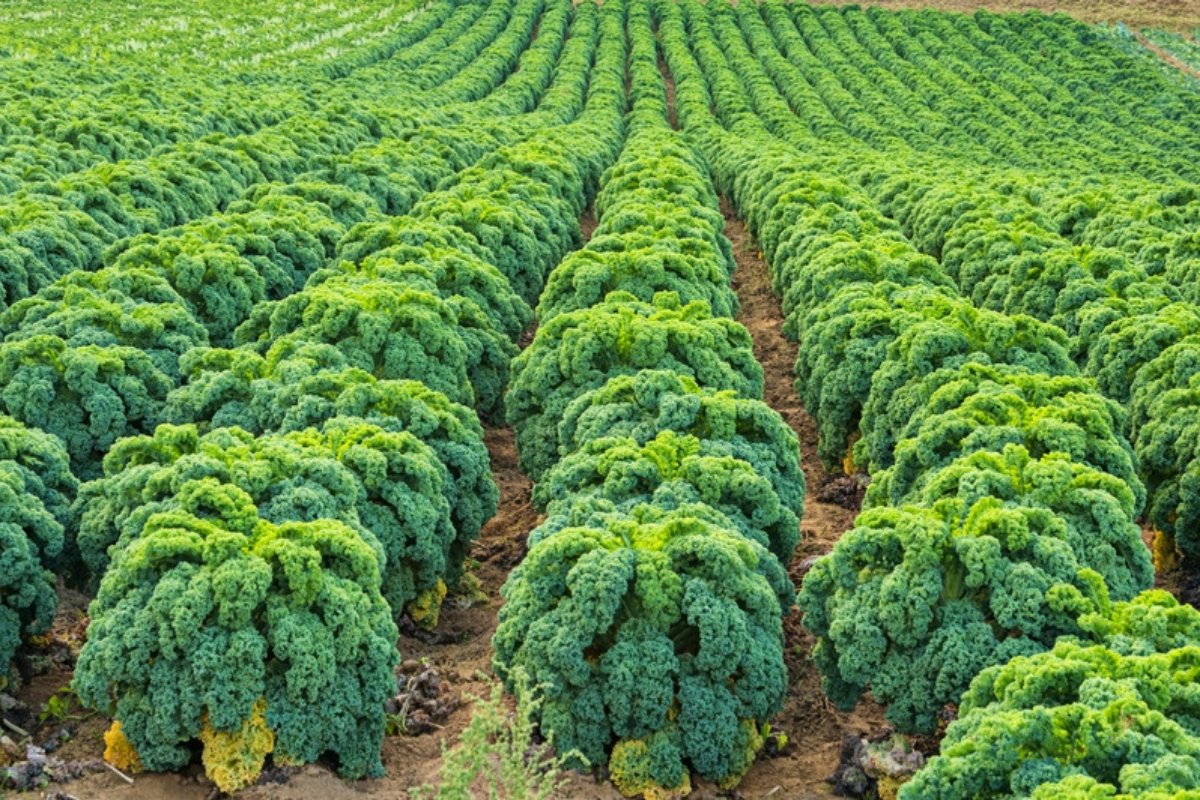
Kale is a cool-season leafy vegetable that, in Mediterranean regions, is grown mainly from autumn to spring, either from transplants or by direct seeding. In the field, rows are usually 60 to 90 cm apart, and plants are 20 to 40 cm apart within the row. The crop is harvested in successive pickings, 2 to 4 times over 4 months, or weekly when demand is high. According to Oregon State University, leaf yield can reach about 45 tonnes per hectare. The product is highly perishable and keeps 10 to 14 days at 0°C, so cooling immediately after harvest is essential. This guide covers kale's place in the market, the product types, climate and soil, crop establishment, fertilisation, irrigation, crop protection, harvest and yields.
Kale in the market
Kale, long a traditional vegetable in Greek and other Mediterranean home gardens, has returned to the market in recent years as a health food. In many markets, including Greece, it is not yet a mass-consumption vegetable, so sales need to be planned before planting. Likely buyers include restaurants, organic shops, farmers' markets, supermarket chains and prepared-salad companies, and securing an agreement before sowing reduces the risk.
According to the Royal Botanic Gardens, Kew, the Acephala Group of Brassica oleracea also includes ornamental varieties with coloured leaves and fodder varieties grown for livestock, so kale has commercial uses beyond the fresh market.
Product types
| Product | What is harvested | Establishment |
|---|---|---|
| Bunches | Mature leaves in bunches of 4 to 8 leaves, about 450 g each | Transplants in rows at standard spacing |
| Stripped leaves | Leaves without the central rib, pre-packaged for retail | Transplants in rows |
| Baby leaf | Young leaves for salad | Dense direct seeding |
For growers starting, bunches are the simplest route, because they need no packing equipment. Baby leaf requires dense sowing and a short cycle, and is aimed mainly at prepared salad companies. Controlled-environment systems are also being explored for baby leaf, as research on the economics of vertically farmed baby kale shows.
Varieties
Variety choice follows the market. Curly varieties are the most familiar to consumers. Lacinato or Tuscan kale, also called cavolo nero, is favoured by chefs, and Red Russian, with tender leaves and reddish stems, also suits baby leaf. For winter production, choose varieties that are cold-hardy and slow to bolt.
Climate and soil
Kale is at its best when it grows quickly and matures before temperatures exceed about 24°C, or after the first autumn frosts, which improve its flavour. Young plants survive down to −4°C without serious damage, mature plants are extremely hardy, and growth continues down to about −7°C. Heat, on the other hand, slows growth and makes the leaves bitter.
The ideal soil is fertile, well-drained, and rich in organic matter, with a pH of 6 to 7.5; the crop tolerates slightly alkaline soils. To limit pests and diseases, kale and other brassicas do not return to the same field for three to four years.
Crop establishment
Kale is established mainly from transplants, raised in trays for 4 to 6 weeks and planted out at 10 to 15 cm tall. The seed is sown about 1 cm deep. For direct seeding, the seed rate is about 3.4 to 5.6 kg per hectare, and plants are then thinned to their final spacing.
- Spacing for bunches: 60 to 90 cm between rows and 20 to 40 cm within the row. Greek cultivation guides often cite 40 to 50 cm between plants and 60 to 70 cm between rows
- For hand harvesting: single rows 75 to 90 cm apart, allowing workers to move through the crop
- For baby leaf: very dense sowing, which for brassica greens corresponds to about 160 to 250 seeds per square metre, depending on the system and product
Fertilisation
Kale needs fast, continuous growth for good quality, and above all, nitrogen, on which leaf colour and tenderness depend. As a guide, recommendations for the base dressing cite about 67 kg of nitrogen per hectare, and up to 67 kg of P₂O₅ and 224 kg of K₂O per hectare depending on the soil test. Once transplants are established, a side-dressing of 34 to 67 kg of nitrogen per hectare follows. Because harvest runs for months, a supplementary nitrogen dose after each heavy picking supports regrowth. Excess nitrogen, however, makes plants more vulnerable to disease and aphids, and rotted manure before planting covers much of the requirement.
Irrigation
Kale needs steady soil moisture, and drip irrigation is the most suitable system because it keeps the foliage dry. The crop tolerates short droughts, but leaf quality and flavour then suffer, and the leaves become tough and bitter. Excess moisture, on the other hand, causes root rot and favours fungal disease. In winter, with slow growth and rainfall, water needs drop considerably.
Crop protection
As a brassica, kale is attacked by a range of pests and diseases:
- Cabbage white caterpillars: the most important pest, eating the leaves and lowering their market value. Controlled with insect mesh on young plants and registered products, such as those based on Bacillus thuringiensis
- Aphids and whitefly: colonies on the undersides of leaves that contaminate the produce and make it unmarketable
- Flea beetles: small beetles that pepper the leaves of young plants with holes in the first weeks after transplanting
- Stink bugs and slugs: especially in humid conditions and on young plants
- Downy mildew and Alternaria: yellowing and dark spots on the leaves under high humidity
Prevention rests on rotation, proper spacing, root irrigation, and regular scouting. Where treatment is needed, use only products registered for kale in your country after an agronomist's diagnosis, and strictly observe the pre-harvest interval, which is particularly important in a crop picked every few weeks. Protecting beneficial insects keeps aphid populations low.
Harvest and cooling
Harvest begins about 60 to 80 days after planting, once the leaves reach marketable size, and is done by hand, starting at the lowest leaves and working upward, without cutting the growing tip. According to Oregon State University, kale is usually harvested 2 to 4 times over 4 months, or weekly when demand is high, and a skilled worker can harvest and bunch about 4 boxes an hour.
At packing, yellow and damaged leaves are removed. Bunches hold 4 to 8 leaves, about 450 g each, and are usually packed in boxes of 12 or 24 bunches, weighing 10.4 to 10.9 kg with 24 bunches. Because the leaves are highly perishable, they are cooled as close to 0°C as possible, where they can be kept for 10 to 14 days.
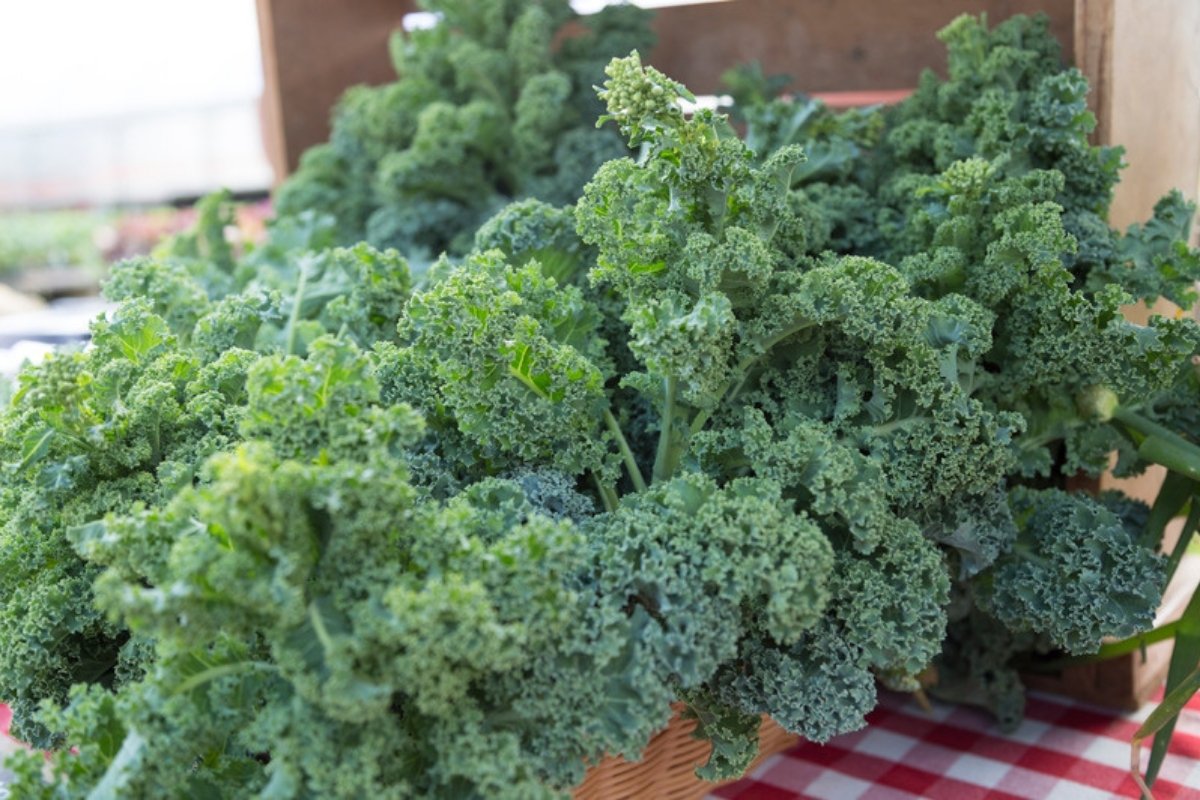
Kale leaves are highly perishable and keep 10 to 14 days at 0°C, so they are cooled right after harvest.
Yields
According to Oregon State University, kale leaf yield can reach about 45 tonnes per hectare, or roughly 95,000 bunches of 450 g. Actual yield depends on variety, the length of the harvest period, the number of pickings and market demand, because kale is usually harvested to order.
Frequently asked questions
What is the yield of kale per hectare?
According to Oregon State University, leaf yield can reach about 45 tonnes per hectare, or roughly 95,000 bunches of 450 g. Yield depends on the variety and on the number and timing of pickings.
What spacing is used for commercial kale?
Usually, 60 to 90 cm between rows and 20 to 40 cm within the row for bunching kale. For baby leaf, sowing is very dense.
How many times can kale be harvested?
Usually 2 to 4 times over 4 months, or weekly when demand is high. The lower leaves are picked and the growing tip is left, so the plant keeps producing.
How long does kale keep after harvest?
At 0°C, 10 to 14 days. Because it is highly perishable, it should be cooled as quickly as possible after harvest.
What fertiliser does kale need?
Mainly nitrogen, with about 67 kg per hectare in the base dressing and 34 to 67 kg as a side-dressing after establishment, as a guide. Phosphorus and potassium follow the soil test.
Is commercial kale production profitable?
It can be, but in many markets, kale is not yet a mass-consumption vegetable, so sales should be secured before planting, for example, with restaurants, organic markets or prepared salad companies.
Important notes
Spacing, seed rates, and fertilisation are adapted to the variety, soil, and the product the market demands, and treatment timing follows local plant protection guidance.
Use only products registered for kale in your country, follow the label and the pre-harvest interval, and apply cultural measures first. For serious or persistent problems, consult a local agronomist for an accurate diagnosis.
References
- Oregon State University, Collards and kale.
- Oklahoma State University Extension, Cool season greens production.
- NC State Extension, Kale.
- Rupp Seeds, Kale.
- The Old Farmer's Almanac, Kale, planting, growing and harvesting.
- Royal Botanic Gardens Kew, Brassica oleracea L., Plants of the World Online.