When cocoa reached a record near USD 9.7/kg in 2024, the price of a chocolate bar in Europe barely moved, and the farmers who grew the beans saw little of the windfall. That gap is the subject of the second half of FAO's study on beverage prices, which follows a price shock from the world market down to the farm and up to the shop. The finding is consistent across coffee, cocoa and tea. Global price shocks pass along the chain incompletely, with a delay, and unevenly, so growers and shoppers at the two ends of the chain experience the same shock very differently.
The reason is structural. A long chain runs from a coffee or cocoa tree to a supermarket shelf, and each stage adds cost and takes a margin. By the time a price change at origin works its way through trading, processing, manufacturing and retail, most of it has been absorbed, so the two ends of the chain feel a world price shock in opposite and unequal ways.
Key takeaways
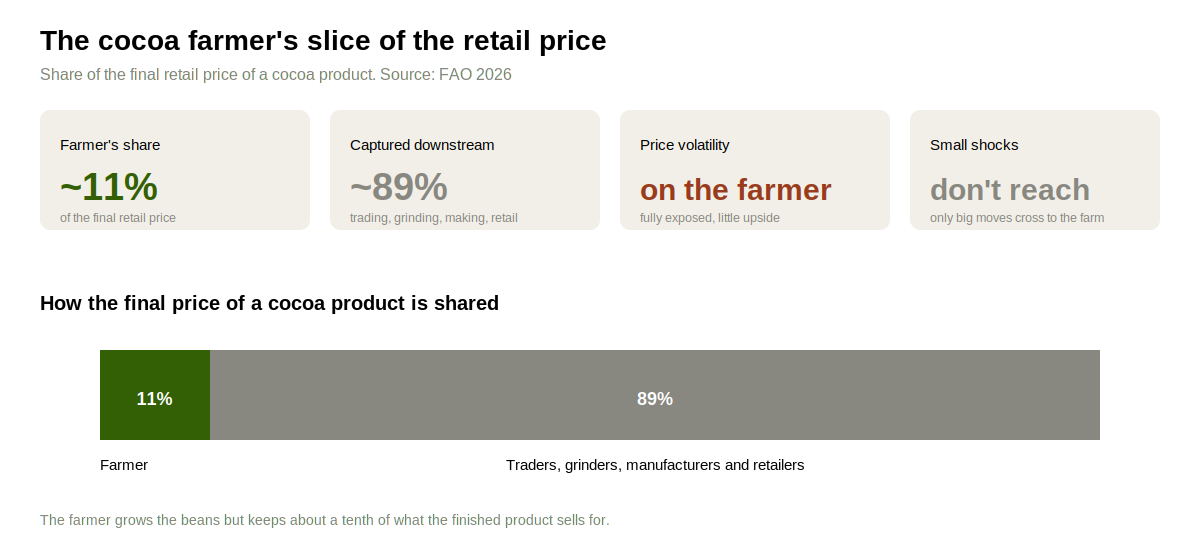
- Farmers keep a small slice. Cocoa growers receive, on average, about 11% of the final retail price of a cocoa product.
- Producers carry the volatility. They are fully exposed to swings in the world price while capturing little of a boom.
- Shoppers barely notice. The raw bean is a small part of a retail price, so even a large move on the world market shows up as a small change on the shelf.
- Rises travel faster than falls. Price increases reach consumers quickly and fully, while decreases arrive slowly and only in part.
- Market structure decides the split. Liberalised markets pass prices through promptly, while administered systems and downstream concentration hold the change back.
The farmer's share is smaller than it looks
Cocoa farmers receive, on average, about 11% of the final retail price of a cocoa product, according to a study cited in the report. The rest is captured downstream, by the traders, grinders, manufacturers and retailers who turn beans into chocolate. That imbalance leaves growers heavily exposed to swings in the world price while limiting how much they gain when prices climb. The upward pass-through is also incomplete, because transaction costs and market frictions mean small price changes never reach the farm, and producer prices tend to move only when a shock is large enough to be worth acting on.
Why your chocolate bar barely moved
At the other end of the chain, the raw bean is only a small part of what a shopper pays. Once processing, transport, branding and retail margins are added, the cost of the cocoa or coffee itself becomes a minor share of the final price, so even a large move on the world market shows up as a small change at the till. The report finds that the 2023 to 2024 cocoa surge did reach chocolate retail prices in the European Union, the largest consuming market, but with a very limited effect. Highly integrated chocolate companies, which own several stages of the chain, pass through even less, because they can absorb or smooth a cost increase internally.
Prices rise like rockets and fall like feathers
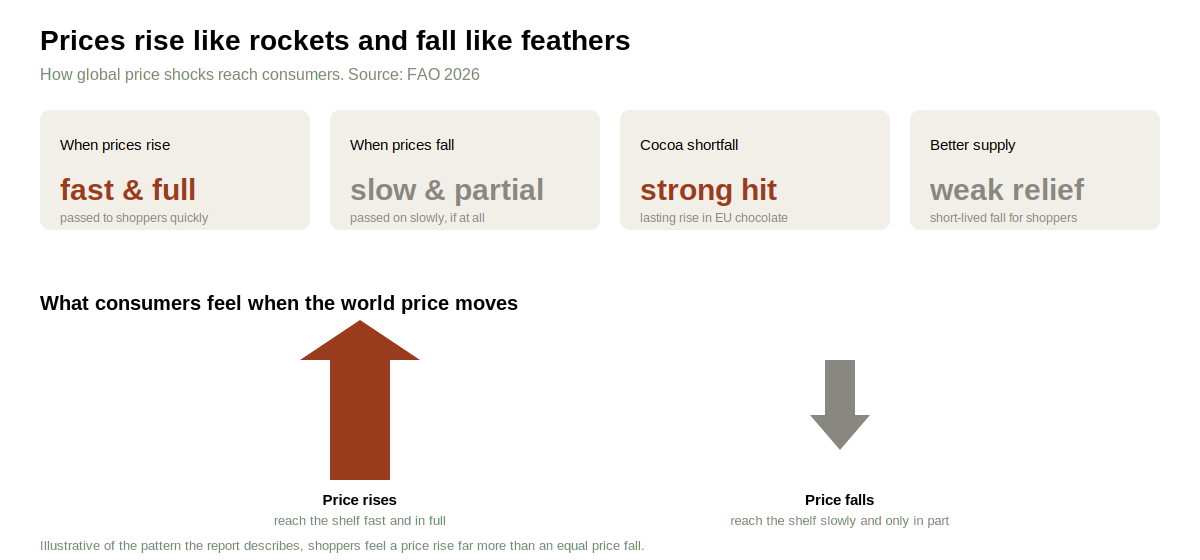
The pass-through that consumers do feel is asymmetric. Price increases travel to the shelf quickly and fully, while price decreases arrive slowly and only in part, a pattern economists call the rockets and feathers effect. In the cocoa market it is clear. A shortfall that pushes world prices up transmits strongly and persistently to consumer prices, whereas an improvement in supply that should pull them down transmits weakly and briefly. The shopper feels the bad news far more than the good.
What decides how much reaches the farm
How much of a world price change reaches a grower depends on how their market is organised. Where the sector is liberalised, farm-gate prices track the international market fairly promptly. Where prices are set administratively, as they are for cocoa in Côte d'Ivoire and Ghana through their marketing boards, short-run pass-through is limited by design, which shields farmers from crashes but also holds them back when prices rise. The two countries created the Living Income Differential, a fixed premium added to the export price, to lift farm-gate earnings and protect growers' livelihoods. Fragmented supply chains, weak infrastructure, high transaction costs and little competition at the farm gate all reduce how much of a price move a farmer ever sees, while concentration among processors and retailers dampens what reaches the consumer.
What would share the gains more fairly
The report's answer is to help producers keep more of the value rather than only chase a higher world price. That means moving into higher-value activities such as quality upgrading, certification, local processing and branding, so more of the final price stays in the producing country. Stronger producer organisations, better access to finance, and public and private investment are what let smallholders take those steps. Clearer market information and steadier trade policy also make the price signals that do travel more reliable, so the chain works better for the people at both ends of it.