Organic farming allows only inputs that meet specific criteria, and biostimulants are no exception. A label reading "natural" or "of biological origin" is not in itself proof of eligibility. That is decided by the regulatory framework, the composition of the product, and the certification of the production process.
What defines eligibility
A biostimulant is allowed in organic farming when its ingredients are among the authorised inputs of Implementing Regulation (EU) 2021/1165, which sets out the products and substances permitted in organic production under Regulation (EU) 2018/848. Annex II of the implementing regulation lists the fertilisers, soil conditioners, and nutrients that may be used.
Beyond natural origin, what counts is the absence of non-permitted substances and the exclusion of genetically modified organisms. The final confirmation does not come from label claims but from the holding's certification body, and every input is recorded in the farm's documentation.
Which types are used
Organic farming draws on five main categories, each acting in a different way. Seaweed extracts strengthen tolerance to drought and high temperatures and carry natural regulatory molecules. Plant-derived protein hydrolysates and amino acids supply nitrogen in organic form and support the plant during stress. Microbial biostimulants, with mycorrhizae and rhizobacteria, improve the uptake of phosphorus and water and the activity of the root. Humic and fulvic acids act on soil structure, cation exchange capacity, and micronutrient availability. Finally, chitosan combines the stimulation of growth with the activation of the plant's defence.
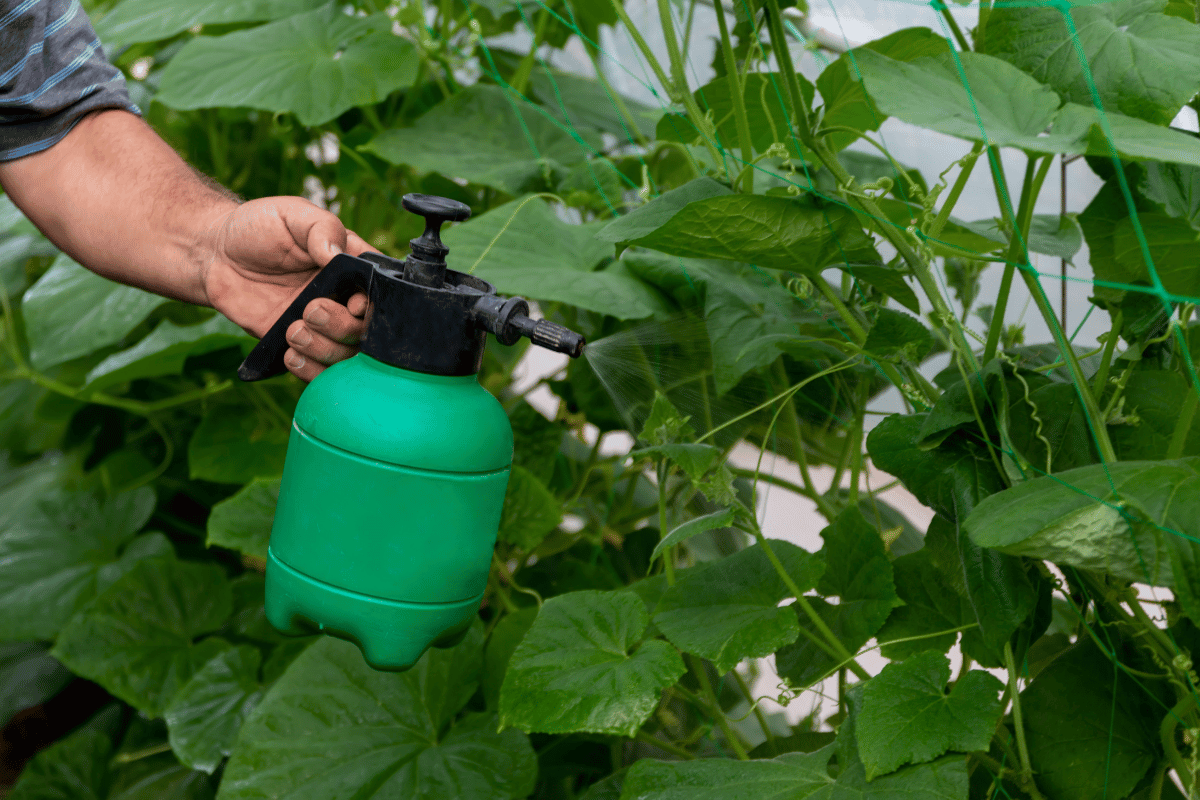
Biostimulants used in organic farming are applied as a foliar spray or through irrigation.
The role of chitosan
Chitosan is derived from chitin, the polysaccharide of the exoskeleton of crustaceans and the cell walls of some fungi, through partial deacetylation. It acts as a biostimulant and elicitor, activating the plant's defence mechanisms and regulating metabolic processes. This activation primes the plant to respond faster to future attacks, with the accumulation of phytoalexins and defence-related proteins.
At the same time, chitosan supports growth and improves tolerance to stress conditions, such as drought and salinity, by strengthening the antioxidant system, through mechanisms that resemble those of beneficial rhizobacteria. Its activity depends on molecular weight and degree of deacetylation, with the shorter oligomeric fractions being more soluble and active at lower concentrations. It is applied as a foliar spray, to the seed, or to the soil.
Whether a product is suitable for organic farming is ultimately confirmed by the label and by the holding's certification body. Which product suits each crop is covered in our guide on choosing a biostimulant for your crop, and how to match fertiliser rates to the crop in our guide on choosing NPK fertilizers by crop.
Sources
- Implementing Regulation (EU) 2021/1165 authorising products and substances for use in organic production.
- Regulation (EU) 2018/848 on organic production and labelling of organic products.
- Protective, biostimulating, and eliciting effects of chitosan and its derivatives on crop plants, Molecules.
- Effects of chitosan on plant growth under stress conditions, Frontiers in Plant Science.