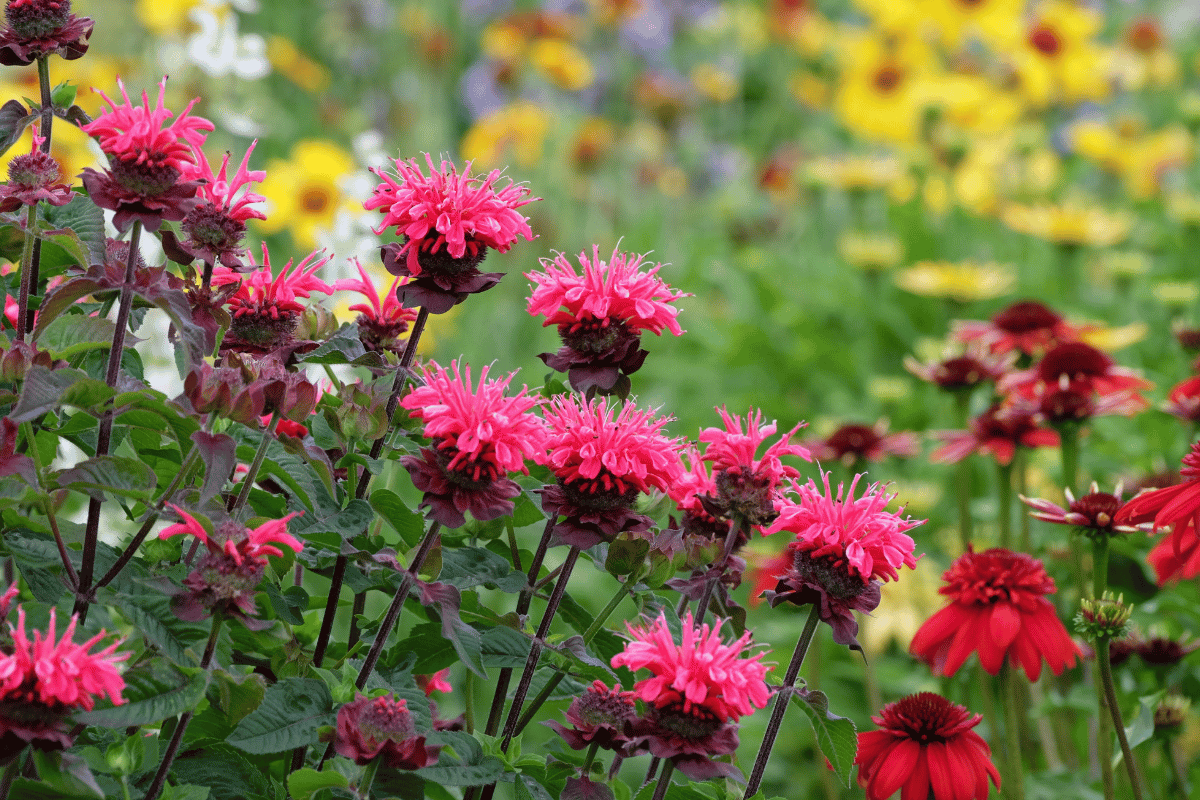
Bee balm is one of the best plants you can grow for pollinators, a native North American perennial whose shaggy, nectar-rich flowers pull in bees, butterflies and hummingbirds all through midsummer. It is easy to grow, comes back bigger every year, and its aromatic leaves can even be brewed into a herbal tea. This guide covers how to grow and care for bee balm, from planting and pollinators to the one problem that defines it, powdery mildew.
Bee balm belongs to the genus Monarda in the mint family, and like other mints it has square stems, fragrant foliage and a tendency to spread. There are several species and many cultivars, so it helps to know what you are growing before deciding where to put it.
What is bee balm
Bee balm (Monarda) is a clump-forming perennial native to North America, with tubular flowers arranged in shaggy whorls on top of upright, square stems. The two most commonly grown species are scarlet bee balm (Monarda didyma), with bright red flowers, and wild bergamot (Monarda fistulosa), with lavender-pink flowers, while cultivars add pink, purple and white to the range. Plants usually grow 60 cm to 1.2 m tall and flower in shades that reliably draw hummingbirds.
The plant carries a few confusing names. It is called bergamot because its scent resembles the bergamot orange, but it is not the source of the bergamot flavour in Earl Grey tea, which comes from the citrus fruit. It is also called Oswego tea, after the Oswego people of New York who brewed its leaves, a use taken up by colonists when imported tea was scarce. The name bee balm itself comes from the old use of its crushed leaves to soothe bee stings.
Where and when to plant bee balm
Plant bee balm in full sun, meaning at least six hours a day, for the most flowers and the healthiest growth. It tolerates part shade, which can help in hot summer climates, but in too much shade, it produces fewer flowers, grows floppy and is more prone to disease. It is hardy in most temperate gardens and grows well in USDA zones 4 to 9.
Set plants out in spring or autumn in moist, well-drained soil enriched with compost, and space them well apart, around 45 to 60 cm, so air moves freely between them. Generous spacing is not just about room to grow, it is the first line of defence against the powdery mildew that bee balm is so prone to.
Watering, soil and feeding
Bee balm likes soil that stays evenly moist but drains freely, and it tolerates clay. Keeping the soil from drying out is important because drought stress is one of the main triggers for powdery mildew, so water in dry spells rather than letting the plant wilt. A mulch around the base helps hold moisture.
Bee balm needs very little feeding, and too much is counterproductive. Rich nitrogen feeding pushes soft leafy growth at the expense of flowers and makes the plant more disease-prone, so at most give a light dressing of balanced fertiliser or compost in spring and leave it at that.
When does bee balm bloom and deadheading
Bee balm flowers from early to midsummer, roughly June and July, and the display lasts for several weeks. Deadheading, removing spent flower heads as they fade, encourages a second flush of blooms later in the season and keeps the plant looking tidy. Cutting the whole plant back after its main flush can also prompt fresh growth. Towards the end of the season, you can leave some seedheads standing, since birds such as goldfinches feed on them.
Powdery mildew is the defining problem
Powdery mildew is the issue that troubles bee balm more than any other, showing up as a white, dusty coating on the leaves in mid to late summer, which then yellow and die back. It rarely kills an established plant but it spoils its looks and weakens it. Prevention comes down to a few things done together. Grow bee balm in full sun with plenty of space and airflow, thin out crowded stems in spring, keep the soil evenly moist so the plant is never drought-stressed, and clear away affected foliage in autumn so the disease does not overwinter.
The single most effective step is to choose a mildew-resistant variety. Among the best known are the red 'Jacob Cline' and the pink 'Marshall's Delight', both tall and highly resistant, while the compact Balmy and Petite series give resistance on shorter plants for the front of a border.
Is bee balm a perennial
Bee balm is a hardy perennial that dies back to the ground each winter and returns from the roots in spring. Like other mints it spreads outward by underground runners, and in rich, moist soil it can spread aggressively and crowd its neighbours. To keep it healthy and in bounds, lift and divide the clump every two to three years in spring, replanting the vigorous outer sections and discarding the woody centre. Dividing also improves airflow through the clump and gives you free plants to spread around the garden. It pairs well in a border with other summer perennials such as peonies.
Bee balm for pollinators
Few garden plants work harder for wildlife. The tubular flowers are built for long-tongued visitors, so bee balm is a particular favourite of hummingbirds and hummingbird moths, alongside bumblebees, native bees and butterflies, which makes it central to any pollinator-friendly garden. Because native bees nest inside the dead, hollow stems, it is worth leaving some stems standing over winter and cutting them back only in late spring.
Bee balm is also edible. The leaves and flowers have a minty, faintly oregano-like flavour, the flowers make a colourful garnish, and the dried leaves brew into the herbal Oswego tea that gave the plant one of its names. It is not toxic to people or pets, and deer and rabbits tend to leave it alone thanks to its strong scent.
Frequently asked questions
Is bee balm a perennial? Yes. It is a hardy perennial that dies back in winter and regrows from the roots each spring, spreading by runners as it goes.
When does bee balm bloom? From early to midsummer, usually June and July, for several weeks, with deadheading encouraging a later second flush.
How do I stop bee balm getting powdery mildew? Grow it in full sun with good spacing and airflow, keep the soil evenly moist, thin crowded stems, and choose a mildew-resistant variety such as 'Jacob Cline' or 'Marshall's Delight'.
Does bee balm attract hummingbirds? Yes. Its tubular flowers, especially the red ones, are especially attractive to hummingbirds, as well as for bees and butterflies.
Can you make tea from bee balm? Yes. The leaves and flowers are edible and the dried leaves make the herbal Oswego tea, with a minty, citrusy flavour.
Important notes
Every garden is different, and conditions vary with your climate, soil and how much sun the spot receives. The guidance above is a general starting point rather than a strict rule.
Because bee balm spreads by runners, give it room or plan to divide it regularly so it does not overwhelm smaller neighbours. If plants show persistent problems that don't respond to better spacing and watering, it's worth consulting a horticulturist or your local nursery, and where any treatment is needed, try non-chemical methods first.
References
- NC State Extension. Monarda didyma.
- The Old Farmer's Almanac. Bee balm.
- Lady Bird Johnson Wildflower Center. Monarda didyma.