When we picture hexagons in nature, the honeycomb built by bees is usually the first thing that comes to mind. But why are these cells hexagonal rather than round or square? The short answer is efficiency, though the fuller explanation lies in a combination of bee behaviour, physical forces, and evolutionary pressure. This article examines the structure of honeycomb cells from both biological and engineering perspectives.
How bees build the comb
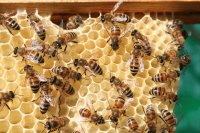
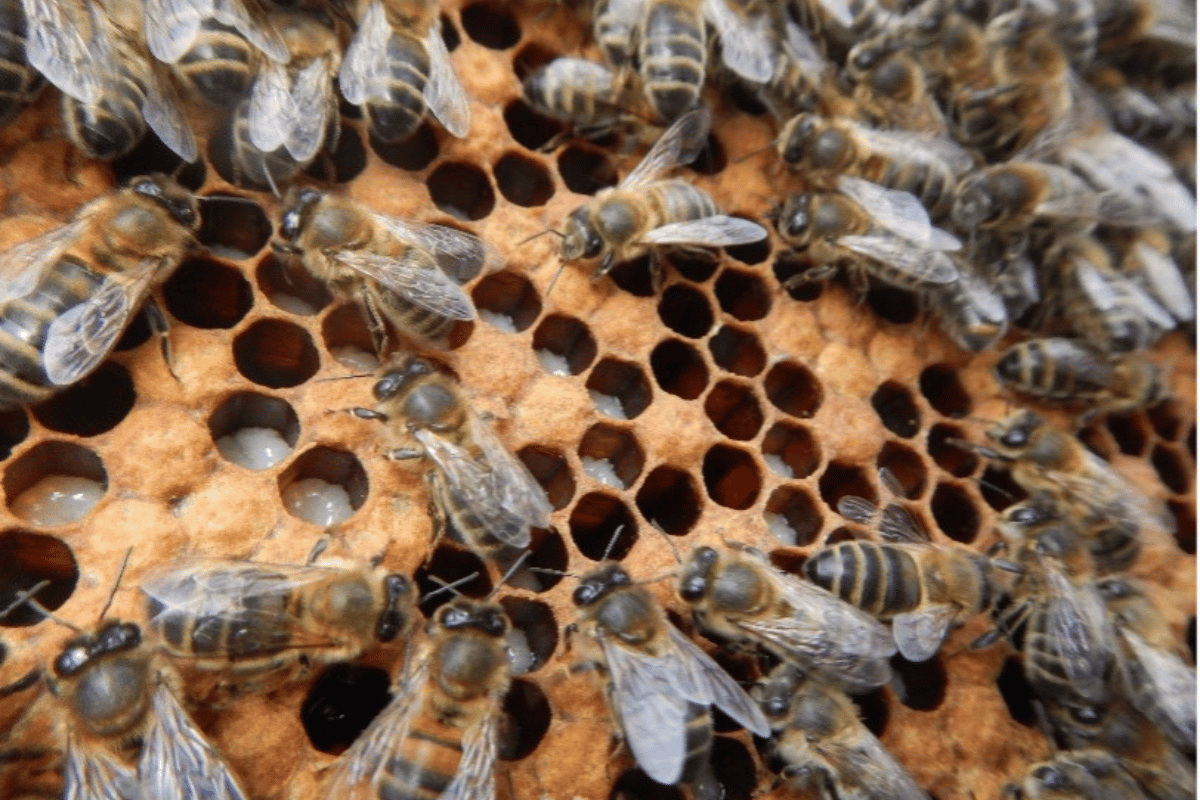
The honeycomb cell is the basic building unit of a bee colony. Worker bees store honey and pollen in these cells, and the queen lays eggs in others, where the larvae grow. Young worker bees have glands on the underside of their abdomens that secrete beeswax for building the walls. The wax emerges soft and firms up into thin scales as it meets the air, and the bees then chew it, mix in salivary secretions, and shape it into cells.
This is an energy-intensive process. To produce one kilogram of beeswax, worker bees consume roughly eight kilograms of honey. To keep the wax workable while they build, bees hold the hive between about 33°C and 36°C.
The geometry behind the hexagon
The goal is tessellation: a repeating pattern of shapes that covers a surface completely, with no gaps or overlaps. Circles placed side by side leave empty spaces and waste room. Squares and triangles tessellate cleanly, but they are less efficient with perimeter, requiring more wall length to enclose the same usable area. The hexagon is the best compromise, enclosing a large area with a short perimeter and no gaps. Because two neighbouring cells share a wall, a single wax partition serves both, saving even more material.
The honeycomb conjecture, proved by the mathematician Thomas Hales in 1999, confirms that a hexagonal grid is the most efficient way to divide a surface into regions of equal area. Bees, of course, do not calculate the angles. The hexagon emerges on its own as adjacent cells meet and the still-soft walls settle toward the balanced 120° junctions favoured by surface tension, much as soap bubbles do when they meet.
Efficiency and energy saving
Wax is far from a free material. It is the end of a long chain that runs from nectar collection through processing, storage, and the consumption of honey to produce the nutrients that become wax. Using that wax sparingly lets the colony put the energy it saves toward regulating the hive and keeping the bees healthy. The hexagonal structure also spreads mechanical load across the entire comb rather than concentrating stress in one place, making it stronger and cheaper to build.
Are bees mathematicians?
Bees have a real, tested aptitude for number. Beyond the instinctive geometry of comb-building, controlled experiments have shown that honeybees can grasp addition, subtraction, and even the concept of zero, which few animals can do. Their waggle dance, performed for nestmates, encodes both the direction and the distance of a food source from the hive. None of this means a bee plans a hexagon on purpose. It means the behaviour and physiology that produce the comb sit alongside a genuine, if narrow, numerical sense.
Why comb geometry matters for beekeeping
For a beekeeper, comb geometry connects directly to colony performance. Good, well-built comb means more room for honey, pollen, and brood, while damaged or overheated comb reduces usable storage and makes the colony harder to manage.
This is why modern beekeepers often give their hives an artificial comb foundation, a sheet of wax or plastic embossed with the hexagonal cell bases. The sheet gives the bees a ready template to build on, saving them time, energy, and nutrients, and keeping comb building in a straight, workable direction.
Hexagons turn up all around us, from ordinary pencils to the panels of a classic football to honeycomb-pattern storage bins. The shape is not only attractive, it is a genuine compromise between storage capacity and strength. Bees do not solve that engineering problem consciously. It falls out of how they build and of the physics of the wax itself.
Sources
The honeycomb conjecture, proved by Thomas C. Hales (1999).
Howard, S. R., et al. (2019). Numerical cognition in honeybees enables addition and subtraction. Science Advances, 5(2).
Food and Agriculture Organization. Production and trade of beeswax.