
Greek growers call it kolla, glue, or kapna, soot, after the honeydew it leaves on the bunches and the sooty mould that grows on it. Vine mealybug, Planococcus ficus, causes serious damage mainly in table grapes. After harvest, while the leaves are still on the vine, a spray is recommended in infested vineyards to cut the population before it retreats to the roots and under the bark for the winter. That treatment, together with checks the following spring, largely decides how many insects reach next year's bunches.
How to recognise vine mealybug on the vine
Adult females are about 3 mm long with a pinkish body visible through a white, mealy wax. The wax filaments around the body are short, and the species has no long tail filaments, which separates it from Pseudococcus mealybugs. Because more than one mealybug species can infest grapevines and their management differs, the species should be confirmed by an agronomist before a programme is set.
The female is wingless and barely moves, while only the male flies. It forms small colonies and lays 200 to 400 eggs in cottony masses, so white cottony tufts in trunk forks, under loose bark and between berries are the first thing to look for in the vineyard.
Where it overwinters and how it moves up the vine
Vine mealybug overwinters under the bark, on the trunk and mainly in the forks of the vine, and even in the soil. In spring, it moves up into the new growth, and in summer, it gathers mostly on the bunches, favouring damp, shaded spots because it avoids light. In Cretan conditions, it completes three to four overlapping generations a year.
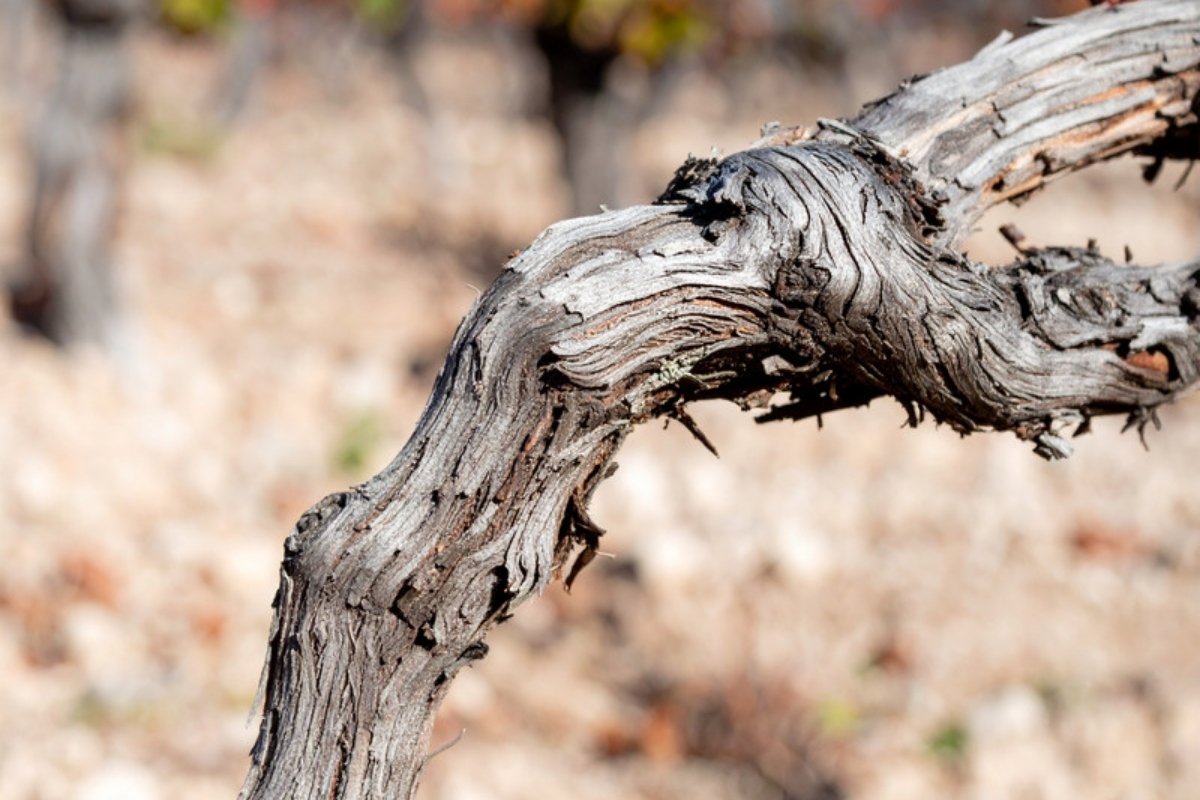
Loose bark and trunk forks give vine mealybug shelter over the winter, so they are the first places to check in spring.
In warmer regions it can reach five to seven generations, and in sandy soils it overwinters almost exclusively on the roots. Ants carry mealybugs from the roots to the aboveground parts of the vine and tend them for the rest of the season, which is also why heavy ant traffic on a vine usually shows where the colonies are.
What damage does it causes to bunches and vines
Honeydew builds up on the bunches, leaves and shoots, and sooty mould grows on it. Raisin grapes dry poorly, wine grapes lose quality when sooty mould develops before harvest, and table grapes become unsaleable. In heavy infestations without ants, honeydew can be so abundant that it looks like melted candle wax, and the insects themselves inside the bunches make them unfit to eat.
Vine mealybug also transmits grapevine leafroll-associated virus 3 (GLRaV-3), and because an infected vine cannot be cured, the pest matters economically even at low densities. As the insect moves through the vineyard, it carries the virus from vine to vine.
Why a post-harvest spray reduces next year's population
In infested vineyards of central Greece, one spray with an approved insecticide is recommended with full coverage of the foliage and the trunk. Where the infestation is not widespread, only the infested vines are sprayed, and they are marked so they can be checked closely from the start of the next growing season.
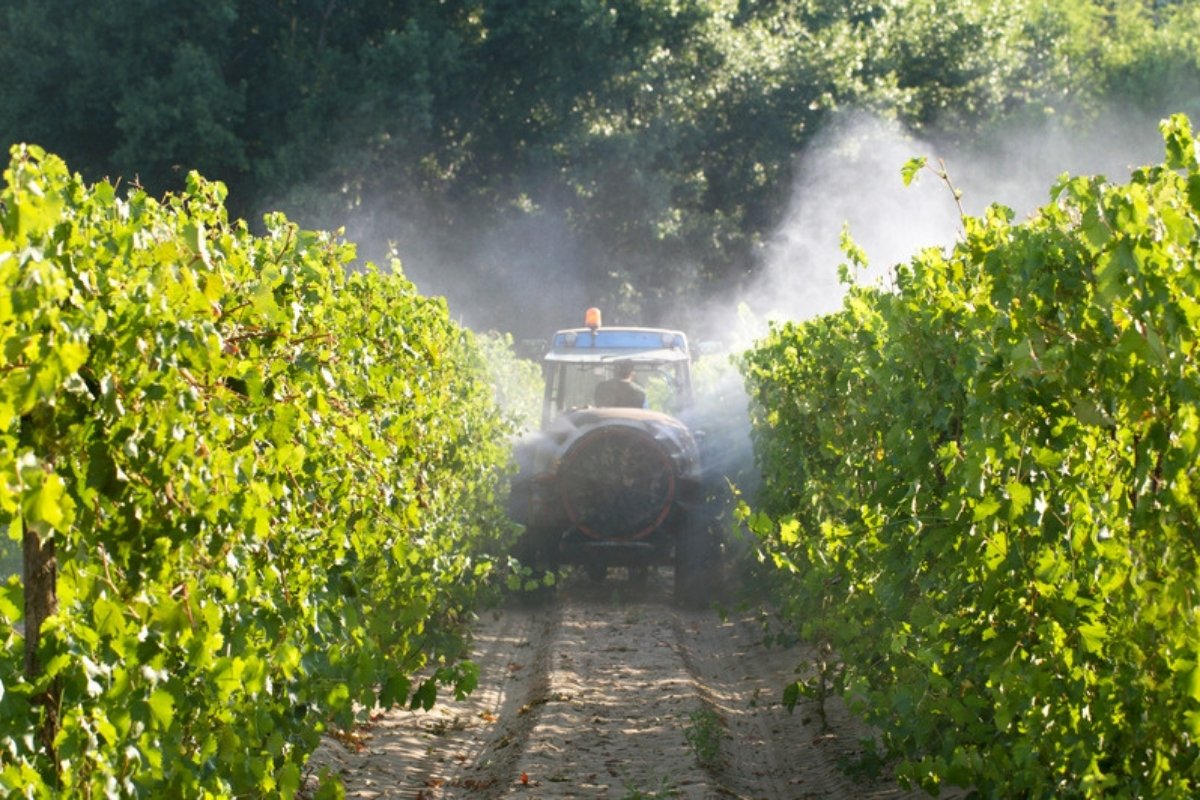
In infested vineyards, one post-harvest spray that fully covers the foliage and trunk is recommended.
Marking takes place at the same time as flagging vines with trunk diseases, so post-harvest sprays in the vineyard and the copper spray against downy mildew can be combined into a single pass through the vineyard.
Insecticides are selected from products authorised for grapevine in the national register, which in Greece is the plant protection product database of the Ministry of Rural Development and Food, and repeat treatments rotate through IRAC mode-of-action groups.
The parasitoid Anagyrus pseudococci is also active at the end of the season, and in California vineyards it reached up to 90% parasitism of exposed mealybugs after harvest, before they returned to the roots. A spray with a selective product leaves room for this natural enemy to reduce the overwintering population.
When to control the population the following spring
Chemical control is difficult because the insect spends much of its life in sheltered spots under the bark. The best timing is when the population moves onto the new growth and the bunches, which usually coincides with fruit set and with bunch closure, respectively. In contrast, after bunch closure, control becomes very difficult. Reducing the spring population is essential for keeping the summer generations that damage the bunches in check.
Checks start early, on the vines marked in autumn and around them, since colonies usually reappear where they were in previous years. On the trunk and at the base of the vine, growers look for adult females and crawlers moving up, while pheromone traps for males show whether the pest is present in or near the vineyard.
Which natural enemies and soft methods help
Vine mealybug has many natural enemies, from egg predators of the family Cecidomyiidae to the mealybug destroyer, Cryptolaemus montrouzieri, and the parasitoids Anagyrus pseudococci, Leptomastidea abnormis, Leptomastix flavus, and Leptomastix dactylopii. Its outbreaks in many table grape vineyards are attributed to a disrupted biological balance caused by indiscriminate pesticide use, so protecting natural enemies should be part of every programme.
Mating disruption targets the males, and since females cannot fly, the method can be very effective. It works best over large areas and when populations are already low, so in the first year, it is usually combined with an insecticide to bring numbers down.
In organic vineyards, repeated applications of oils approved for organic production suppress vine mealybug in wine and raisin grapes. Still, they are not used on table grapes because they affect berry appearance. Combining oils with sulfur requires caution due to the risk of phytotoxicity.
How to stop it spreading between vineyards
Vine mealybug is carried by wind, tools, workers' clothes and harvest and packing equipment, and it moves to neighbouring vines along the trellis wires and through canes that touch each other.
Machinery is cleaned before moving to clean vineyards, and stems and pomace are not spread in the field. Pomace piles are covered with clear plastic for several weeks, and vine pruning avoids leaving bunches hanging directly on the cordon, which reduces bunch infestation.
Frequently asked questions
What is the sticky residue on grape bunches?
It is the honeydew of vine mealybug, Planococcus ficus, which builds up on the bunches, leaves and shoots. Sooty mould then grows on it, blackening the bunches.
When should the vine mealybug be sprayed?
In spring, when the population moves onto the new growth at fruit set and before bunch closure, and after harvest in infested vineyards, with full coverage of foliage and trunk, before the insect retreats for the winter.
Does the vine mealybug spread viruses?
Yes. It is a vector of grapevine leafroll-associated virus 3, which is why its presence matters even at low densities.
Why are there ants on vines with mealybugs
Ants live alongside the mealybug and feed on its honeydew. Heavy ant activity helps locate the colonies.
Where does the vine mealybug spend the winter?
Under the bark, on the trunk and mainly in the forks of the vine, and in sandy soils almost exclusively on the roots.
Does mating disruption work against the vine mealybug
Yes, because it targets males and females who cannot fly. It works best over large areas and at low population levels, so heavy infestations are first reduced with an insecticide.
Important notes
Conditions vary by region, variety, soil type and year, so the above is a general guide and a starting point for checking the vineyard. For heavy or persistent infestations, an agronomist should be consulted to confirm the species and plan treatments.
Non-chemical methods come first, meaning vineyard hygiene, proper pruning, and the protection of natural enemies. When chemical control is needed, use only products authorised for grapevine and follow the label instructions.
Sources
- Regional Centre for Plant Protection, Quality and Phytosanitary Control of Volos, Grapevine pests and diseases, post-harvest treatments, Bulletin No 16, 23 September 2026 (in Greek).
- Regional Centre for Plant Protection, Quality and Phytosanitary Control of Heraklion, Vine mealybug, Planococcus ficus, 3rd edition, May 2022 (in Greek).
- UC Statewide IPM Program, Vine mealybug.
- Insecticidal activity of plant essential oils against the vine mealybug, Planococcus ficus, Journal of Insect Science.