
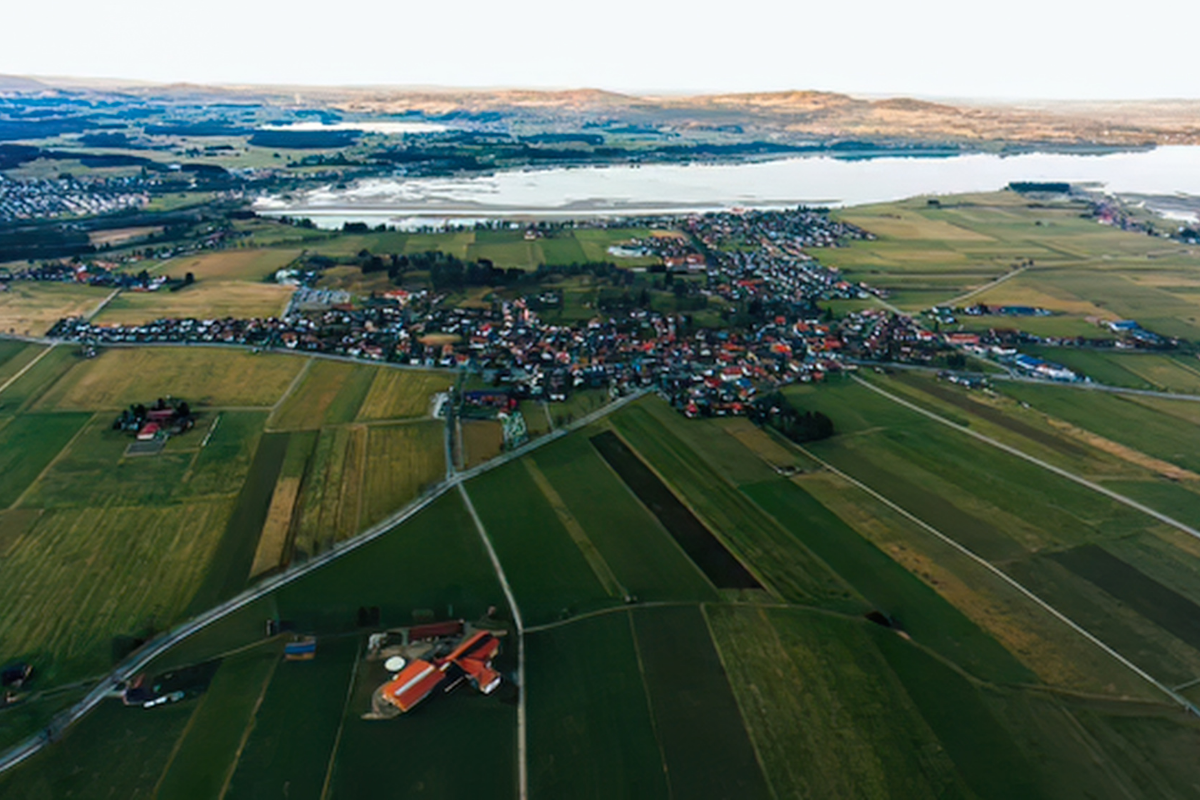
Urban land is projected to grow from 213 million hectares in 2000 to 621 million hectares by 2040, rising from 2.1% of the world's land surface to 4.7%. The expansion is not distributed randomly across the map. It happens preferentially on land that is both suitable and available for growing crops, which is why the Status of the World's Soil Resources 2026 attaches a production figure to it. The growth projected over those four decades would displace almost 65 million tonnes of crop production.
That loss then propagates. Replacing the displaced output is estimated to require converting 35 million hectares of new cropland, carved out of land currently under natural vegetation, with the erosion, carbon loss, and biodiversity damage that follow any such conversion.
Where the displaced production is concentrated
Four regions account for most of the loss. China stands to lose 13.9 million tonnes of crop production to urban expansion, followed by sub-Saharan Africa at 12.8 million tonnes, Central and South America at 8.0 million tonnes and India at 7.4 million tonnes.
The reason cities take good land is historical rather than accidental. Settlements were founded where soils were fertile, water was accessible and terrain was workable, which are the same criteria that define productive farmland. Urban growth then radiates outward from those points, consuming the highest quality soil in each region first. Sub-Saharan Africa's position on that list carries the most risk, since it combines rapid urban growth with the lowest yields per hectare and the least capacity to compensate through intensification elsewhere.
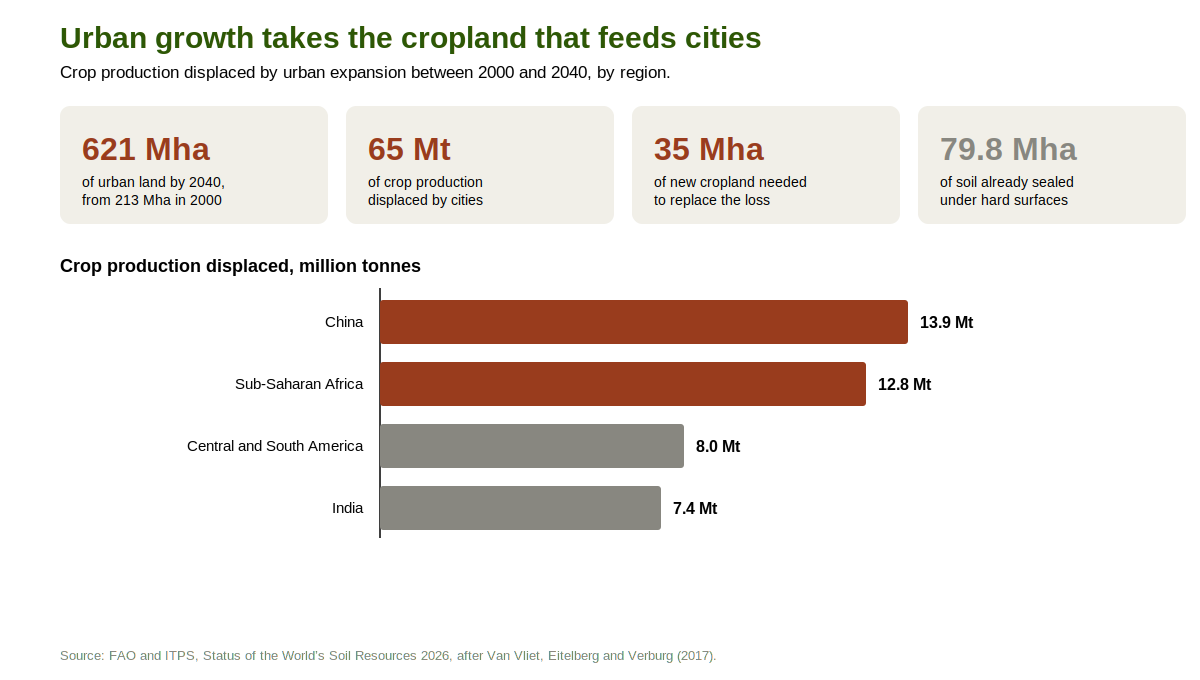
China and sub-Saharan Africa together account for more than 26 million tonnes of the crop production displaced by urban growth to 2040.
Sealed soil stops performing almost every function
Soil sealing is defined as the permanent covering of the surface with impervious material such as concrete, asphalt or buildings, in a form that cannot easily be removed. By 2018, artificial impervious surfaces covered 79.8 million hectares, one and a half times the area recorded in 1990, measured from a 34-year satellite record. The largest increases occurred in Asia and North America, followed by Europe, South America and Africa, with China and the United States showing the greatest national growth.
Sealing removes food and biomass production, hydrological regulation, carbon sequestration potential and biodiversity in a single step. The hydrological effect is identified as the most significant, because water that would have infiltrated now runs off. Beyond the familiar consequences of urban flooding, altered subsurface water movement can destabilise surface soil and increase the incidence of shallow landslides that can kill people.
Not all urban soil is equally lost, and the distinction is useful for planning. Urban soils fall into four groups: pseudo-natural soils, such as urban forests and gardens; vegetated engineered soils, where topsoil is spread over disturbed subsoil; dumping site soils; and sealed soils. The first two continue to deliver a considerable range of services, including biomass production, water storage, runoff and flood protection, biodiversity and recreation. Dumping sites can be reclaimed for a limited range of functions. Sealed soils offer almost nothing.
Solar farms have become a new competitor for farmland
Photovoltaic installations on agricultural land have expanded steadily since 2015, creating direct competition between food production and renewable energy for the same hectares. The report notes that the effects of these systems on soil functions have been little studied, a gap worth flagging given how quickly the installed area is growing.
The mitigation identified is agrivoltaics, meaning systems designed so that cultivation continues beneath and between the panels rather than being displaced by them. Unlike sealing beneath concrete, a solar installation does not have to be permanent or impervious, leaving the underlying soil recoverable if the system is designed and decommissioned with that in mind.
What can actually be protected
Land taken for building is effectively permanent on any agricultural timescale, which puts the decisive choices in planning offices rather than in soil management. Directing expansion toward lower-quality land, increasing urban density rather than extending the perimeter, and protecting peri-urban soils that supply nearby cities with perishable produce all reduce the amount of productive soil consumed for a given amount of growth.
The report's framing puts the choice plainly. Each hectare of good farmland sealed near a city creates pressure to clear more than a hectare of natural land elsewhere, since the replacement land is usually less productive. Protecting the soil health that determines what land can produce counts for little if the field itself is under a car park, and the decision that determines which outcome occurs is made in a planning office rather than on a farm.
Sources
- FAO and ITPS. (2026). Status of the world's soil resources 2026. Rome, FAO.