Fruit cracking can take a serious toll on a crop, and working out why it happens is rarely straightforward. Conditions vary within a single orchard and among fruits hanging on the same tree. Where a fruit sits in the canopy determines how much sunlight, heat, moisture and airflow reach it, and those differences shape conditions at the fruit surface.
Capturing such small differences across hundreds of fruits is the problem TOMMY was built to solve.
What TOMMY is
TOMMY, short for Terrestrial Orchard Measuring and Monitoring Yaw, was developed by the Leibniz Institute for Agricultural Engineering and Bioeconomy in Potsdam, Germany (ATB), which leads the work on proximal sensing within CrackSense. It combines several sensors to collect information directly from the canopy, at the scale of the individual fruit rather than the field.
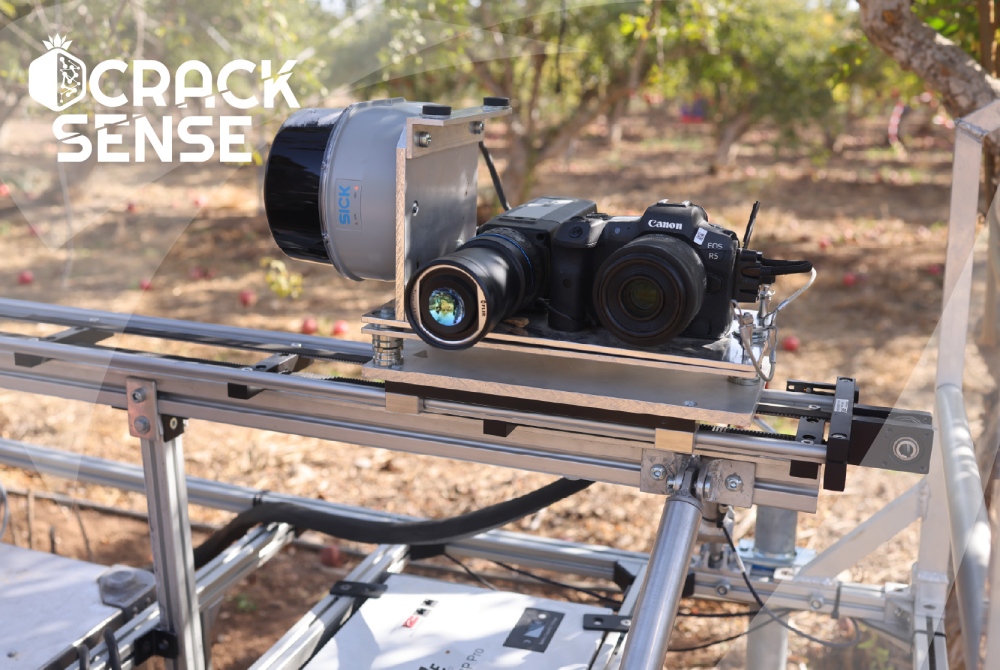
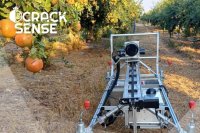
The sensor head carries a LiDAR scanner alongside thermal and RGB cameras.
Three sensors, one picture
TOMMY carries an RGB camera, a thermal camera and a LiDAR scanner, and the value lies in what they produce together rather than separately.
The RGB camera captures high-resolution images of the canopy and fruit, providing a visual record of the scan and enabling researchers to identify individual fruits.
The thermal camera measures surface temperature. Unlike an ordinary photograph, thermal imaging reveals temperature differences between canopy areas and between one fruit and the next.
LiDAR uses laser pulses to measure the position and shape of objects, producing a 3D point cloud that represents the structure of the tree and its fruit.
Combined, the three give a three-dimensional view of the canopy with temperature attached to the points. That is more than an image of a tree. It tells researchers where a fruit is and what its surface temperature was at the moment of the scan.
Why surface temperature matters
The temperature at the fruit surface carries information about the conditions immediately around the fruit. In crops prone to cracking, temperature and moisture drive the processes that lead to damage, and sweet cherries are particularly sensitive to water sitting on the fruit surface. Changes in temperature also alter the moisture conditions around a fruit, which is why fruit wetness is among the measurements the project is most interested in, as it has not been available until now.
Measuring any of this across a whole canopy defeats conventional sensors. A sensor fixed in one place reports on that place, while conditions a metre away may be entirely different. TOMMY measures many fruits and records where each one is, so the variation itself becomes visible.
How the scan works
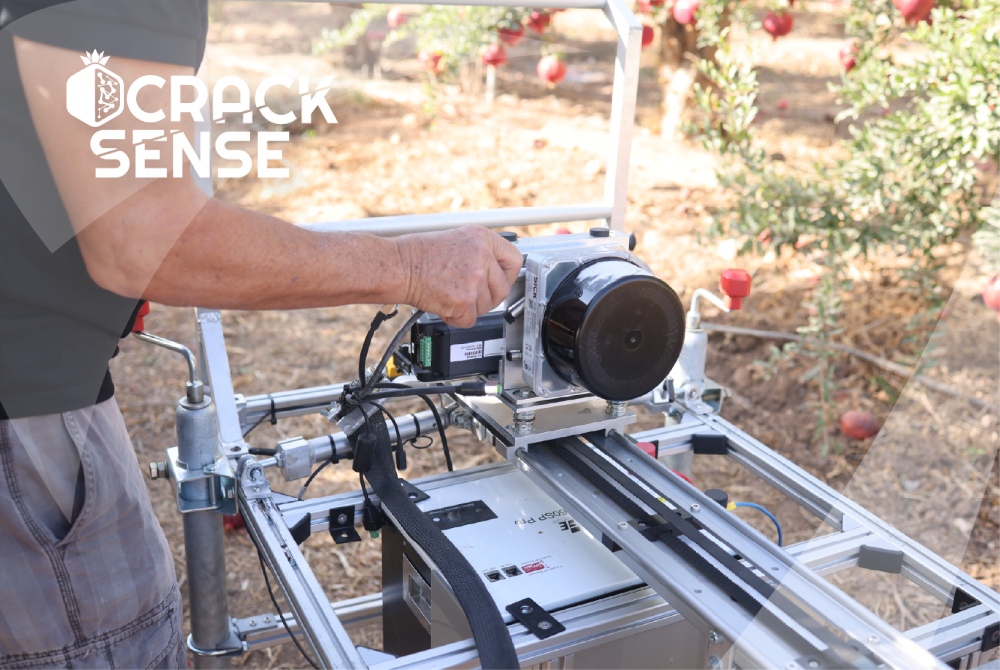
TOMMY is mounted on a rigid frame and travels along a linear axis while its sensors scan the canopy, carrying its own computer and battery so it can work in the field. Software developed by ATB controls it and lets researchers set the scanning distance and movement speed.
During a scan, the RGB camera records images, the thermal camera captures temperature, and the LiDAR records the three-dimensional structure of the canopy. The outputs are then integrated via sensor fusion, with thermal data overlaid onto the 3D point cloud to produce a representation of the canopy that holds both spatial and temperature information.
Four units across four crops
Four TOMMY units were built by ATB and deployed in experimental and pilot fields across the CrackSense project, which runs from 2023 to the end of 2026 with 14 partners in seven countries, with field sites in Israel, France, Germany, Lithuania and Greece. The project brings together researchers, technology developers and agricultural partners to understand the drivers of cracking in citrus, pomegranate, table grapes and sweet cherries.
After a scan, individual visible fruits can be identified in the point cloud and analysed based on their position and surface temperature. Those measurements can then be compared with local weather data, allowing researchers to compare what is happening at the surface of one fruit with the broader conditions across the site.
The aim is to find the patterns that explain when and why cracking happens. Where precision farming tools measure the tree and the soil, through dendrometers, tensiometers and stem water potential, TOMMY works at the scale where cracking actually begins, which is the surface of a single fruit.
CrackSense is funded by the European Union's Horizon Europe research and innovation programme. Follow us on LinkedIn and read more stories like this in our Newsroom.