Fruit cracking can cause heavy losses for fruit growers, particularly when the weather turns unpredictable. The Horizon Europe project CrackSense is developing smart farming tools to monitor, assess and predict the problem, so that growers have better information for managing their orchards.
Why fruit cracking is difficult to predict
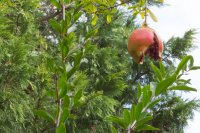
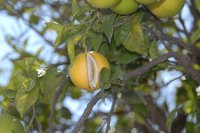
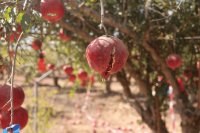
Fruit cracking is a disorder that splits the skin of developing fruit and lowers its quality and market value. It affects several crops, including citrus, pomegranates, table grapes and sweet cherries, and it usually appears in the weeks before harvest.
The problem varies widely between seasons and growing conditions. Weather extremes, changes in temperature and rainfall, irrigation practices, soil conditions and the characteristics of the fruit itself all influence what makes fruit crack in the field. In pomegranate, cracking can cost up to 50% of the marketable yield. Because it is hard to anticipate, growers often have little time to adjust irrigation or other orchard practices before the damage is done.
Sensors follow the orchard at three levels
CrackSense has developed what it calls the Integrated CrackSense Solution, which combines several sensing technologies and data analysis methods to assess the risk of cracking. It monitors orchards at the level of the fruit, the tree and the plot, and extends to wider regions through satellite data, giving researchers a fuller picture of the conditions linked to cracking.
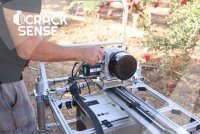
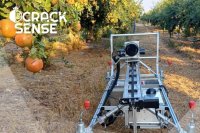
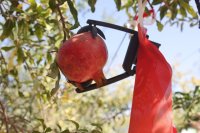
Fruit level: RGB, thermal and LiDAR imaging identify visible cracks and track changes in the temperature and wetness of the fruit surface. A robotic scanner that measures conditions at each individual fruit is part of this work, and its data can help assess cracking risk before damage appears.
Tree level: ground-based sensors and unmanned aerial vehicles (UAVs) carrying RGB, thermal, multispectral and LiDAR sensors record the health and water status of the trees. The drones cover the canopy, while measurements on the ground show how individual trees respond to their environment.
Plot level: data from individual trees is combined with local weather, soil characteristics, topography and soil water status. Satellite observations extend the assessment beyond single orchards to regional analysis.
Models turn the data into a cracking risk
CrackSense uses machine learning and computer vision models to analyse the data and find patterns associated with fruit cracking. By combining observations from different sources, the models estimate the likelihood of cracking for single fruits, single trees and whole regions. Imaging data and deep learning algorithms, for example, can pick up signs linked to cracking before visible damage develops, while at tree level, water status and environmental conditions feed into the risk assessment.
An early warning of that kind gives growers time to adjust irrigation and orchard management, and to direct labour and inputs to the plots most at risk.
An open repository and a decision support platform
The project has also set up a publicly accessible data repository with the datasets collected at fruit, tree, plot and regional level. Users can explore and download the data by crop type, country and sensing technology.
In parallel, CrackSense is developing a Spatial Decision Support System (SDSS), a web platform that brings together predictive models and geographical information. It uses Earth observation data, including the European Copernicus Sentinel satellites, alongside information supplied by users. Farmers, agricultural advisers and policymakers will be able to select a field, enter what they know about it and receive an estimate of cracking risk, calculated by combining their inputs with environmental and satellite data.
"The Integrated CrackSense Solution combines advanced sensing technologies and machine learning models to monitor and predict fruit cracking risk at multiple scales, from individual fruits and trees to entire orchards and regions. These models are integrated into a web-based Spatial Decision Support System (SDSS), supported by a public data repository, enabling growers and other stakeholders to assess cracking risks, optimize orchard management, and reduce yield losses," say Victor Alchanatis, D.Sc., and Avi Sadka, Ph.D., CrackSense project coordinators at the Volcani Institute.
What growers can expect from the tools
The Integrated CrackSense Solution brings sensing technologies, machine learning, open datasets and digital decision support together to address a problem with serious consequences for fruit production. Better monitoring and prediction of cracking should help growers reduce losses, use water and other resources more efficiently and protect the quality of their harvest.
Updates on the project's research and results are posted on CrackSense's LinkedIn page and on the project website, cracksense.eu.
Sources
CrackSense. Estimating pomegranate fruit cracking through proximal and aerial remote sensing. CrackSense project.