
At midday on 26 October 2026 the Hellenic National Meteorological Service (HNMS, ΕΜΥ) upgraded its emergency weather deterioration bulletin to an emergency bulletin of dangerous weather phenomena, with a red warning for the prefectures of Larisa and Magnesia on Wednesday 28 October. The station at Agia had already recorded 47.4 mm of rain on 25 October, according to a Wikifarmer analysis of daily data from the station network of the National Observatory of Athens (meteo.gr). The storm coincides with the cotton harvest in Thessaly, in the country to which the European Commission attributes 80% of the cotton area and production of the European Union, and at a time when, according to the Larisa Directorate of Agricultural Economy, the bolls had already started to open by the end of September.
The weather service raised the Thessaly warning to red for Wednesday 28 October
Emergency bulletin of dangerous weather phenomena 8/2026, issued at 12:00 on 26 October and valid until midnight on 28 October, forecasts locally heavy rain and thunderstorms, mainly in eastern Greece, possibly with local hail, over three days. For Magnesia and Larisa the warning is orange on Monday until the evening and again from Tuesday evening, and it turns red on Wednesday until late at night. The bulletin replaced emergency weather deterioration bulletin 15/2026, issued on Sunday 25 October at the orange level.
By decision of the Secretary General for Civil Protection, the regional units of Larisa, Magnesia and the Sporades were placed on RED CODE mobilisation from 26 to 29 October, the Region of Thessaly announced. The Region advises against unnecessary travel and outdoor work and asks for particular care in areas at risk of flooding, landslides or hail.
Agia recorded 47.4 mm of rain on 25 October
Among the observatory's stations in Thessaly, Agia had the highest rainfall on 25 October, followed by Dasochori with 36.2 mm, Nikaia with 26.8 mm, Volos with 26.2 mm and Larissa with 21.2 mm. The rain continued on Monday 26 October, and by 17:45, when the files were read, Agia had collected another 36.2 mm and Nikaia 22.8 mm, while totals stayed lower at the stations of western Thessaly, with 10.0 and 6.8 mm in Karditsa and 8.4 and 5.2 mm in Trikala over the two days. This storm follows the rain of 13 and 14 October, when Larissa recorded 28.4 mm and Farsala 36.4 mm, so it is the second wet spell on the Larisa plain within two weeks.
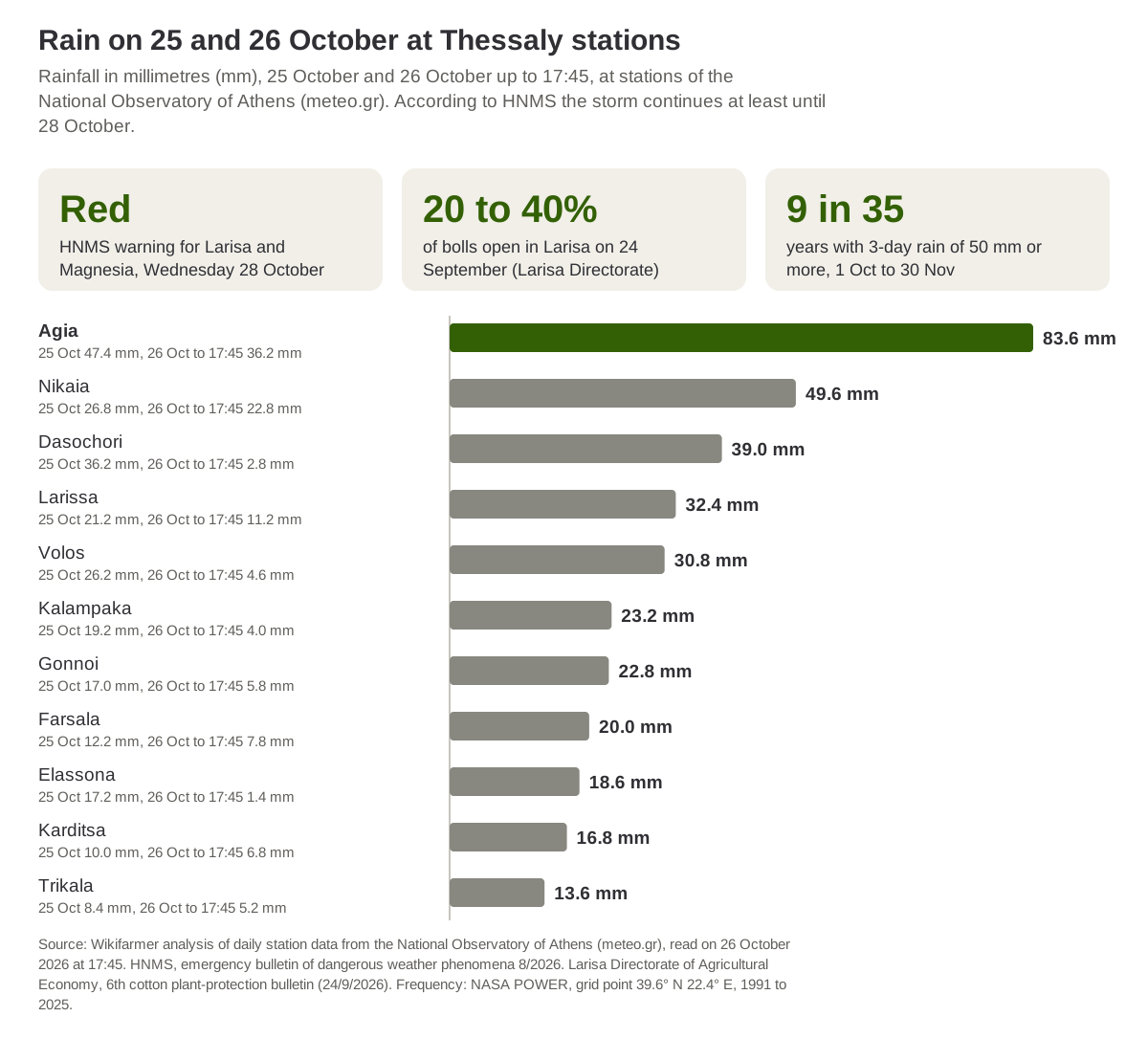
Source: Wikifarmer analysis of daily station data from the National Observatory of Athens (meteo.gr). 26 October includes rain up to 17:45. Warnings: HNMS, emergency bulletin of dangerous weather phenomena 8/2026.
20 to 40% of bolls had already opened by late September
In its 6th integrated plant-protection bulletin for cotton, dated 24 September 2026, the Directorate of Agricultural Economy of the Regional Unit of Larisa, working with the Regional Centre for Plant Protection of Volos, reported that about 20 to 40% of the bolls had opened in the cotton fields of Larisa. The bulletin noted that the summer weather had helped the crop develop normally and that growers who intervened in time had no particular problems with pink bollworm and cotton bollworm. The same bulletin recommends defoliation once at least 50 to 60% of the bolls have opened and about 12 to 15 days before the expected harvest, so that open cotton does not stay exposed to adverse weather for long.
For defoliants to work well, the bulletin asks for day and night temperatures above 15 to 18 °C for 4 to 5 days after application, low soil moisture and sunshine. Sunshine and dry soil are absent while it rains, and defoliation is an active biological process in the plant and depends on temperature. When soil moisture is high, or when defoliation is late and rain is expected, the Directorate recommends adding bud-desiccating products to the spray solution to prevent regrowth. For storage it considers suitable only seed cotton with up to 12% moisture, since higher moisture contributes to heating and to a loss of quality.
Rain on open bolls lowers the colour grade of the lint
According to CSIRO, Australia's national science agency, rainfall is the main cause of lint discolouration in the field, in particular heavy or prolonged rain, as the waxy cuticle of the fibre repels moisture only in part and does not make the open boll impermeable to water. In a 2016 field experiment by the Australian Cotton Research Institute at Narrabri, 20 mm of rain falling in four events of less than 8 mm did not change the colour grade. Once rain came with cloud cover and the crop could not dry, the grade dropped after each such period, and after 141 mm over 15 weeks it fell from the base grade 31 to 41. On the Australian scale, grade 11 is the highest quality and 61 the lowest, and grade 31 (Middling) is the Australian base grade.
The experiment reflects Australian conditions and cumulative rain over many weeks, so it does not transfer directly to Thessaly. It does show that how long the boll stays wet, and not only how much rain falls, decides the grade. The Larisa Directorate adds that green leaves left on the plant stain the lint and lower the quality of ginned cotton and with it its market price.
A 3-day rain of 50 mm or more in October or November occurs in 9 of the last 35 years
At the NASA POWER grid point covering the Larisa plain, the largest 3-day rainfall between 1 October and 30 November reached or passed 50 mm in 9 of the 35 years from 1991 to 2025, according to a Wikifarmer analysis of NASA's daily data. Rain of this size during the cotton harvest therefore occurs about once every four years, although grid values, at a resolution of about 50 km, differ from the local totals recorded at stations, such as the 47.4 mm that fell at Agia in one day.
No official estimate of damage or quality exists yet
In the official sources Wikifarmer examined up to 26 October there is no estimate of how much cotton was still in the field or of damage from the storm, for which HNMS has issued a red warning for Wednesday. For Larisa and Magnesia, HNMS forecasts locally heavy rain and thunderstorms from Tuesday evening and at least until Wednesday. For growers with cotton still in the field, harvesting and delivery to the gins will depend on how fast the fields and the seed cotton dry, the same conditions that decide every year when and how cotton is harvested. For gins and buyers of Greek lint there is no data yet on how the rain affected quality, and such data come from lint classing after ginning.
Frequently asked questions
How much rain fell in Thessaly on 25 and 26 October 2026?
At the stations of the National Observatory of Athens, Agia recorded 47.4 mm on 25 October and another 36.2 mm by 17:45 on 26 October, Nikaia 26.8 and 22.8 mm, Dasochori 36.2 and 2.8 mm, Volos 26.2 and 4.6 mm, and Larissa 21.2 and 11.2 mm. Totals in Karditsa and Trikala were much lower.
How long does the red warning for Larisa and Magnesia last?
Under HNMS emergency bulletin 8/2026, the red warning covers Wednesday 28 October until late at night, and the Region of Thessaly has placed Larisa and Magnesia on RED CODE until 29 October. HNMS updates its emergency bulletins with new issues, so field work should follow the latest one.
How does rain affect cotton that has already opened?
According to CSIRO, rain is the main cause of lint discolouration in the field, and the damage grows when rain comes with cloud cover and the cotton cannot dry. The Larisa Directorate also notes that seed cotton should be stored only at up to 12% moisture.
Should defoliation be done before or after the rain?
The 6th bulletin of the Larisa Directorate asks for temperatures above 15 to 18 °C for 4 to 5 days, low soil moisture and sunshine for defoliation, and when rain is expected it recommends adding bud-desiccating products. For each field, the Directorate's instructions and an agronomist's advice apply.
Is rain like this common in the harvest season?
At the NASA POWER grid point for the Larisa plain, a 3-day rainfall of 50 mm or more between 1 October and 30 November occurs in 9 of the 35 years from 1991 to 2025.
Important notes
Wikifarmer analysed daily data from the automatic stations of the National Observatory of Athens (meteo.gr) as available at 17:45 on 26 October 2026, so the 26 October value is partial, while according to HNMS the storm continues at least until 28 October. The 25 October value is the full day. Station values are point measurements and do not describe the whole cotton area. The frequency of 9 in 35 years comes from the NASA POWER grid point at 39.6° N 22.4° E, at a resolution of half a degree, or about 50 km, and is the largest rainfall over three consecutive days between 1 October and 30 November of each year. The warnings are those of HNMS and Civil Protection. The CSIRO result comes from an experiment in Australia and uses the Australian classing scale. The article does not estimate damage and gives no spraying advice. For any treatment, the plant-protection bulletins, the product label and an agronomist's advice apply.
Sources
- Hellenic National Meteorological Service (HNMS). (2026, 26 October). Emergency bulletin of dangerous weather phenomena 8/2026 (in Greek).
- Region of Thessaly. (2026, 26 October). Civil Protection press release: RED CODE in Larisa, Magnesia and the Sporades (in Greek).
- Region of Thessaly, Directorate of Agricultural Economy of the Regional Unit of Larisa. (2026, 24 September). 6th integrated plant-protection bulletin for cotton in the Regional Unit of Larisa (in Greek).
- National Observatory of Athens, meteo.gr. (2026). October monthly climate summaries for the stations of Agia, Larissa, Nikaia, Volos, Dasochori, Farsala, Karditsa, Trikala, Kalampaka, Gonnoi and Elassona, retrieved 26 October 2026. The files are updated continuously.
- Heimoana, S., CSIRO Agroecology. The impacts of rainfall and sooty mould contamination on cotton colour grade. Cotton Research and Development Corporation, project CSP1703.
- European Commission, Directorate-General for Agriculture and Rural Development. Cotton.
- NASA Langley Research Center. POWER Project, Daily API.