
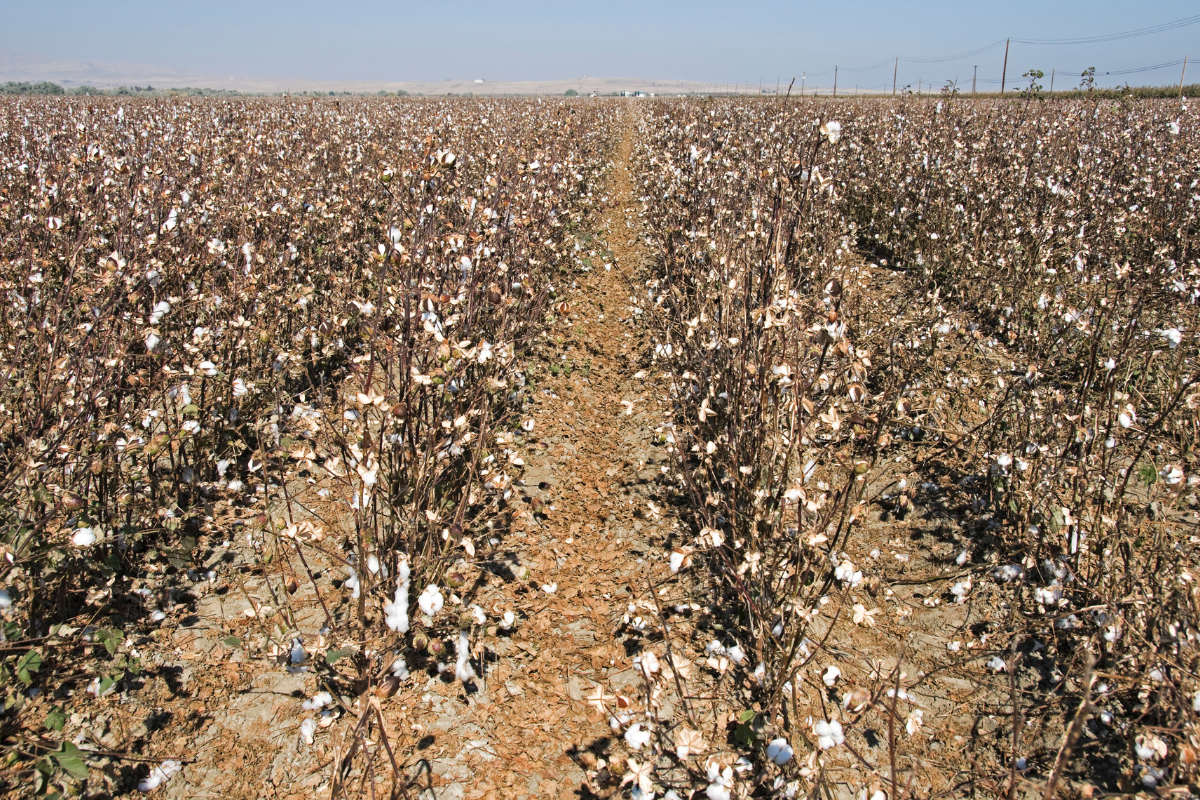
From mid-September, as bolls open across the cotton-growing plains of Thessaly, Central Greece, and Central Macedonia, plant protection bulletins from Larissa and Karditsa, through to Serres and Evia, repeat the same warning. A rate higher than recommended dries the leaves and leaves them stuck on the plant rather than dropping them. The phenomenon is known as leaf stick, and it degrades the fibre because dry leaves are shredded by the picker and mixed into the harvested crop.
The explanation is that defoliation is not about killing the leaf. It is an active biological process requiring living tissue and time to complete.
The abscission zone
At the base of every leaf petiole sits a narrow band of specialised cells, the abscission zone. This is where the leaf separates from the plant, through the controlled breakdown of the cell walls.
The process runs through four stages. The zone itself is first determined, it then acquires competence to respond to abscission signals, separation is activated, and finally, a protective layer differentiates over the scar left behind. That last stage explains why a properly defoliated plant shows no open wounds where its leaves used to be.
Ethylene gives the signal
The central abscission signal is ethylene, a gaseous hormone that moves readily through plant tissue. Its presence activates, within the abscission zone, the genes encoding enzymes that break down cell walls, with cellulases as the clearest example.
Ethylene alone is not sufficient, however. In experiments with plants unable to perceive ethylene, abscission was delayed but not halted, which shows that other factors are involved.
The auxin gradient
The second decisive factor is auxin, specifically the concentration difference across the abscission zone.
For as long as the leaf produces more auxin than the stem side, the abscission zone remains insensitive to ethylene. Once leaf auxin levels fall and the gradient reverses, the zone acquires the capacity to respond.
Work with thidiazuron showed exactly this sequence. Ethylene accumulated earlier in the leaf than in the abscission zone, while auxin fell far more sharply in the leaf, shifting the gradient in the direction that permits separation.
Two classes of defoliant
Products reach the same outcome by two different routes, and the difference carries direct practical consequences. Hormonal materials, such as thidiazuron and ethephon, directly enhance ethylene production. Ethephon releases ethylene, which in turn stimulates the plant to synthesise more of it, activating abscission zones in leaf petioles and in boll walls alike.
Herbicidal materials such as tribufos and endothall work indirectly, injuring the tissue so that the plant responds by producing ethylene, which then activates the abscission zone. Because hormonal materials bypass the injury step entirely, they are less likely to cause stuck leaves than herbicidal ones.
The thidiazuron paradox
Thidiazuron deserves particular mention, because its action runs contrary to what one would expect. It is a synthetic molecule that mimics cytokinins, hormones that, in most plant species, keep leaves healthy and delay senescence. In cotton and related species, however, very high cytokinin concentrations promote ethylene synthesis and therefore act as a defoliant.
The same hormone that keeps a leaf alive will, at many times the dose, cause it to drop.
Why overdosing fails
Forming the abscission zone requires living cells to produce ethylene, synthesise enzymes, and break down their own walls in a controlled way. All of that needs a functioning metabolism, and it needs time.
An excessive rate of a herbicidal defoliant causes rapid leaf death before ethylene can be produced to form the abscission layer. The leaf dies, but it dies attached to the plant, because the mechanism that would have separated it never had the chance to engage.
The result is desiccation rather than leaf drop, which the guides describe as "stuck leaves."
Why does temperature governs the rate
The same mechanism explains the role of temperature, which advisory bulletins cite without accounting for.
Plant metabolism slows in the cold, and below roughly 15-18°C, ethylene production and enzyme synthesis proceed very slowly, so the abscission zone takes longer to form. A rate that performs correctly in warm weather can therefore prove excessive in cold weather, not because the quantity changed, but because the plant's response slowed when it needed to outpace the injury.
Three harvest aids that get confused
Defoliants induce leaf drop via the abscission zone and are used with picker-type harvesters, while desiccants kill tissue rapidly, causing leaves to dry out and remain on the plant. That outcome suits other harvest systems, but it counts as failure where leaf drop is the objective.
The third category is boll openers, ethephon being the main representative, which accelerate boll opening. Since thidiazuron does not directly affect boll ripening, it is frequently combined with ethephon to achieve both outcomes.
Notes
The active substances mentioned are presented to explain the mode of action. Their approval status varies by country and changes over time, so it should be checked in the competent authority's database. Rates, boll opening percentages and application timing are set by each product label and by local plant protection bulletins, in consultation with an agronomist.
Sources
- Cothren, J. T. Physiology of Cotton Defoliation and Desiccation. Cotton Harvest Management.
- University of Tennessee Extension. MidSouth Cotton Defoliation Guide, W 376.
- Thidiazuron Promotes Leaf Abscission by Regulating the Crosstalk Complexities between Ethylene, Auxin, and Cytokinin in Cotton. International Journal of Molecular Sciences.
- Comparative Physiological and Transcriptomic Mechanisms of Defoliation in Cotton in Response to Thidiazuron versus Ethephon.
- Crosstalk between cytokinin and ethylene signaling pathways regulates leaf abscission in cotton in response to chemical defoliants. Journal of Experimental Botany.