Stone Fruit Market Digest | Week 24, 2026
In Week 24, the peak-season stone fruit volumes flooded in. Spain saw large volumes, and prices resumed easing across the board. The German market eased too, with cherry prices dropping across every origin as supply fanned out to seven countries. France eased as well on peak-season volume. Plums are now ramping up in Spain and reaching German and French wholesale markets.
This report covers fresh fruit activity in four major EU wholesale markets: Mercamadrid (Spain), Rungis International Market (France), the Federal Office for Agriculture and Food (BLE) market reporting system (Germany), and Athens Central Market (OKAA) in Greece.
Stay up to date with our weekly Fresh Fruit Market Digests
Mercamadrid prices drop
With the season now peaking, Mercamadrid prices fell again in almost all categories: cherries eased to €3.76/kg (from €4.00), nectarines to €2.50/kg (from €2.70), flat peaches to €2.41/kg and the sharpest moves were in yellow peaches down to €2.31/kg (from €3.30) and purple plums to €2.34/kg (from €3.10). Only apricots edged up, to €2.11/kg.
.jpg)
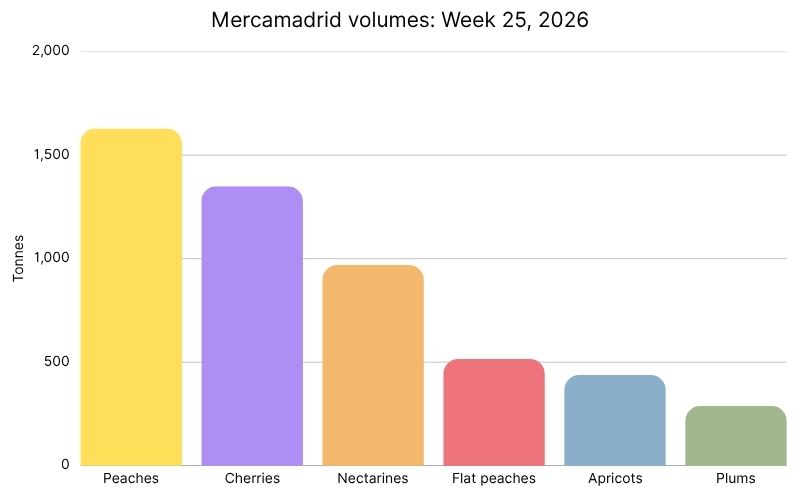
Volumes surged. The peach complex (1,629 tons) overtook cherries (1,350 tons) as the largest line, ahead of nectarines (969 tons), flat peaches (515 tons), apricots (438 tons) and plums (288 tons).
Cherries soften
The cherry market supply widened this week, and prices declined. At Mercamadrid, the most frequent price slipped to €3.76/kg (range €1.00–4.50) on a large 1,350-ton lot, mostly from Cáceres and Zaragoza.
Greece (OKAA, Athens) held domestic cherries at €2.50/kg, around half the year-ago level.
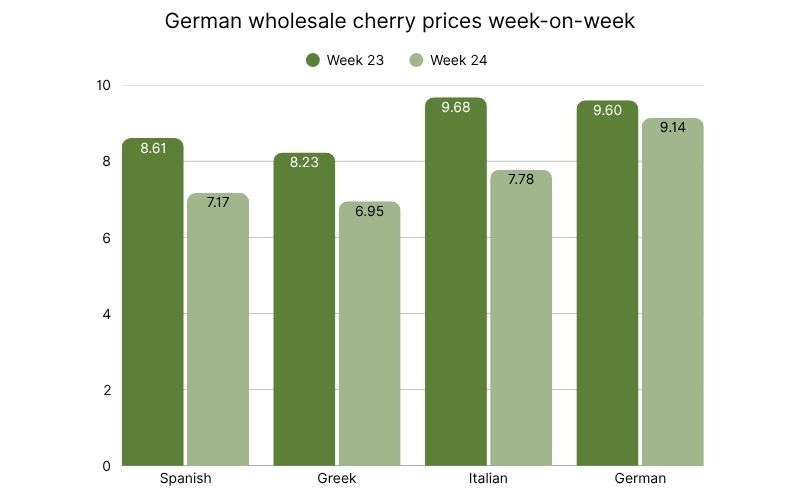
In Germany, the assortment fanned out further: Spanish, Greek, Italian, Turkish, French, German and North Macedonian fruit. Condition and taste were uneven across origins, and demand could not keep pace. Dealers cut prices broadly: large-fruited Spanish fell to €7.17/kg (from €8.61), Greek to €6.95/kg (from €8.23), and Italian to €7.78/kg (from €9.68).
In France, Rungis reported cherry prices regressing across all origins and calibres. French fruit is in full season and of good quality, but demand is low, while large Spanish volumes are competing.
Rungis sees peak season
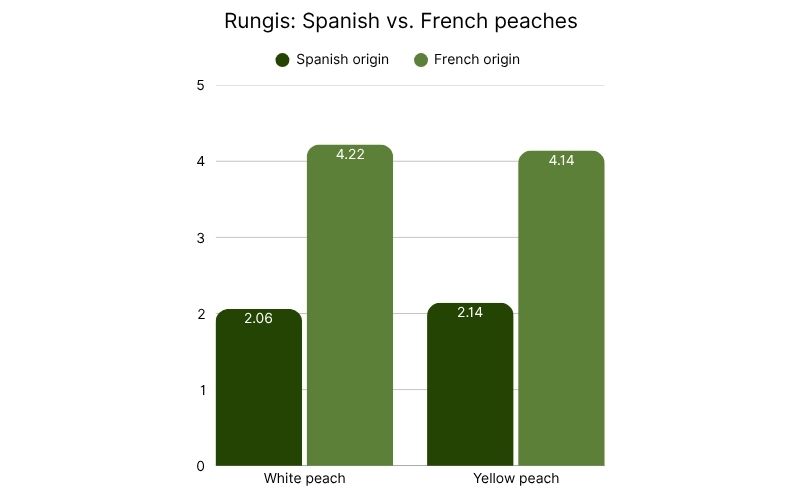
At Rungis, the peak of the stone-fruit season filled the market, and prices decreased. French peaches and nectarines held the premium but eased, with yellow peaches at €4.14/kg (−6%), and white peaches and nectarines at €4.22/kg (−4 to −5%). Spanish peaches sat far below at €2.06–2.14/kg, down 10–13% from the week before.
French apricots softened to €3.34/kg as the offer broadened. Spanish red plums entered the market mid-week at a start-of-campaign price about a third above last year.
Apricots
Apricots were the week’s exception: they stayed broadly steady. At Mercamadrid, common apricots firmed slightly to €2.11/kg (€1.20–5.50) on a much larger 438 tons, mostly from Murcia.
Greece held early apricots at around €1.50/kg, with premium grades quoted at €3.80–4.00.
In Germany, apricot prices eased to French €3.97/kg, Greek €3.25/kg, Italian €3.24/kg, and Spanish €3.06/kg, with the first German apricots around €4/kg. Taste was flagged in places. The first Turkish imports are expected shortly.
At Rungis, French apricots softened to €3.34/kg as varieties broadened.
Peaches and nectarines
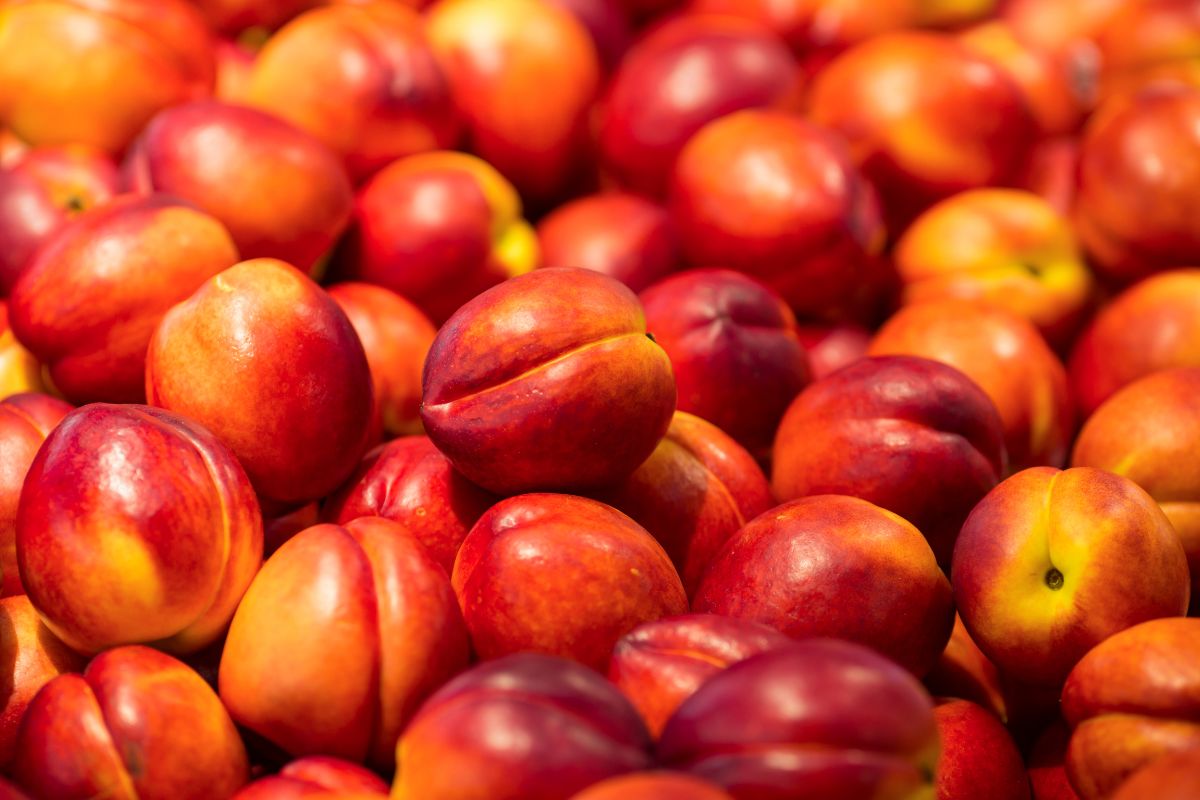
The peak supply hit hardest in peaches and nectarines. At Mercamadrid, yellow peaches dropped to €2.31/kg (from €3.30) and early red peaches held at €2.05/kg, while nectarines eased to €2.50/kg, all on much higher volumes.
Greece saw domestic peaches ease to about €1.50/kg.
In Germany (week 24), Spanish supply dominated and expanded again. Yellow AA nectarines were priced at €3.46/kg, and white AA at €3.65/kg. French nectarines AA were priced around €4.6, and peaches AA at €4.53. Demand in Frankfurt and Hamburg worsened due to the weather, so sellers cut prices to clear the overhang.
France’s split is shown above.
Flat peaches and flat nectarines
Spanish flat fruit eased on heavy volume. Paraguaya (flat peach) at Mercamadrid slipped to €2.41/kg on a large 515 tons.
In Germany, Spanish paraguayos fell to €3.30/kg (from €4.04) and platerinas (flat nectarines) to €4.46/kg (from €5.20).
Plums ramp up
Plums are increasing in volume as prices ease. Mercamadrid now lists three Spanish lines: early fresa plums at €3.82/kg, dark plums at €2.68/kg and purple plums down to €2.34/kg (from €3.10), all on 288 tons, roughly double the week before. The purple line’s price drop means the domestic crop is ramping up, and early-season scarcity pricing is unwinding.
Spanish plums were quoted at the German wholesale market at around €3.79/kg, and French and Italian new-harvest red and yellow plums arrived.
At Rungis, the first Spanish red plums opened about a third above last year’s level.
Key factors to keep an eye on
- Prices dropping: Peak-season volumes resumed the price slide at Mercamadrid. Expect continued pressure while supply runs at its seasonal peak.
- Cherry supply increases: Seven origins now feed the German market, but uneven quality and lower demand pulled every origin price lower. The premium for clean large-calibre fruit is what to track, not the average.
- Weather and demand: Below-normal temperatures in France held back cherry demand, while warm-weather demand could not keep pace with peach and nectarine volumes in Frankfurt and Hamburg. Demand is the swing factor.
- Plums increasing and spreading: Spain’s plum crop is building fast, with new lines and roughly doubled volume. Spanish plums are now at German and French wholesale. Watch prices as volume grows.
- Apricots steady: Apricots held, slightly firmer in Spain, broadly stable in Greece, easing only gently at the northern markets. First Turkish imports are expected at BLE shortly.
Buy and sell fresh fruit on the Wikifarmer Marketplace and track real-time prices with Wikifarmer’s Price Insights
Disclaimer: The information provided on this website, including market prices, insights, and projections, is for general informational purposes only. While we strive to ensure accuracy and timeliness, we make no guarantees regarding the completeness, reliability, or suitability of the information presented. Users are solely responsible for independently verifying the data and assessing its relevance to their specific circumstances before making any decisions. Wikifarmer and its operators shall not be held liable for any losses, damages, or consequences arising from the use of the information provided herein.