Important note: Seasonal forecasts are intended for informational purposes only and should not be interpreted as precise predictions. The team accepts no liability for any decisions or actions taken based on this information.
Scroll through this page for an overview of the state of the climate in Europe for July, as well as seasonal outlooks for September-November 2025. Want to find out more? Explore the in-depth seasonal climate outlook for August Seasonal Climate Outlook for Europe, August 2025 — Climate Strategies (PDF).
State of the Climate – August 2025 Observations
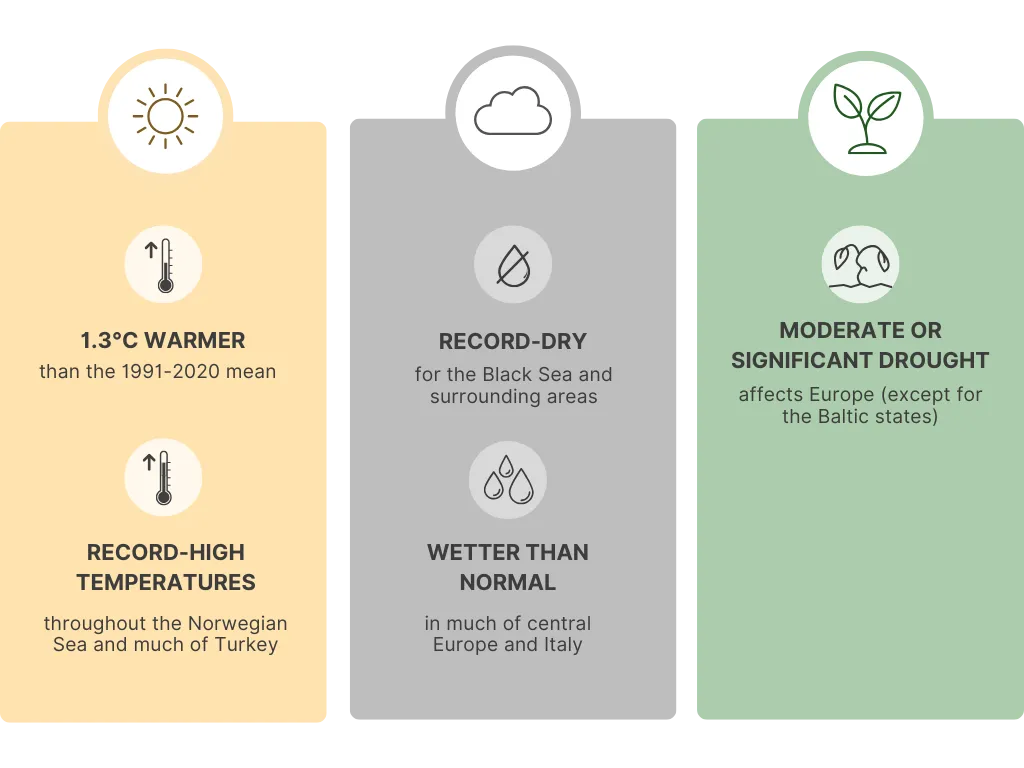
- Europe experienced its 4th warmest July on record, at 1.3°C above the 1991–2020 mean. Monthly-mean temperatures were significantly above normal in Fennoscandia and southeastern Europe. Record-high temperatures characterised the Norwegian Sea and a big part of Turkey.
- In terms of precipitation, July was record-dry for the Black Sea and areas around it, while much of central Europe and Italy experienced a wetter-than-normal July.
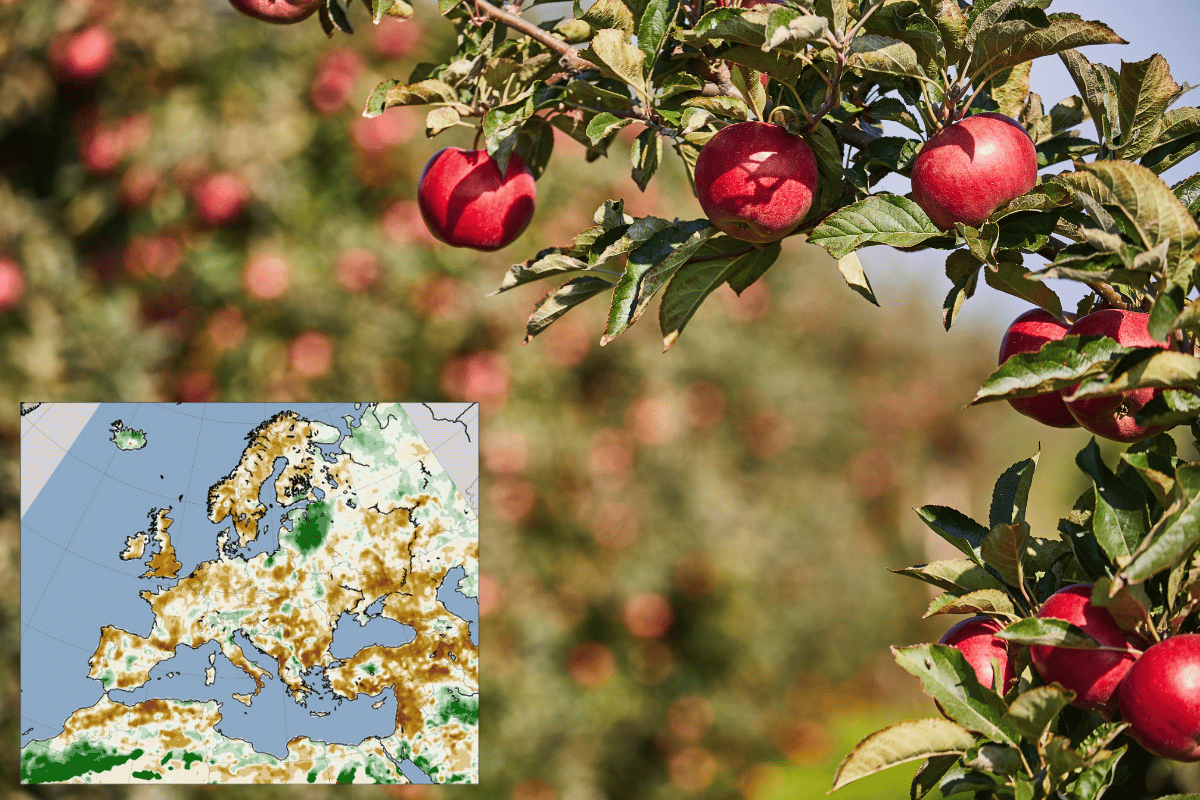
- A state of moderate or significant drought affects Europe except for the Baltic states based on the August 1st soil moisture conditions (Fig. 1). Compared to last month, the drought conditions have improved considerably in much of central Europe, owing to the aforementioned rainfall surplus.
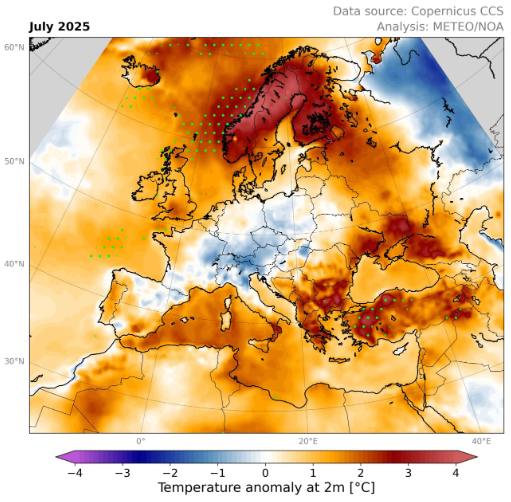
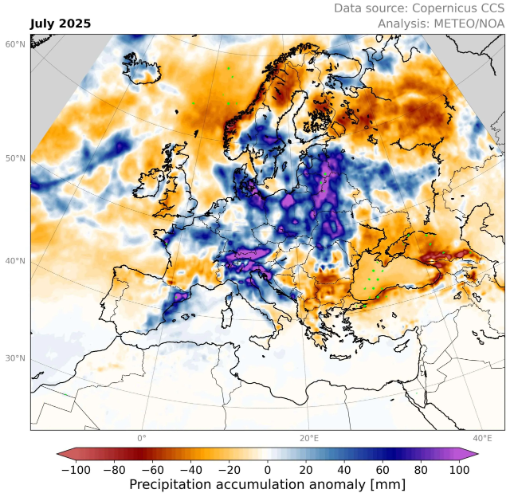
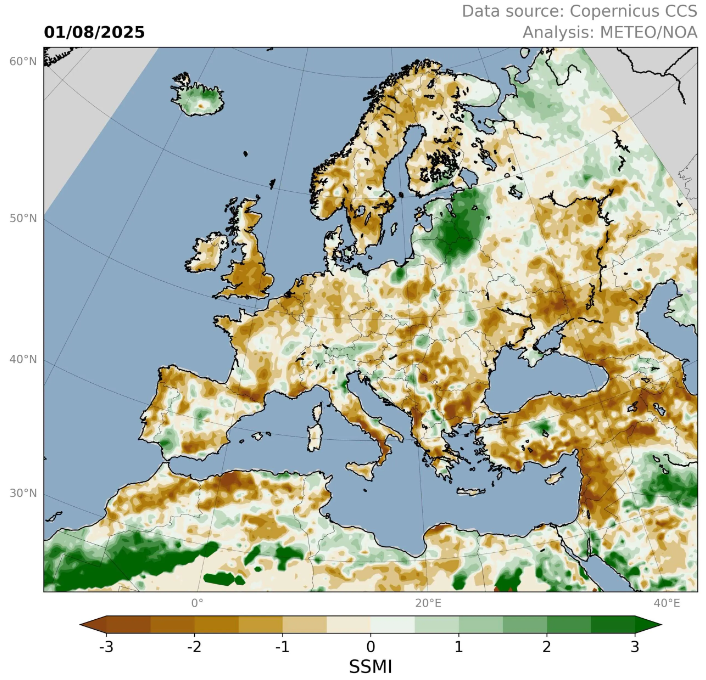
Figure 1. Figure 1. Agrometeorological overview of July 2025 in Europe. Anomalies in temperature at 2m (TOP) and precipitation accumulation (MIDDLE). Green dots indicate the areas where the observed anomalies were record-high (positive or negative) for July in the period from 1960 to today. BOTTOM: Standardised anomaly in soil moisture in the 28-100cm layer below the surface. Values below -1, -1.5, -2, and -2.5 indicate “moderately dry”, “significantly dry”, “severely dry”, and “extremely dry” conditions, respectively. Values above +1, +1.5, +2, and +2.5 indicate “moderately wet”, “significantly wet”, “severely wet”, and “extremely wet” conditions. Values between -1 and +1 reflect near-normal conditions. The climatological baseline for the computation of anomalies is the 1991-2020 period.
Seasonal Outlook – Forecasts for September-November 2025
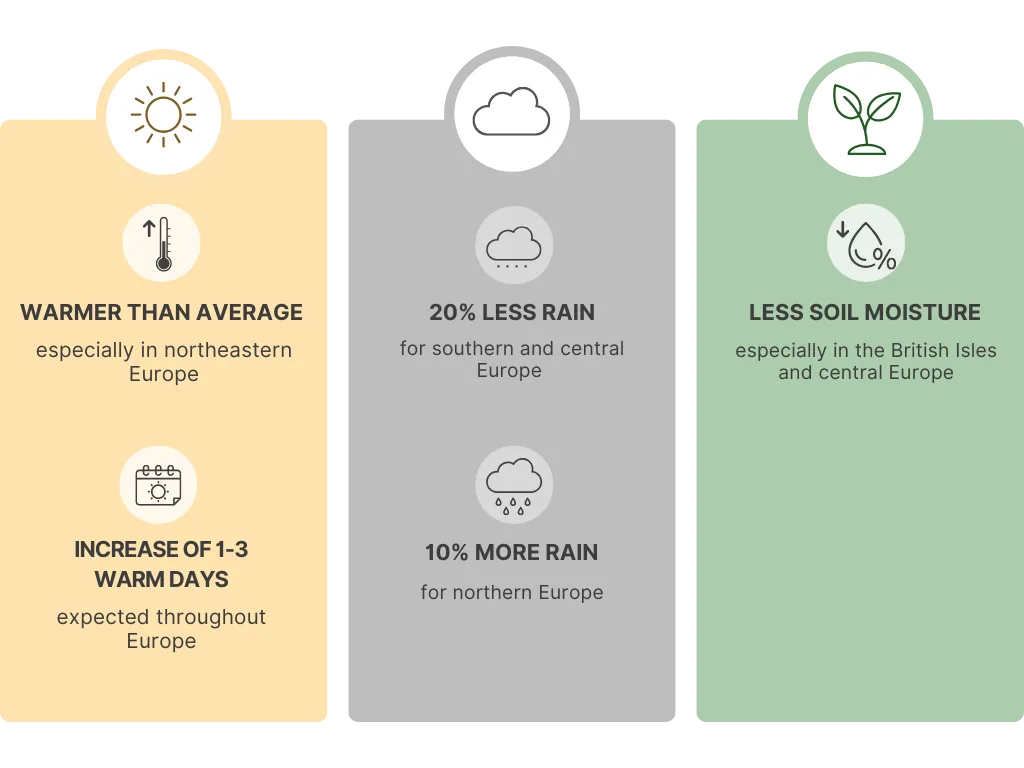
The key points of the seasonal forecasts issued in early August 2025 for the upcoming autumn in Europe are summarised below:
- Most of Europe is projected to be 0.75-1°C warmer than average, with the strongest anomalies expected in northeastern Europe (Fig. 2).
- While the day-to-day weather evolution of the coming months cannot be foreseen, an increase of 1-3 Warm Days and a decrease of 1-3 Frost Days per month are expected throughout Europe.
- In terms of the total precipitation, the mean of all examined scenarios results in negative anomalies of up to 20% for southern and central Europe and positive anomalies of up to 10% for northern Europe (Fig. 2).
- Given the state of the climate and the aforementioned forecasts, negative soil moisture anomalies are projected to persist in much of Europe and especially the British Isles and central Europe.
Considering the complexity of the Earth system, seasonal forecasts are characterised by large uncertainty. Daily and local weather conditions may differ significantly from the monthly average conditions in a broader region.
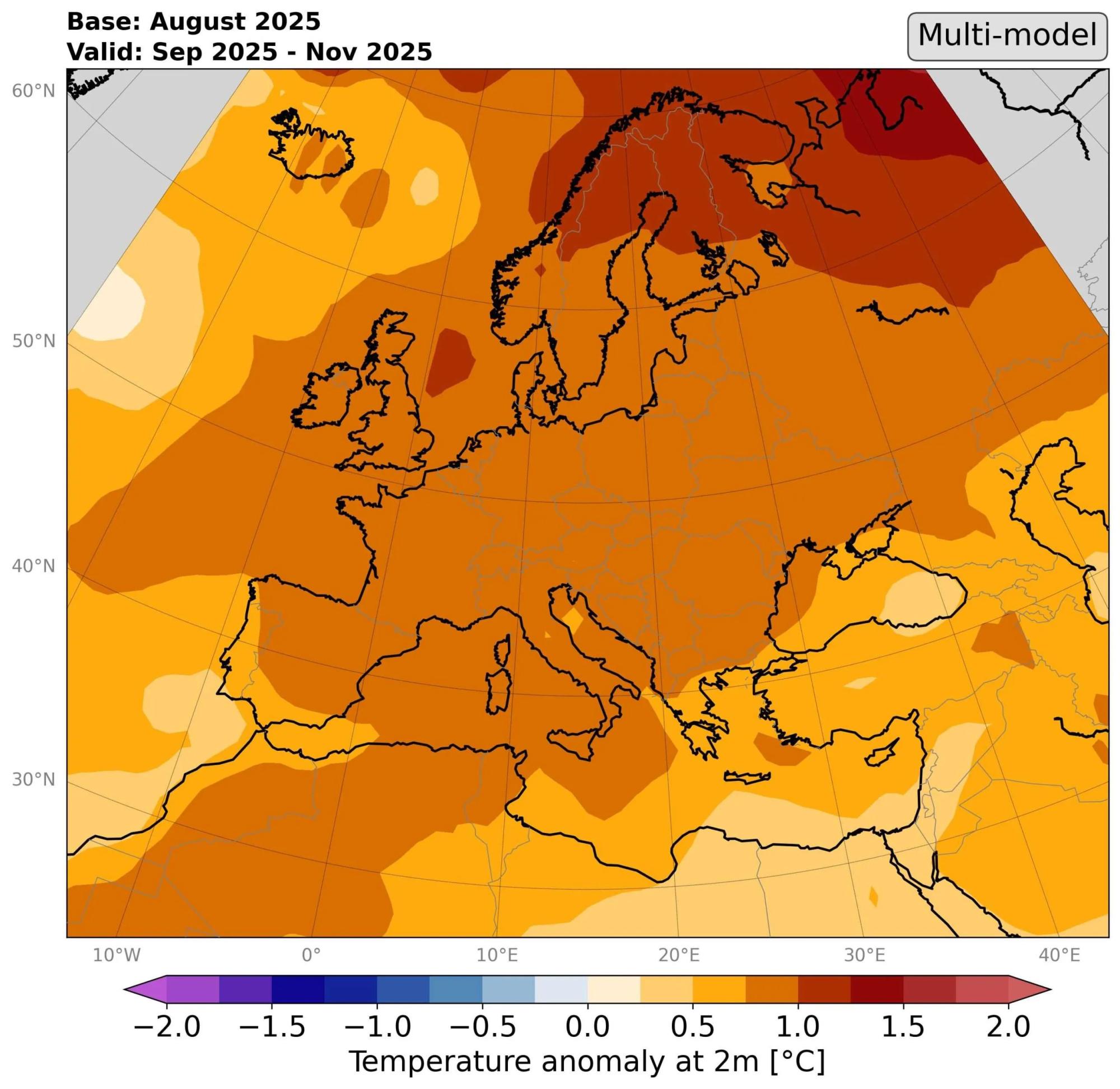
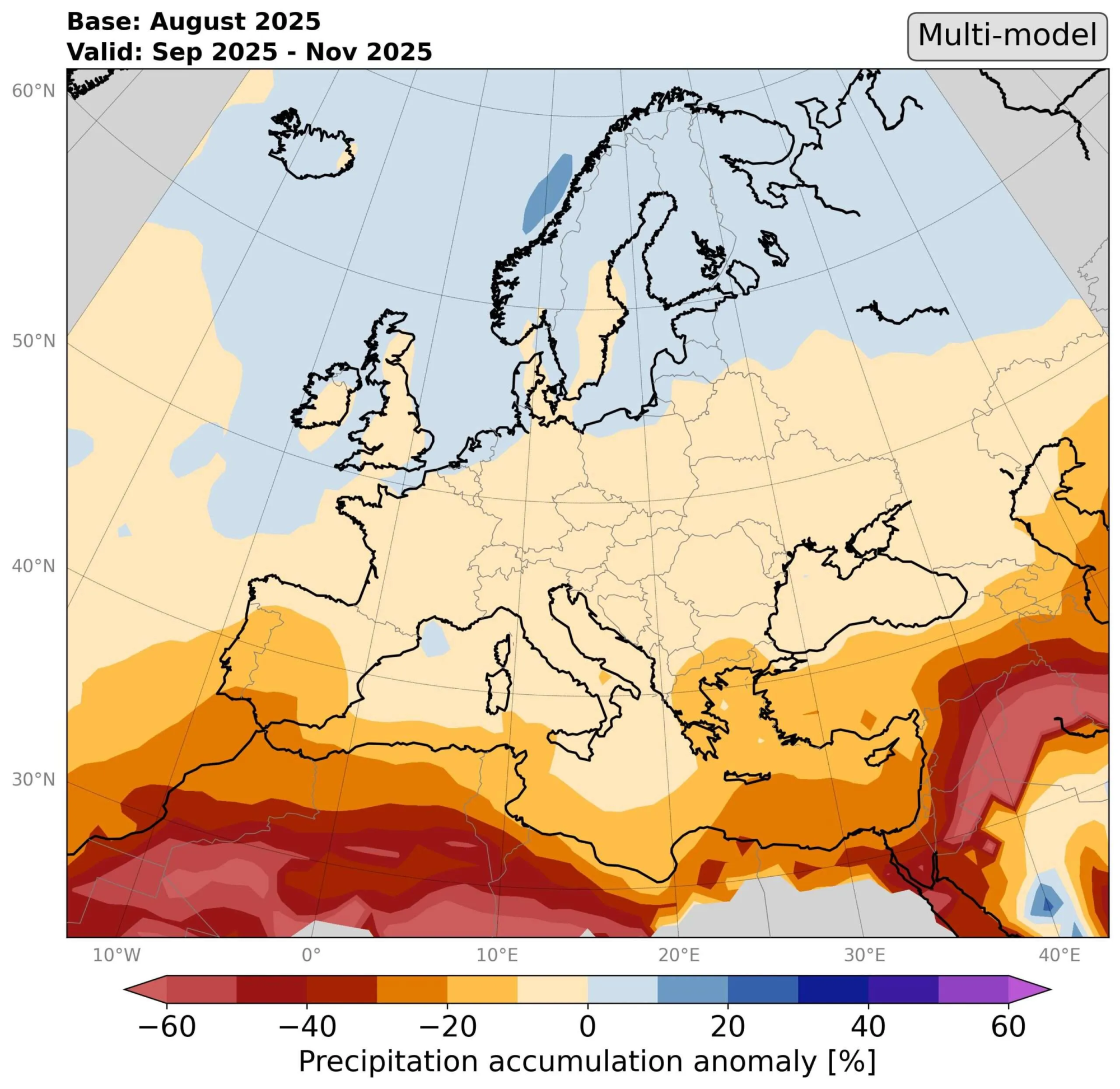
Figure 2. Figure 2. Multi-model mean 2m-temperature (TOP) and precipitation (BOTTOM) anomaly for the upcoming autumn in Europe, based on the seasonal forecasts issued in August 2025.
The Wikifarmer team of agronomists uses the data presented above to make some data-driven assumptions about how these conditions may affect the crops growing across Europe for the indicative period, highlight possible risks that may arise, and advise farmers on management measures.
Agricultural weather outlook and implications: September-November 2025
Following Europe's 4th warmest July on record and ongoing drought conditions across much of the continent, farmers face significant challenges as autumn approaches. The seasonal forecasts indicate continued above-average temperatures of 0.75-1°C warmer than normal through November, with particularly pronounced warming expected in northeastern Europe. This extended warm period, combined with projected precipitation deficits, will create critical decision points for agricultural operations across the continent.
Regional climate patterns and agricultural impacts
Southern and Central Europe face the most challenging conditions ahead, with precipitation expected to be up to 20% below normal through autumn. Countries including Spain, Italy, and the Balkans, already experiencing record-dry conditions around the Black Sea region, will see continued stress on water-dependent crops. The persistent negative soil moisture anomalies will particularly impact late-season crops and winter crop establishment.
In contrast, Northern Europe may receive up to 10% more precipitation than average, providing some relief to drought-stressed regions like the Baltic states, which currently show better soil moisture conditions. However, even these areas will experience the projected temperature increases and reduced frost days.
Central Europe, despite experiencing wetter-than-normal conditions in July that improved drought conditions considerably, remains vulnerable to the forecasted precipitation deficits ahead. The temporary moisture gains may not sustain crops through the extended warm, dry period projected for autumn.
Critical risks for key crops
Maize and sunflower crops approaching maturity will face continued heat stress during critical grain-filling periods. The combination of above-average temperatures and reduced precipitation will accelerate crop development while potentially reducing yield quality and quantity.
Winter crop establishment presents a major concern, as the projected decrease of 1-3 frost days per month may disrupt normal vernalization processes for winter wheat and barley. Simultaneously, dry soil conditions will complicate seedbed preparation and germination.
Permanent crops including vineyards and orchards will experience accelerated ripening schedules due to sustained warmth. While this may advance harvest timing, it also increases risks of quality degradation and requires careful monitoring of sugar accumulation and acid balance.
Forage and grassland productivity will likely decline significantly in drought-affected regions, potentially creating winter feed shortages for livestock operations.
Strategic management recommendations
- Water resource management becomes paramount given the persistent negative soil moisture anomalies projected for much of Europe. Farmers should prioritize irrigation scheduling for high-value crops and implement deficit irrigation strategies where water availability is limited.
- Harvest timing adjustments are essential, with many crops likely to mature earlier than normal due to sustained warmth. Monitoring crop development closely will prevent quality losses from over-maturation.
- Winter crop planning requires immediate attention. Consider drought-tolerant varieties and adjust seeding dates to optimize soil moisture utilization. In regions expecting continued dry conditions, evaluate alternative cropping strategies or cover crop options.
- Soil conservation practices should be intensified, including reduced tillage and mulching to preserve remaining soil moisture. These practices become increasingly critical as the moderate to significant drought conditions persist into autumn.
Regional Adaptation Strategies
Northern European farmers should capitalize on the expected precipitation increases while preparing for temperature-related challenges. Southern and central European operations must focus on water conservation and crop protection strategies.
The increase of 1-3 warm days per month across all regions necessitates adjustments to traditional seasonal farming calendars and consideration of heat-stress mitigation techniques.
Looking Ahead
The continuation of Europe's exceptional climate patterns demands adaptive management approaches. Farmers should maintain flexible operational plans, secure alternative water sources where possible, and consider climate-resilient crop varieties for future seasons. The current forecasts underscore the importance of sustainable water management and climate adaptation strategies in maintaining agricultural productivity across Europe's diverse farming regions.
Regular monitoring of updated seasonal forecasts and maintaining communication with local agricultural extension services will be crucial for navigating these challenging conditions successfully.