
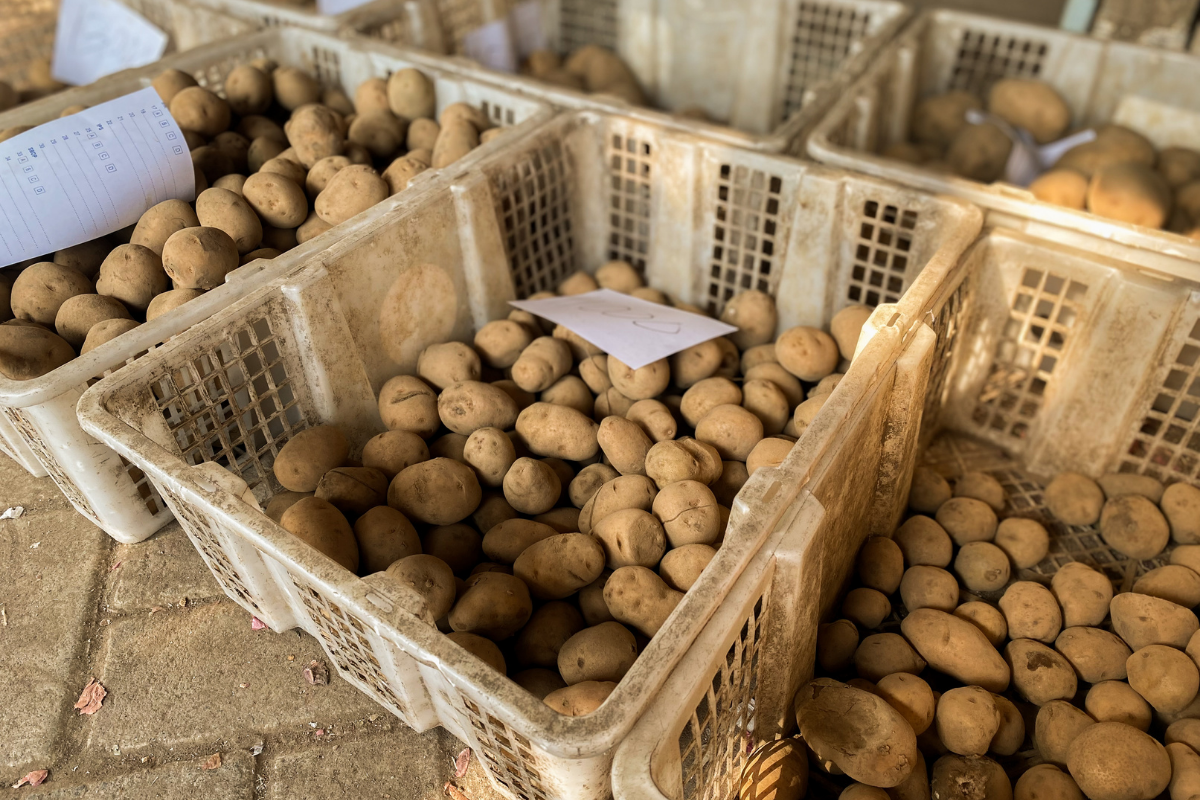
On the Lasithi plateau and across the other potato-growing areas of Greece, the September harvest largely ends up in store. The period immediately following lifting determines how long that crop will hold, and it rests on a capability of the tuber itself.
Every harvest, however careful, leaves micro-wounds, abrasions and bruises. The tuber can seal these on its own, provided it finds the right conditions within a specific window of time.
Suberization
The process is called wound healing, and it rests on suberization, the deposition of suberin into the cell walls surrounding the wound.
A wound periderm then forms over the injured surface, a new protective layer functioning like normal skin, while in immature tubers the skin itself matures in parallel, a process known as skin set. The outcome is twofold. Water loss through the wound falls sharply, and the entry route for the bacteria and fungi that cause rot closes off.
The conditions that allow it
Healing is not automatic. It requires a temperature of 10 to 15°C and relative humidity above 95 per cent, for a period international practice puts at anything from ten days to three weeks, with most guidance converging on two weeks as a minimum.
Humidity plays the opposite role here from the one you might expect. Without it tubers lose water and shrivel, while suberization itself needs hydrated tissue to proceed.
There is an upper limit, however. Very high humidity leads to condensation on tubers and on the surfaces of the store, creating the free water that favours precisely the pathogens the process is meant to exclude.
The temperature compromise
Choosing a temperature means balancing two opposing tendencies, and the reasoning is worth following.
Healing accelerates with temperature, since warmer conditions enhance suberin synthesis while cooler ones suppress it. A two-year storage study found that temperatures of 15.6 and 18.3°C produced less total weight loss across every variety tested, over eight months of storage, compared with the industry standard practice of 12.8°C.
Those same warm temperatures, however, also favour pathogens, while affecting respiration rate and other physiological processes that reduce storability. The temperature finally chosen is therefore not the optimum for healing but the one that balances both.
Weight loss concentrates here
The greatest weight loss of the whole storage season occurs during the curing period, through water loss from wounds and a high respiration rate. As much as two to four per cent of tuber weight can be lost as water during the first month, so managing this phase well limits the loss while managing it badly multiplies it.
When curing is skipped
The most significant exception overturns everything above, and it connects directly to the diseases recorded in plant protection bulletins. Where rot potential is high, meaning late blight, frost damage or bacterial soft rot is present in the lot, curing conditions work in reverse. The warm, very humid atmosphere that helps a healthy tuber seal its wounds simultaneously accelerates wet breakdown in those already infected.
The recommendation in that case is explicit. Curing is skipped, temperature is dropped immediately, ventilation is increased, and the lot is marketed as soon as possible. This is also where grading before the store earns its keep, since the decision on whether to apply a curing period depends on the health status of the lot.
Cooling proceeds gradually
Once healing is complete, temperature comes down towards holding levels, but not abruptly. Guidance calls for a reduction of about half a degree Fahrenheit per day or less, roughly three tenths of a degree Celsius. That gradual approach prevents the condensation that would form if warm air met cold tubers.
For the same reason, when tubers are due to leave the store they are allowed to warm gradually through the heat of their own respiration rather than by introducing warm air.
The role of ventilation
Air movement through the pile serves three purposes at once. It removes moisture given off by any rotting tubers, dries the surface of those that went in wet, and limits the spread of decay through the lot.
The rate needs balancing. Excessive ventilation drops relative humidity around the tubers and increases weight loss, while insufficient ventilation leaves local wet spots where rot spreads.
Notes
The temperature, humidity and duration figures quoted come from international literature and from storage guidance developed under particular conditions and varieties, so they serve as a framework. Requirements differ according to the destination of the crop, whether table stock, processing or seed. For crop and store protection, follow local plant protection bulletins and use only approved products in line with label directions.
Sources
- UC Statewide IPM Program. Storage, Potato, Pest Management Guidelines.
- Utah State University Extension. Potato Harvest and Handling.
- Effects of Wound-Healing Management on Potato Post-Harvest Storability. Agronomy.
- Cold Temperature Delays Wound Healing in Postharvest Roots.