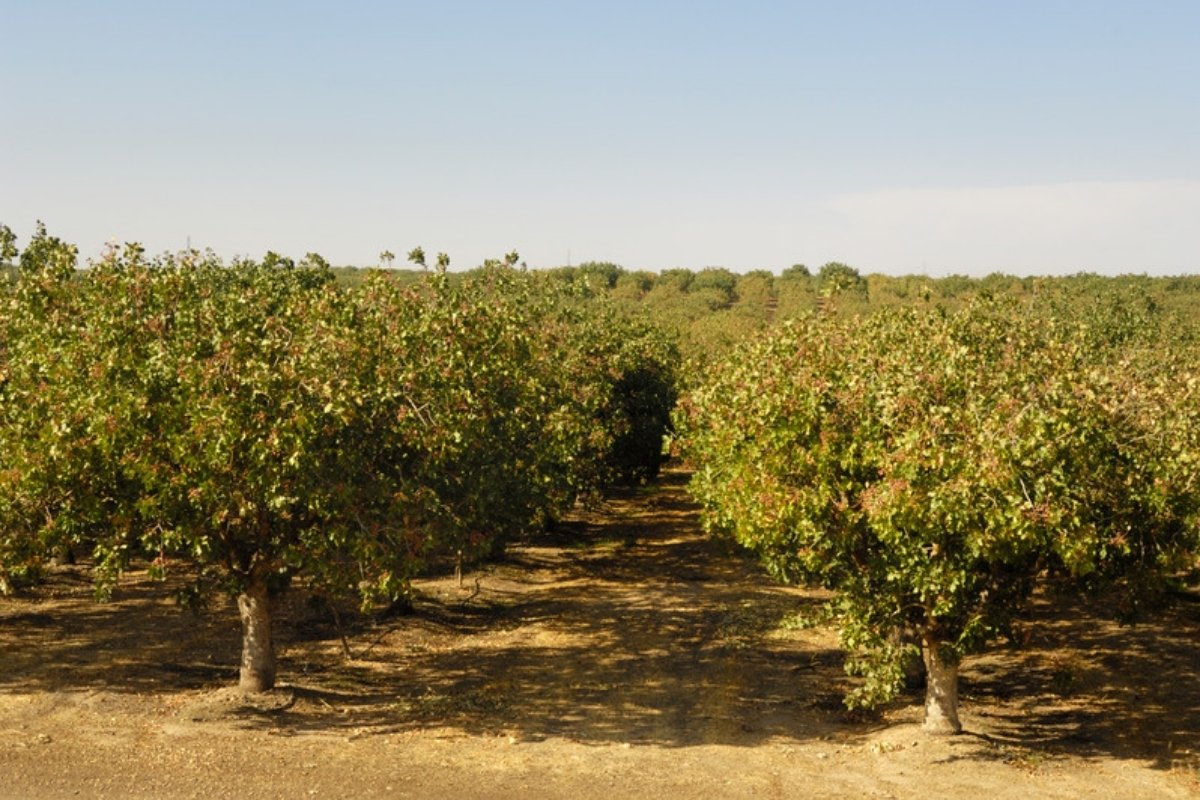
Dry leaves, nuts and panicles left on pistachio trees after harvest are a source of inoculum for the next growing season, and at the same time, three insects, the pistachio psyllid, the seed wasp and the twig borer, settle into the orchard for the winter. Right now, before leaf fall, infected growth can still be told apart from healthy growth so that it can be collected and destroyed accurately. Every infected part removed in autumn reduces the inoculum and pest numbers the orchard will face next spring.
What Botryosphaeria looks like at this time of year
Symptoms of Botryosphaeria dothidea are distinctive in autumn, with blighted leaves, nuts, panicles and whole branches. On leaves, lesions expand and, from August to October, develop into large necrotic areas with pycnidia in the centre, the black fungal structures that hold the spores.
Infected panicles usually hang on the tree for three to four years, supplying inoculum every season. Botryosphaeria lesions look similar to Alternaria, but they are easy to separate: rub the lesion with a finger, and if the finger turns black, the cause is Alternaria.
What to do with infected parts
All infected parts are collected and destroyed before the leaves drop, and dry fallen leaves are removed or worked into the soil with light rotavation. Blighted branches are cut back into healthy wood, about 5 cm beyond the blighted margin, after harvest and again during dormancy, and unharvested nuts and mummies are removed from the trees.
Infected prunings do not remain in the orchard because the fungus continues to produce pycnidia on dead tissue. This autumn, sanitation cut links with winter pistachio pruning, which finishes removing inoculum and opens up the canopy.
Why Septoria needs a copper spray
In orchards that were not adequately sprayed, or where the spray did not properly cover the trees, Septoria can be severe and cause leaf drop. To limit next year's primary inoculum, leaves are sprayed with a copper product before or after they fall, and fallen leaves are removed and burned where burning is permitted, or worked into the soil with light rotavation.
Only copper products authorised for pistachio are used. Because both Septoria and Botryosphaeria are favoured by high relative humidity, winter pruning should keep the canopy well aired.
Where the pistachio psyllid overwinters, and how to reduce it
The common pistachio psyllid, Agonoscena pistaciae, overwinters as an adult in bark crevices, under fallen leaves and in other sheltered spots in the orchard. In spring, the adults return to the trees, and the insect completes five to six generations a year, so the overwintering population sets how quickly the summer infestation builds.
Adults and nymphs suck sap from the leaves and produce large amounts of white powder made of dried honeydew, while their feeding reduces growth and causes leaf drop and loss of flower buds. Populations are rising in several Mediterranean countries, including Greece.
For heavy infestations, four measures are recommended to reduce the overwintering population: collecting and destroying every dry or half-dry part, working fallen leaves into the soil, painting the trunk and scaffold branches with Bordeaux paste, and a post-harvest spray of an approved adulticide combined with summer oil.
The psyllid also has natural enemies, including Anthocoris predatory bugs and the parasitoid Psyllaephagus pistaciae, which do better when sprays are limited to those that are needed.
Why mummified nuts are collected
The pistachio seed wasp, Eurytoma plotnikovi, overwinters as a mature larva inside mummified nuts on the tree or on the ground. To reduce its population, mummified nuts are carefully collected, removed and destroyed, because every nut left in the orchard can produce an adult in spring.
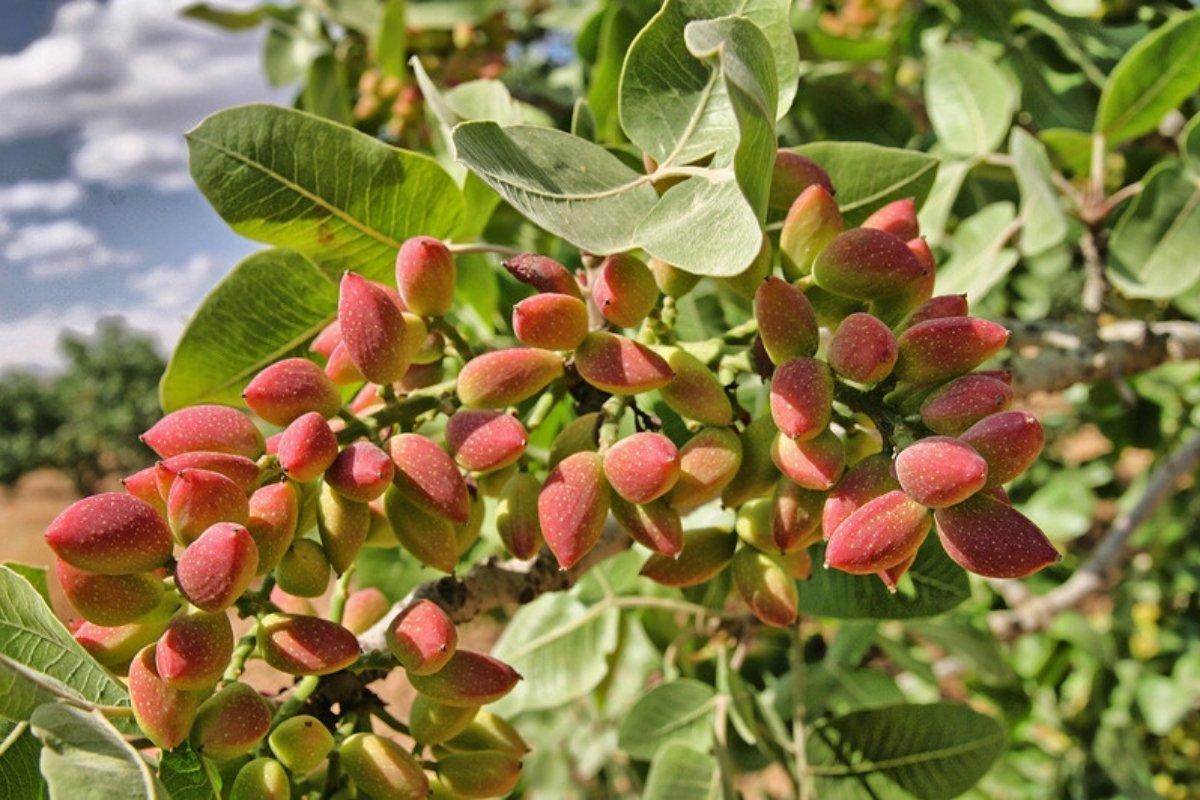
Nuts left on the tree after harvest can turn into mummies, where the seed wasp larva spends the winter.
The wasp has one generation a year: females appear from late April to June and lay eggs in developing nuts, and a single larva eats the seed and overwinters inside it. In Greece, the seed wasp is considered one of the most serious pistachio pests, with infestation reaching up to 90% of nuts.
Some of the mummified nuts are checked for larvae and kept in clear plastic or glass containers in spring, so that the exact emergence date of the adults, and therefore the timing of any treatment, can be determined.
How to trap the pistachio twig borer
When the tree goes dormant, adults of the twig borer Acrantus vestitus leave their feeding tunnels and look for weakened shoots or branches, where they bore breeding galleries and overwinter. Every dry, half-dry or weak branch is removed immediately and burned where burning is permitted.
In autumn, a few dry and half-dry branches are placed near the trees as traps for egg laying and overwintering. These branches are collected and burned in February, before the adults emerge.
| Problem | Where it overwinters | What to do after harvest |
|---|---|---|
| Botryosphaeria | Dry panicles, nuts, branches and leaves | Collect before leaf fall, prune back into healthy wood |
| Septoria | Fallen leaves | Copper on the leaves: remove or incorporate |
| Pistachio psyllid | Bark crevices, fallen leaves | Bordeaux paste, adulticide with summer oil |
| Seed wasp | Mummified nuts | Collect and destroy, keep a sample in containers |
| Twig borer | Weakened branches | Remove dry branches, trap branches until February |
Source: Plant Protection Centre of Volos, nut crop bulletins No 17 and No 18, 25 and 28 September 2026
The wider range of pistachio problems through the season is covered in pistachio tree diseases and pests, while this list focuses on what can be removed from the orchard between harvest and bud break.
Frequently asked questions
Why do pistachio clusters dry up in autumn?
Usually, it is because of Botryosphaeria, which at this time of year causes blight of leaves, nuts, panicles and whole branches. Dry panicles are collected before the leaves fall.
When should pistachio trees get a copper spray in autumn?
In orchards with Septoria, leaves are sprayed with copper before or after they fall to limit next year's inoculum.
Why collect mummified pistachio nuts?
Because the seed wasp larva overwinters inside them, and every nut left on the tree or the ground can produce an adult in spring.
What is the white powder on pistachio leaves?
It is usually dried honeydew from the pistachio psyllid, which sucks sap from the leaves and causes leaf drop at high numbers.
What should be done with dead pistachio branches?
Remove and burn them right away, because the twig borer bores galleries and overwinters in them. A few dry branches placed near the trees act as traps and are burned in February.
How to tell Botryosphaeria from Alternaria?
Rub the lesion with a finger. If the finger turns black, it is Alternaria, while a Botryosphaeria lesion leaves no powder.
Important notes
Conditions vary by region, variety, tree age and year, so the above is a general guide and a starting point for checking the orchard. For heavy or persistent problems, an agronomist should be consulted for an accurate diagnosis and treatment plan.
Cultural measures come first, meaning the removal of infected parts, pruning, and the collection of mummified nuts. When chemical control is needed, use only products authorised for pistachio in Greece, which are listed in the plant protection product database of the Ministry of Rural Development and Food, and follow the label instructions.
Sources
- Regional Centre for Plant Protection, Quality and Phytosanitary Control of Volos, Nut crops, pistachio, Bulletin No 17, 25 September 2026 (in Greek).
- Regional Centre for Plant Protection, Quality and Phytosanitary Control of Volos, Nut crops, pistachio, Bulletin No 18, 28 September 2026 (in Greek).
- UC Statewide IPM Program, Botryosphaeria panicle and shoot blight of pistachio.
- Rousse P. et al., First report of the pest pistachio-seed wasp Eurytoma plotnikovi in France, EPPO Bulletin, 2022.
- ISHS, Pistachio nut insect pests and means of control in Greece, Acta Horticulturae 470.
- Toxicological and biochemical characterizations of AChE in phosalone-susceptible and resistant populations of the common pistachio psyllid, Agonoscena pistaciae, Journal of Insect Science, 2014.
- The Hebrew University of Jerusalem, Agonoscena pistaciae, Middle East pests.