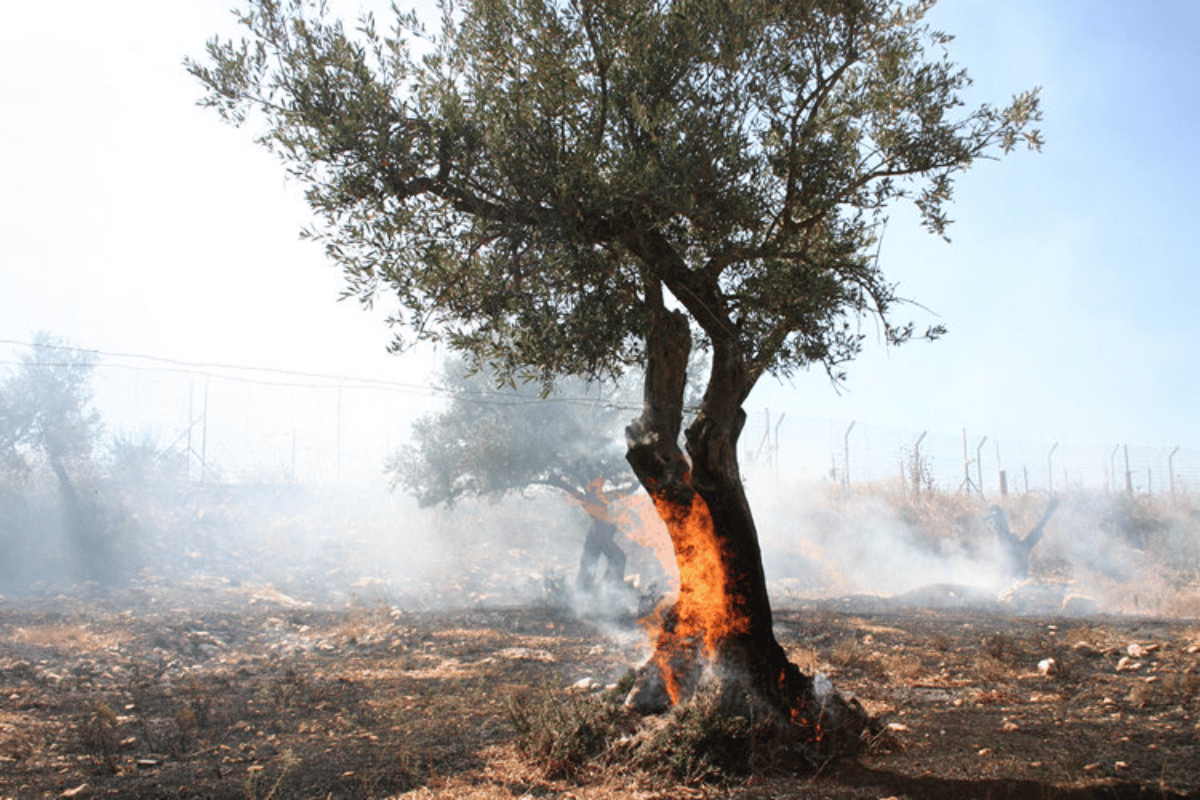
A burnt olive grove looks like a total loss. In most cases, it is not. Olive belongs to the Mediterranean species that regenerate vegetatively after fire rather than depending on seed. Recovery is not automatic, though, and it is not the same for every tree. One decision taken during the first year determines whether the grove comes back as the variety you planted or as something else entirely.
Why olive trees resprout
The ability is structural—Olea europaea subsp. Europaea is among the Mediterranean species that form a lignotuber, a woody swelling at the root-to-shoot transition zone that carries clusters of dormant buds and carbohydrate reserves. In some species, the swelling is obvious. In others, it becomes visible only once the collar region is excavated.
Survival depends on the insulating capacity of the soil itself. Dormant buds sitting at collar level and slightly below are shielded from the heat, so they stay alive even when the entire above-ground structure is destroyed. Recovery in resprouting species is comparatively straightforward, precisely because new shoot growth draws on below-ground biomass that survived the fire almost intact.
What actually kills the above-ground part
A tree is not lost because its leaves burned. It is lost when the cambium dies, the thin layer of living cells directly beneath the bark through which water and nutrients move.
In high-intensity fires, sap inside the trunk heats enough to steam, destroying the cambium from within even when the bark still looks reasonably intact from outside. The result is a tree that is dead above the soil line with a living root system underneath. This is exactly the condition that produces the suckers appearing around the trunk over the following months.
Damage assessment, therefore, does not rely on how the canopy looks. It relies on the condition of the bark and cambium. Within roughly a month, destroyed sections show bark splitting and detachment, while living sections start to push out new shoots.
How quickly does resprouting begin
Faster than most growers expect. Work on olive trees subjected to severe pruning recorded resprouting starting within a couple of weeks.
There is an apparent paradox worth understanding. Trees whose above-ground parts were destroyed often show the first signs of regeneration well before trees that lost only part of their canopies. The explanation lies in how reserves are allocated. With no above-ground growth left to maintain, the root system channels its reserves straight into new basal shoots. Where the canopy remains, the tree supports it first and follows the normal seasonal rhythm.
What determines whether a tree survives
Two factors have been documented clearly.
Tree size: In a study of a low-intensity fire, larger trees with trunks and branches over 20 mm in diameter were not killed, while 80% of younger plants with stems under 20 mm died. Larger individuals carry more protected buds and larger reserves.
Water status before the fire: In the same study, lower rainfall preceding the event appears to have increased mortality by reducing small plants' capacity to resprout under water stress. A grove that enters a fire already water-stressed has poorer odds than one that was adequately irrigated.
These observations come from feral olive populations outside cultivation, so the percentages do not transfer directly to a managed grove. The direction, however, is consistent and matches field experience.
The graft union decides which variety comes back.
This is the decision that determines what your grove will be in five years, and it is routinely left out of recovery guidance.
Where a tree was propagated by grafting, the suckers emerging from the base do not belong to your variety. They belong to the rootstock, which is frequently wild olive or a different cultivar selected for vigour and soil adaptation.
Genetic work shows how common this is. In a study using molecular markers on 310 old olive trees across 32 groves, comparing the genetic fingerprint of the canopy against that of basal suckers, the two were genetically different in 82.7% of trees. Genetic diversity among suckers was, in fact, far higher than among scions. Monumental olive trees in Sicily produced the same picture, with canopy and sucker showing no correspondence in most cases.
The practical consequence is simple. Select a sucker originating below the graft union, let it become the new tree, and you are growing the rootstock. It will grow, it will be vigorous, and it will bear fruit that is not what you expected.
Locate the graft union before choosing any sucker. It appears as a lump or line on the trunk, often with a difference in bark colour or texture between the two sides. Keep only shoots arising above it. Trees raised from cuttings rather than grafted carry no such risk, and can be retrained even from shoots emerging at or below soil level.
Three options after a fire
| Option | When it applies |
| Retrain a sucker | Vigorous shoots are present above the graft union, or the tree was never grafted. |
| Graft onto the sucker. | Shoots come from the rootstock. Keeps the established root system and saves years compared with replanting |
| Remove and replant | No resprouting at all by the following spring |
The middle option deserves attention because it is often overlooked. Rather than removing a tree whose root system is entirely healthy simply because its suckers belong to the rootstock, the sucker can be grafted with the wanted variety. A root system built over decades feeds new growth at a rate no newly planted tree can approach.
How long does recovery take
Recovery is measured in years rather than months. A California grower who tracked his own trees after a fire reports that three and a half years later, the regenerated trees were carrying a light crop of olives.
I just wanted to note how unusual this capacity is among fruit trees. In Californian orchards, regeneration from the stump is essentially limited to olive, fig and date. Other orchard species are grafted onto rootstocks of a different variety or even a different species, so basal resprouting does not restore the crop.
How much punishment does an olive tree take
An example from eastern Spain shows the range of that resilience. Olive trees at Montán, planted long ago for production and originally single-stemmed with the characteristic thick trunk, burned in 1994. The fire killed the main stem, and the trees pushed out many basal suckers, becoming multi-stemmed. In 2015, the area burned again, killing those twenty-one-year-old resprouts, and the trees produced new ones.
The second fire also consumed the dead trunk left by the first, including its base, leaving a hole in the tree. Researchers note that this picture is fairly common. The trees survived two wildfires over twenty-one years.
What not to do
Two courses of action look sensible and are not.
Do not prune before resprouting begins: Pruning before living cambium reveals itself either removes live wood or leaves dead wood behind. Resprouting dictates the pruning, not the other way round.
Do not thin the shoots during the first growing season: The tree needs to rebuild leaf area and root system first. Every leaf feeds the roots, and every root supports more growth. Shaping comes later, once there is something to choose between.
New growth is also highly vulnerable to defoliating insects and mites, while weakened trees are a preferred target for wood-boring insects. Protection during the resprouting period matters as much as the pruning decisions that follow.
Notes
Every burnt grove presents a different picture, depending on fire intensity, how long the fire stayed in the grove, the age and condition of the trees, and water availability. The figures and timings quoted come from studies and records made under specific conditions and serve as an order of magnitude rather than a prescription. Damage assessment and recovery planning are best carried out with an agronomist.
Sources
- Paula, S., Naulin, P. I., Arce, C., Galaz, C. & Pausas, J. G. Lignotubers in Mediterranean basin plants. Plant Ecology.
- Barazani, O. et al. A comparative analysis of genetic variation in rootstocks and scions of old olive trees. PMC.
- Recovery and genotyping ancient Sicilian monumental olive trees. Frontiers in Conservation Science.
- Horticulture Industry Network, Victoria. Recovery of olive groves after fire.
- Pausas, J. G. Olive trees resprouting.
- University of California ANR. After the Fire in the Avocado Grove, Replant or Sucker-Graft.