
An insect a few millimetres long locates the right fruit, the right mate and the right food source within a grove of hundreds of trees. It does so almost entirely by smell, and the compounds guiding it have largely been identified, with substantial contributions from Greek research groups.
That body of knowledge underpins every trap and every bait spray in use today.
Three distinct categories of scent
The olive fly responds to three groups of volatile compounds, each with a different role.
Host volatiles, released by the fruit itself, guide the female to a site for egg laying.
Food odours, chiefly nitrogen-bearing compounds, guide both sexes towards protein sources.
Pheromones, released by the insect itself, bring the two sexes together.
Each has been turned into a monitoring or control tool, with varying degrees of success.
Olean
The principal sex pheromone of the olive fly was identified as the spiroketal 1,7-dioxaspiro[5.5]undecane, known as olean. It is produced mainly by females, secreted from the rectal glands, and attracts males.
Identification came in the early 1980s, through the work of Baker and colleagues and of Mazomenos and Haniotakis, researchers based in Greece whose work was central to understanding chemical communication in the species.
The pheromone is not a single compound. Alongside olean, α-pinene, nonanal and ethyl dodecanoate have been identified, while later work added more than twenty minor components. Olean remains the most active and the only one put to wide practical use.
One molecule, two different recipients
The most interesting finding in work on this species concerns the geometry of the molecule itself.
Olean is chiral, meaning it exists in two mirror-image forms that cannot be superimposed, in the way a left hand cannot be superimposed on a right. The two forms are called enantiomers.
Females release olean as a racemate, with equal amounts of both enantiomers. The two sexes, however, do not perceive the same thing.
In laboratory and field tests, males responded exclusively to the (R) enantiomer, which functions as a sex attractant. Females responded exclusively to the (S) enantiomer, with evidence that it acts as a short-range arrestant and as a stimulant during mating.
A single secretion therefore carries two different messages, and the recipient is determined by the geometry of the molecule.
The male replies
Communication does not run one way. Males have been found to produce (Z)-9-tricosene, also known as muscalure, in their rectal glands, a compound that selectively attracts females.
That finding revised the earlier picture of the species, showing that both sexes release attractants and take an active part in locating a mate.
Why traps do not use pheromone
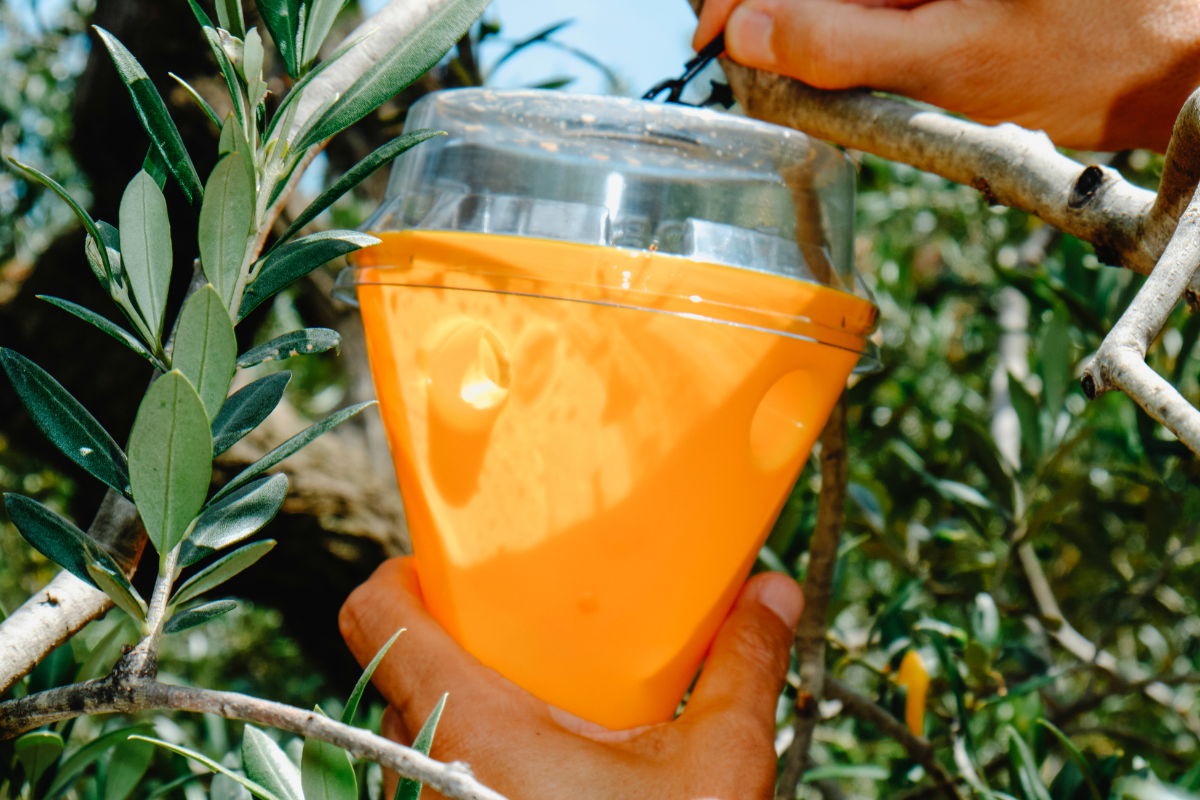
Although olean has been known and available in synthetic form for decades, organised monitoring networks use food attractants, namely ammonium salts and protein hydrolysates.
The reason follows from the findings themselves. Olean attracts mainly males, while damage to the fruit is caused exclusively by females. A trap catching males gives an indirect measure of population size rather than a direct measure of egg-laying pressure.
Food attractants work differently. They target the nutritional need rather than the reproductive one, so they draw both sexes. And because females require protein to mature their eggs, their response to nitrogen-based lures is strongest precisely when they are about to lay.
Gamma-hexalactone and a possible shift
Recent work has opened a new line. γ-hexalactone was identified, a compound released only by males yet attractive to both sexes.
In field trials, traps baited with a combination of ammonium bicarbonate and γ-hexalactone caught significantly more individuals of both sexes per week than traps baited with the ammonium salt alone, or with the ammonium salt plus olean.
The finding carries practical weight. If it holds at scale, it could improve the efficiency of mass trapping, a method currently constrained by the large number of traps it requires.
Temperature changes the response
One further point links chemical ecology to the calendar of the grove.
Work under Mediterranean conditions showed that female response to fruit volatiles depends on temperature. Response peaks around 30°C and falls essentially to zero at 15°C and at 35°C.
The same compounds therefore do not act the same way under all conditions. A trap that performs in September may return very few catches during the August heat, without the population having declined at all.
Related articles
Notes
The findings described come from research studies and concern understanding of insect behaviour. Choice of attractant, trap density and treatment timing in the field are set by local programmes and plant protection bulletins, in consultation with an agronomist.
Sources
- Mazomenos, B. E. & Haniotakis, G. E. Sex-specific activity of (R) and (S) 1,7-dioxaspiro[5.5]undecane, the major pheromone of Dacus oleae. Journal of Chemical Ecology.
- Analyzing Diurnal and Age-Related Pheromone Emission of the Olive Fruit Fly, Bactrocera oleae by Sequential SPME-GCMS Analysis. Journal of Chemical Ecology.
- Canale, A. et al. Behavioural and electrophysiological responses of the olive fruit fly to male and female borne sex attractants. Chemoecology.
- A shift in the paradigm, a male-specific lactone increases the response of both sexes of the olive fruit fly to the food lure ammonium bicarbonate. Journal of Pest Science.
- International Olive Council. The olive fruit fly Bactrocera oleae (Rossi), World Catalogue of Olive Varieties.