
Diets were not measured in the Sustainable Development Goals for a decade. That changed in March 2025, when the UN Statistical Commission approved minimum dietary diversity for children and women as new indicators under SDG 2, and the 2026 edition of The State of Food Security and Nutrition in the World now presents the first full picture of them. It is not encouraging. Only 30.8% of children aged 6 to 23 months worldwide eat foods from at least 5 of 8 food groups in a day, and only 62.7% of women aged 15 to 49 reach the equivalent threshold.
The children's figure has barely changed over the past 10 years, from 29.4% in the pooled data for 2011-2017. More than two-thirds of the world's young children are eating diets narrow enough to put their intake of vitamins, minerals and other nutrients at risk during the period when growth and brain development are most sensitive.
Key takeaways
- 30.8% of children aged 6 to 23 months eat a minimally diverse diet, against 29.4% a decade earlier.
- 62.7% of women aged 15 to 49 reach the threshold, meaning about one in three does not.
- Africa records the lowest figures, at 20.5% for children and 43.0% for women.
- The indicators are new, approved for SDG monitoring in March 2025 after diets went unmeasured since 2015.
- Targets are now attached, with the World Health Assembly asking for a 20% rise in children's dietary diversity and a 30% rise for women.
What minimum dietary diversity actually measures
Both indicators count food groups rather than nutrients, which is what makes them usable at scale. For children aged 6 to 23 months, a caregiver reports everything the child ate or drank in the previous 24 hours, at home and elsewhere, and the child is considered to have reached the minimum dietary diversity if the list covers at least 5 of the 8 groups. Those groups are breastmilk, grains, roots and tubers, plantains, pulses and nuts and seeds, dairy, flesh foods, eggs, vitamin A-rich fruits and vegetables, and other fruits and vegetables. Any amount counts, with no minimum quantity.
For women aged 15 to 49 the threshold is five of ten groups, and here a quantity rule applies, since a food group only counts if roughly 15 g was eaten, about a tablespoon. The ten groups separate dark green leafy vegetables from other vitamin A-rich produce and from other vegetables, making the measure sensitive to the foods that carry micronutrients.
Neither indicator claims to measure nutritional adequacy directly. Both were validated as proxies, and women or children who clear the threshold are considerably more likely to be getting enough of the micronutrients that matter, including calcium, folate, vitamin A and zinc. What the indicators capture is diversity and adequacy, two of the four principles of a healthy diet, and they leave the other two, balance and moderation, unmeasured.
Two-thirds of young children fall short
The global figure of 30.8% comes from surveys pooled between 2018 and 2024, and its stagnation is the headline. Ten years of nutrition programming has moved children's dietary diversity by 1.4 percentage points.
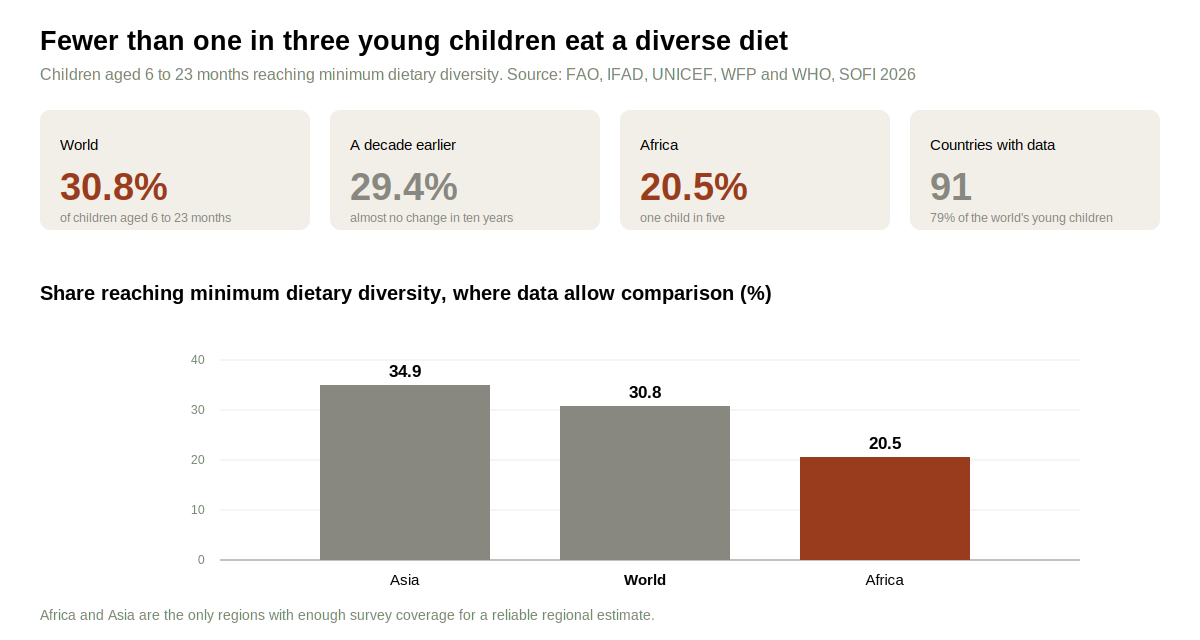
Regional differences are wide where data allow a comparison. In Africa, only one child in five, 20.5%, eats a minimally diverse diet, against 34.9% in Asia. Those two regions are the only ones with enough survey coverage to produce reliable aggregates, which is itself part of the story.
The context makes the numbers heavier. An estimated 150.2 million children under five are stunted, and 42.8 million are affected by wasting, while obesity has overtaken underweight as the dominant form of malnutrition among school-age children and adolescents. Narrow diets feed both ends of that problem, because a diet built on a couple of starchy staples can deliver enough calories while leaving a child short of iron, vitamin A and zinc.
One in three women falls short too
Among women aged 15 to 49, 62.7% reached minimum dietary diversity in the pooled data for 2021 to 2025. Last year's report gave 65.0% for 2020 to 2024, so on this measure, there has been effectively no progress either.
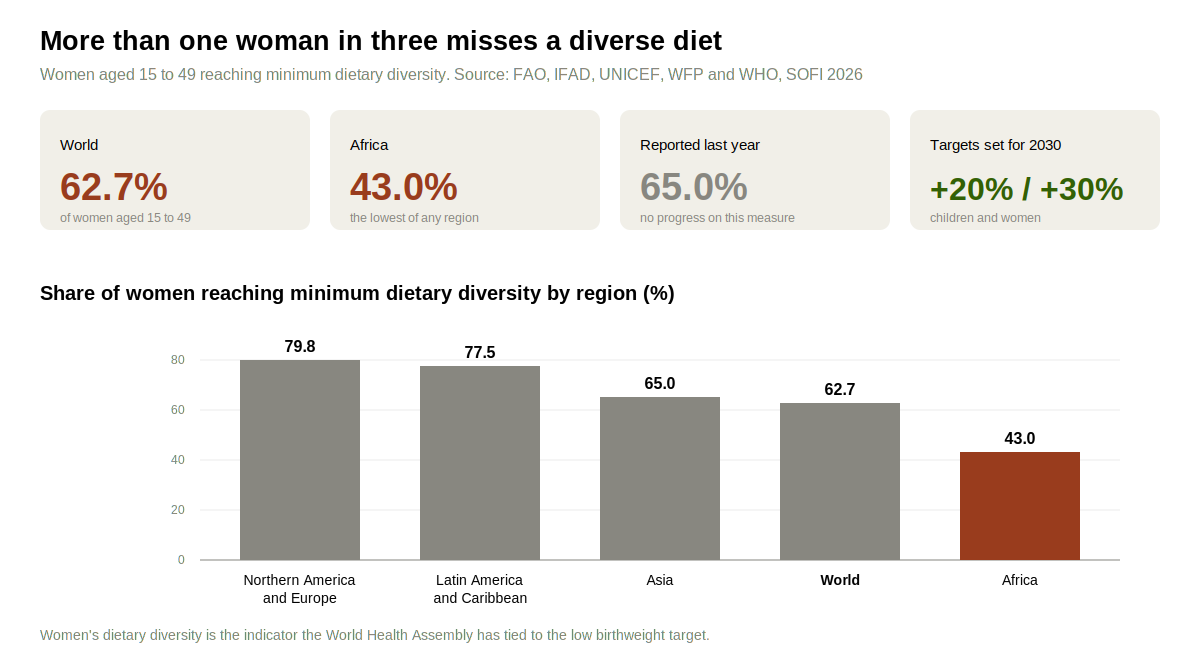
The regional spread runs from 43.0% in Africa to 65.0% in Asia, 77.5% in Latin America and the Caribbean and 79.8% in Northern America and Europe. Women's dietary diversity matters beyond the women themselves, since it is the indicator the World Health Assembly has linked to low birthweight, where global progress has almost stalled at 14.7%.
Where the data does not exist yet
Coverage is the quiet problem running underneath both indicators. Children's data exist for 91 countries, covering 79% of the world's children aged 6 to 23 months, but that coverage is concentrated. Africa reaches 89.1% and Asia 89.6%, while Latin America and the Caribbean sits at 47.9%, Northern America and Europe at 5.4% and Oceania at 1.5%.
Women's data cover 99 countries and 87.6% of women of reproductive age globally, with Africa at 94.5% and Asia at 93.9%, but Northern America and Europe reach only 51.7% and Oceania 2.2%. High-income countries, in other words, largely do not measure what their own populations eat in a way that feeds this indicator, which makes global comparisons partial and hides problems in places that assume they do not have them. Both indicators also rest on a single day's recall, so they describe a population rather than an individual and can miss seasonal swings.
Why this lands on what gets grown
Dietary diversity is a production question as much as a consumption one, because people cannot eat variety that nobody grows or brings to market. The report is clear that shortfalls in the availability of fruits, vegetables, legumes, nuts, and seeds are pronounced worldwide, with large regional gaps in animal-source foods, and that agrifood systems currently produce enough food but do not deliver enough nutritious food.
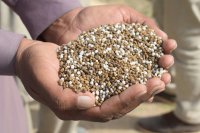
That is where the measure becomes useful for anyone working in production rather than in health ministries. Underused and indigenous species expand what is available locally at prices people can afford, which is the same mechanism that lets countries drawing on their own least-cost local foods build a healthy diet basket 34% cheaper than one assembled from internationally traded items. Work on underutilised and indigenous crops speaks directly to this, since crops such as millet, sorghum, teff and quinoa carry micronutrients that the dominant staples lack.
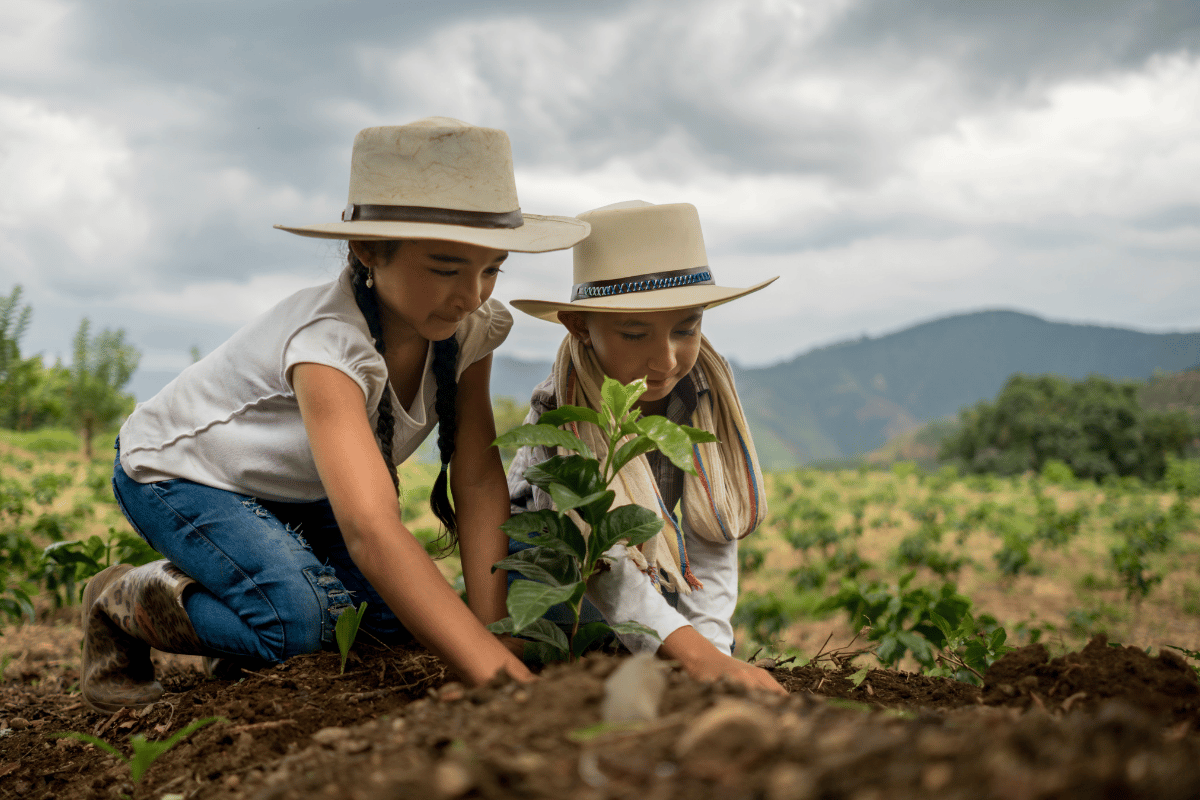
Household production counts as well. Evidence gathered from IFAD-supported projects shows where it works and where it does not. A ten-year watershed and orchard programme in Türkiye increased the food group diversity score among women of reproductive age by 3 percentage points compared with comparison households, with more women eating nuts and seeds, meat, poultry and fish, and dark green leafy vegetables. A climate adaptation project in Nepal that pushed commercial vegetable and fruit growing raised the same score by nine percentage points. A water infrastructure project in Cabo Verde showed no significant effect, which is the honest counterpoint. Infrastructure alone does not change diets unless the crops and markets follow. The same logic underlies the case for home gardens as a route to more varied household diets.
The targets are now attached to the numbers
Measurement without a target changes little, and in May 2025, the Seventy-eighth World Health Assembly adopted six process indicators for the extended global nutrition targets. Two of them are these. Children's minimum dietary diversity is to rise by 20% relative to a 2025 baseline and is treated as the operational lever for the child stunting target. Women's minimum dietary diversity is to rise by 30% and be linked to the low birthweight target.
Both targets sit within a broader picture where the world is off track on all seven global nutrition targets, so the value of these two indicators lies in giving governments something they can act on and measure within a few years rather than a decade. Dietary diversity responds to changes in what is available, affordable, and marketed far more quickly than stunting rates do, making it an early signal of whether policy is working. Turning that signal into better outcomes means treating diet quality as an agricultural objective alongside yield, and that is the point where dietary diversity stops being a health statistic and becomes part of food security.
Sources
- FAO, IFAD, UNICEF, WFP and WHO. 2026. The State of Food Security and Nutrition in the World 2026. Rome.