
Maize yields are forecast up to 36% below average in some of the main producing counties of western Kenya, according to forecasts by the Kenya ADAPT project and Kenya's Ministry of Agriculture cited in the GEOGLAM early warning bulletin of 1 October 2026. The summer drought is linked to the 2026 El Niño and the risk it poses to crops and food prices, and the harvest in the west is under way while the Kenya Meteorological Service Authority (KMD) forecasts above-average rain in the western counties until January.
June to September was among the driest on record in western Kenya
In its special report on El Niño of 16 October, GEOGLAM, the international crop monitoring initiative, writes that the June to September 2026 rainy season was exceptionally poor in northern and western East Africa, with totals below 30 to 75% of average in many areas, and that it ranked among the driest on record across large areas of western and north-western Kenya. In western Kenya and the North Rift rainfall deficits reached 100 to more than 300 mm, and record-high maximum temperatures were observed in the deficit areas, so heat added to the crops' moisture stress. KMD's review of June to August shows the same picture, with most of the country receiving below-average rain and only the Kisii, Malindi, Lamu, Kericho, Kisumu and Mombasa meteorological stations recording near-average rainfall, while temperatures were above average over most of the country.
Summer rain in the North Rift was the lowest since 2009
In a Wikifarmer analysis of NASA's gridded POWER estimates for a North Rift point between Uasin Gishu and Trans Nzoia, the main maize counties, rain from June to September 2026 reached 558 mm, 76% of the 1991 to 2020 average of 730 mm. It was the seventh lowest total since 1991 and the lowest since 2009, after seven years from 2019 to 2025, six of which had above-average rain. The mean maximum temperature over the same period reached 23.1 °C, about 2.1 °C above average and the highest in the 36 years since 1991 at that point.
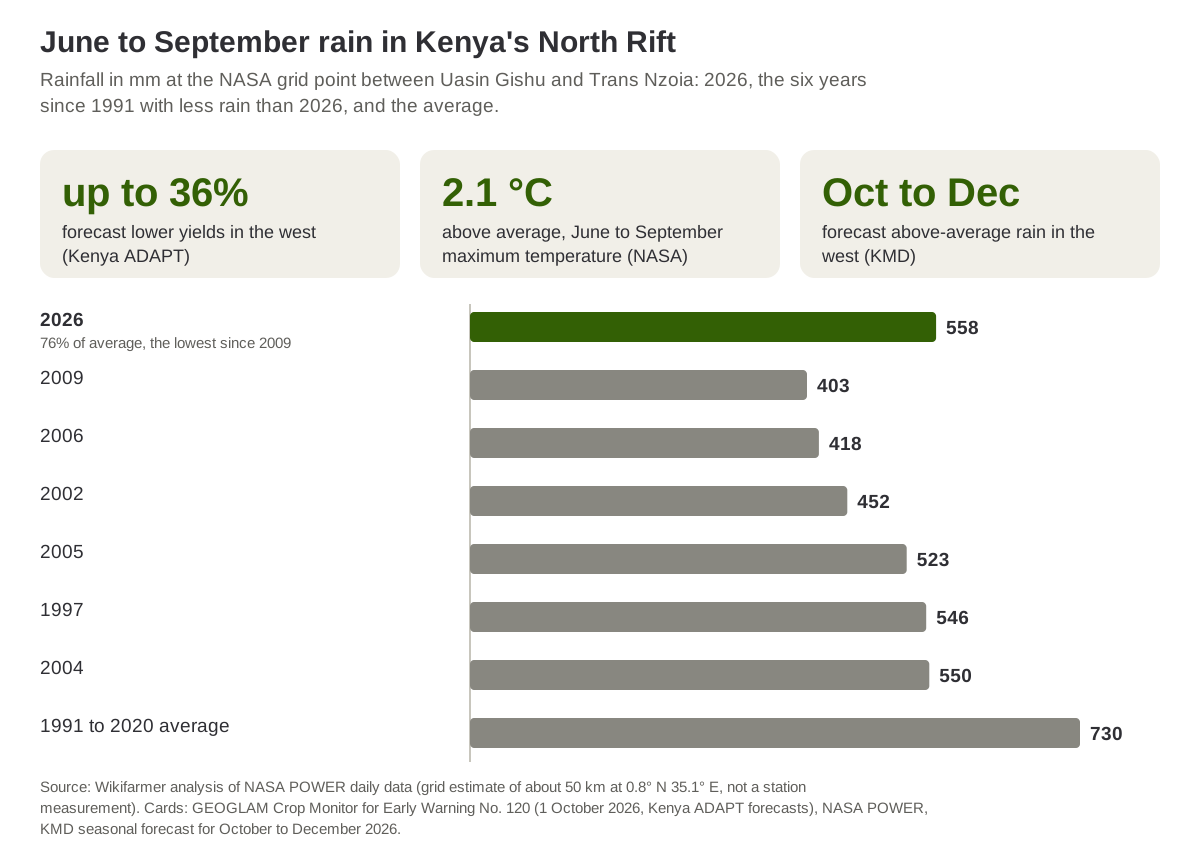
Source: Wikifarmer analysis of NASA POWER daily data (grid estimate at 0.8° N 35.1° E, 1991 to 2020 reference period), GEOGLAM Crop Monitor for Early Warning No. 120 (1 October 2026) and the KMD seasonal forecast for October to December 2026.
Maize yields in the west are forecast up to 36% below average
According to GEOGLAM's bulletin, harvesting is under way in the western half of the country, which has one rainy season a year and holds the main producing areas, and erratic rains, prolonged deficits since April and high temperatures are expected to result in poor yields in most areas, particularly in the western half. Yield forecasts by the Kenya ADAPT project, made in partnership with Kenya's Ministry of Agriculture using the GEOCIF model, put maize yields up to 36% below average in some major producing counties in the west. GEOGLAM notes that poor rainfall and prolonged dry spells reduced the moisture available to crops during key growth stages, when maize water requirements rise.
KMD forecasts above-average rain from October to December
In its seasonal forecast for the October to December "short rains", issued on 31 August 2026, KMD expects above-average rainfall in most counties, including the maize counties of Trans Nzoia, Uasin Gishu, Bungoma, Nakuru, Nandi, Kakamega and Elgeyo-Marakwet. In the western counties the rains are expected to continue from September into January with fair to good distribution, while mean temperatures are forecast to be warmer than average. The service explains that a positive Indian Ocean Dipole enhances the season's rainfall and that El Niño, currently strong, also enhances it when it occurs together with a positive Dipole.
GEOGLAM also expects above-average and generally well-distributed rain this season, which is particularly important in the eastern and south-eastern areas with two rainy seasons a year, where it contributes more than 40% of annual rainfall. It warns, however, that heavy rain could cause flooding, with very high risk in north-eastern and south-eastern Kenya and the Tana River basin.
Moisture at harvest raises the risk of losses and aflatoxins
Among the forecast's impacts on agriculture, KMD lists that high moisture may cause produce to rot or become contaminated, leading to pre- and post-harvest losses, that high humidity may increase pests and diseases, and that planting fertiliser applied after the onset of the rains is likely to be washed away. The measures it proposes include post-harvest infrastructure such as solar dryers and storage, and surveillance of grain reserves and markets for aflatoxin contamination in maize and other cereals. KMD also advises early land preparation, dry planting before the rains and long-maturing, high-yielding maize varieties suited to a possibly extended rainy season.
The western crop will be dried and stored in an autumn forecast to be wet
For growers in the North Rift and western Kenya, the crop being harvested now is expected to be smaller than usual and has to be dried and stored in a season forecast to be wetter than normal, while for the eastern and south-eastern areas that grow crops in the short rains the outlook favours the new planting, with flood risk near rivers. For buyers of maize in Kenya, the GEOGLAM and Kenya ADAPT assessments point to lower yields in the main western areas, while the official sources Wikifarmer checked up to 26 October contained no national production estimate. The picture may change with official estimates from the Ministry of Agriculture and with how the season's rains develop.
Frequently asked questions
How much are maize yields expected to fall in Kenya?
Forecasts by the Kenya ADAPT project with Kenya's Ministry of Agriculture, cited by GEOGLAM, put yields up to 36% below average in some of the main producing counties in the west. GEOGLAM expects poor yields in most areas, particularly in the western half of the country.
Why was the summer so dry in western Kenya?
GEOGLAM attributes the June to September 2026 drought in northern and western East Africa to the strengthening El Niño, with rainfall deficits of 100 to more than 300 mm in western Kenya and the North Rift and record-high maximum temperatures.
What does KMD forecast for October to December?
KMD expects above-average rainfall in most counties, including the maize counties of the west, with rains continuing into January and temperatures warmer than average.
Why is rain at harvest a problem for maize?
According to KMD, high moisture may cause produce to rot or become contaminated before and after harvest, and the service calls for aflatoxin surveillance of grain reserves and markets and for more dryers and storage.
Where is there a risk of flooding in Kenya?
GEOGLAM sees a very high flood risk in north-eastern and south-eastern Kenya and the Tana River basin, as well as in southern Somalia.
Important notes
The article is based on GEOGLAM's early warning bulletin and special report on El Niño, KMD's seasonal forecast and review, and a Wikifarmer analysis of NASA POWER daily data. The NASA data are grid estimates of about 50 km at 0.8° N 35.1° E, between Uasin Gishu and Trans Nzoia, and not station measurements, with a 1991 to 2020 reference period and rankings over the 36 years 1991 to 2026. The yield forecast is by the Kenya ADAPT project as cited by GEOGLAM and is not a national production estimate. Forecasts are probabilities for average seasonal conditions and change with every new issue. The article does not give farming or marketing advice. For planting, fertilising and storage, follow the guidance of the competent authorities and the advice of an agronomist.
Sources
- GEOGLAM Crop Monitor. (2026, October 1). Crop Monitor for Early Warning, No. 120.
- GEOGLAM Crop Monitor. (2026, October 16). Special Report, El Niño 2026-2027, Regional Outlooks.
- Kenya Meteorological Service Authority. (2026, August 31). Outlook for the October-November-December 2026 "short rains" season and review of the June-July-August 2026 season.
- NASA Langley Research Center. (2026). POWER, daily point data, community AG, retrieved 23 October 2026.