As the table olive harvest approaches in Messinia, Laconia and Aetolia-Acarnania, Kalamon is the Greek variety with the widest international recognition. That reputation, however, comes with a naming confusion that has reached the European Commission and Greece's Council of State.
The variety and the PDO are different things
Kalamon is the name of the variety. Elia Kalamatas is a Protected Designation of Origin, recognised since 1996, covering exclusively olives of the Kalamon variety produced in the prefecture of Messinia. Olive oil produced in the same prefecture may carry the same designation.
The European Commission has stated this explicitly, pointing out that "Kalamon" is the name of the variety rather than the registered PDO name. Olives of the same variety grown outside Messinia, whether elsewhere in Greece or abroad, may lawfully be sold under the variety name.
The gap between the two is wide. PDO table olives cover just 3,400 stremmata, about 340 hectares, with 165,000 trees and average production of 3,000 to 3,500 tonnes, while the variety itself is grown across a far larger area.
The use of "Kalamata" as a synonym of the variety has occupied Greek administration and courts for years. For the current position on labelling and export, the correct source is the competent ministry and the regulation in force.
The variety's other names
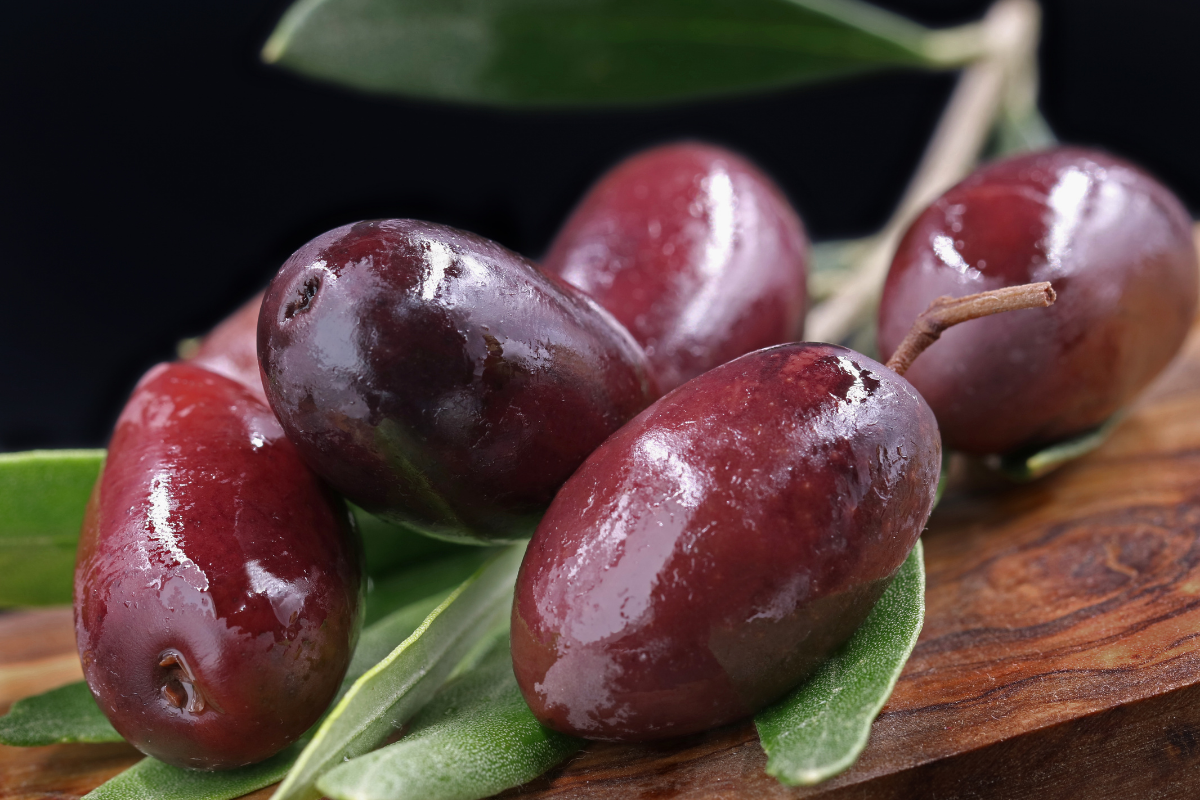
Kalamon also circulates as Aetonycholia, Kalamatiani and Tsigkeli, and the name Aetonycholia has its own explanation. The fruit has a cylindro-conical shape recalling the berry of the Aetonychi grape variety, with which it shares its long, pointed form.
The fruit
The fruit weighs on average 5 to 6 grams, with colour at maturity ranging from chocolate to dark brown or violet, and a characteristically pointed shape. Of particular commercial value for a table variety is that the stone is smooth and separates easily from the flesh, which favours both eating and processing. Although primarily a table variety, it also yields olive oil of very good quality, so some sources class it among dual-purpose varieties.
Why price is set by fruit size
This feature governs the economics of the crop and sets Kalamon apart from oil varieties.
Price is set not by the total weight of the load but by the size of each fruit, expressed as the number of fruit per kilo. A large fruit of around 7 grams corresponds to roughly 140 fruit per kilo, while a small fruit of around 4 grams corresponds to 250 fruit per kilo, with the price gap between the two categories approaching double.
That pricing creates a strong incentive for growers to enlarge the fruit, often through heavy irrigation and foliar feeding. The practice can work against quality, however, since over-hydrated fruit has looser flesh and behaves worse during debittering.
The tree and its requirements
The tree is vigorous, with branches showing a climbing tendency and characteristically large leaves, a trait that allows the variety to be recognised even without fruit. Productivity is rated moderate.
The variety is demanding of both soil and atmospheric moisture, a double requirement that limits the positions where it performs well. It is nonetheless frequently grown rainfed in the Peloponnese, with a corresponding effect on fruit size. It grows on all soils, even poor and stony ones, but performs far better on reasonably fertile soils that hold sufficient moisture.
Tolerances
The variety is resistant to Verticillium wilt, a disease that causes serious losses in susceptible varieties, and tolerant of soil salinity, a trait useful in coastal areas and on soils irrigated with high-conductivity water. Those two tolerances suit it to positions where other varieties struggle.
On cold, it is sensitive to severe frost and thrives in areas with a mild Mediterranean climate.
The mother tree
According to a publication by ELGO-DIMITRA, the national agricultural research organisation, the mother tree of the variety is around 190 years old, with a trunk so broad that eight people fit inside it. It remains productive to this day, yielding up to 1,000 kilos of fruit in a good year, and continues to supply the Institute of Olive Tree with propagation material.
When it is harvested
Ripening is rated mid-early, with fruit maturing from late November to December.
Harvest timing is set by colour and by purpose. For table olives, picking happens once the fruit has taken on its characteristic dark colour while still holding firm flesh, since over-ripe fruit softens and degrades in processing. Handling is more careful than for oil varieties, because every knock shows in the final product.
In Messolonghi, Kalamon grown for table olives is harvested from the end of October, while in Gytheio it follows the green Koroneiki of early November, as the growers describe in when and how olives are harvested in Greece. How ripeness is judged and how the fruit should reach the mill is covered in the guide to harvesting olives.
Where it is grown
The variety is grown mainly in Messinia, home to the PDO zone, and also in Laconia, Aetolia-Acarnania, Phthiotis and Crete, while in more recent times its cultivation has spread beyond Greece, including to South America.
Notes
Fruit weight and fruit-per-kilo figures are indicative, and producer prices vary considerably from year to year. The legal status of the name and of labelling should be confirmed with the competent ministry and the regulation in force. Before establishing a new planting, consult a local agronomist, since the variety's double requirement for soil and atmospheric moisture does not make it suitable for every position.
Sources
- ELGO-DIMITRA. The mother tree of the Kalamon olive. Dimitra magazine.
- Agronews. The variety and the PDO are different, says the Commission on Kalamon.
- Wikipedia. Kalamon olive.