Grass seed germinates best in early autumn and mid-spring, when the soil is warm, moisture is plentiful, and the weather is neither too cold nor too hot. Of the two seasons, autumn has the edge, because the soil still holds the warmth of summer, and weed competition is lower than with an early spring sowing. Success depends on more than timing, though. It comes down to the right grass type, the right quantity of seed and, above all, the watering of the first days. This guide covers when to sow, which grasses suit each season, how much seed each square metre needs, how to prepare the soil, how to water and mow the new lawn, and how to fill thin patches in an existing one.
When to sow a lawn
In temperate and Mediterranean climates, there are two sowing windows, early autumn and mid-spring, typically September to October and March to May in the northern hemisphere. Sowing starts once daytime temperatures reach at least 15°C, and autumn brings together most of the advantages:
- Warm soil: the heat stored over summer speeds up germination
- Cool nights and early rains: they keep the surface moist without constant watering
- Fewer weeds: weed pressure is markedly higher on lawns sown in early spring
- Time to root: the young grass establishes well before winter and enters its first summer strong
Autumn is therefore the best time to sow a lawn, alongside the rest of the September planting jobs. There is one important exception, the warm-season grasses, which are not sown in autumn.
Cool-season and warm-season grasses
Lawn grasses fall into two groups, and the group decides the sowing season. Cool-season grasses remain green year-round and are sown in autumn and spring. Warm-season grasses cope exceptionally well with heat and drought, but they turn straw-coloured in winter and are sown only in warm weather.
| Grass | Character | When to sow |
|---|---|---|
| Tall fescue (Festuca arundinacea) | The most widely used and toughest grass in hot Mediterranean climates, tolerant of heat, wear and shade | Autumn and spring |
| Red fescue (Festuca rubra) | Fine-leaved, a common component of mixes for shaded areas | Autumn and spring |
| Perennial ryegrass (Lolium perenne) | Germinates fast and tolerates heavy wear, but needs more water | Autumn and spring |
| Bermuda grass (Cynodon dactylon) | Outstanding tolerance of drought, hard use and coastal sites, but dormant and brown in winter | From spring to summer, soil above 18°C |
| Kikuyu (Pennisetum clandestinum) | Grows very fast and covers ground quickly, but needs frequent mowing | Spring to summer |
| St Augustine grass (Stenotaphrum secundatum) | Broad-leaved, for coastal areas, with good salt tolerance and lower water needs | Not sown, established from plugs or turf |
Bermuda grass deserves particular attention, because it is the most common cause of a failed autumn sowing. Its seed will not germinate until soil temperature reaches about 18°C, so sowing it in October leaves the ground never greening up. The same applies to all warm-season grasses. St Augustine grass, for its part, is not sold as seed and is established from plugs set 20 to 30 cm apart, roughly 15 per square metre.
The traits of each type of lawn grass, from shade tolerance to salt tolerance, decide which one suits a given garden. In practice, most gardens are sown with seed mixes that combine fescues, ryegrass and meadow grass, so the lawn pairs fast germination with wear tolerance and adaptation to both sun and shade. For ground that gets very little watering, creeping clover is an alternative that tolerates harsh conditions and requires minimal water.
How much seed per square metre
The quantity depends on the grass and is always stated on the packet, with these general rates:
- Mixes and fescues: 35 to 50 grams per square metre, meaning 3.5 to 5 kg per 100 square metres
- Warm-season grasses such as kikuyu: 15 to 20 grams per square metre, and even less for coated seed
For autumn sowing, the upper end is preferred, around 50 grams for mixes, while in spring, 35 to 40 grams are enough. Measure the area accurately before buying, so there is neither leftover seed nor bare gaps.
Preparing the soil
Soil preparation is the stage that determines how even the lawn will be for years to come. It takes five steps:
- Clearing: remove stones, rubble, roots and all weeds, especially perennial ones
- Digging or rotovating: to a depth of 15 to 20 cm, so the soil becomes loose and well aerated
- Enriching: work in compost, peat or well-rotted manure free of weed seeds, while on heavy clay soils, a sandy loam improves drainage
- Base feeding: a slow-release lawn fertiliser is worked into the surface
- Levelling: rake the surface level and firm it lightly with a roller, so no hollows remain where water would pool
One point often overlooked is that digging brings dormant weed seeds up to the surface, where light and water wake them. If you have a moment, please water the prepared ground, wait for the weeds to germinate, remove them, and then sow.
Sowing step by step
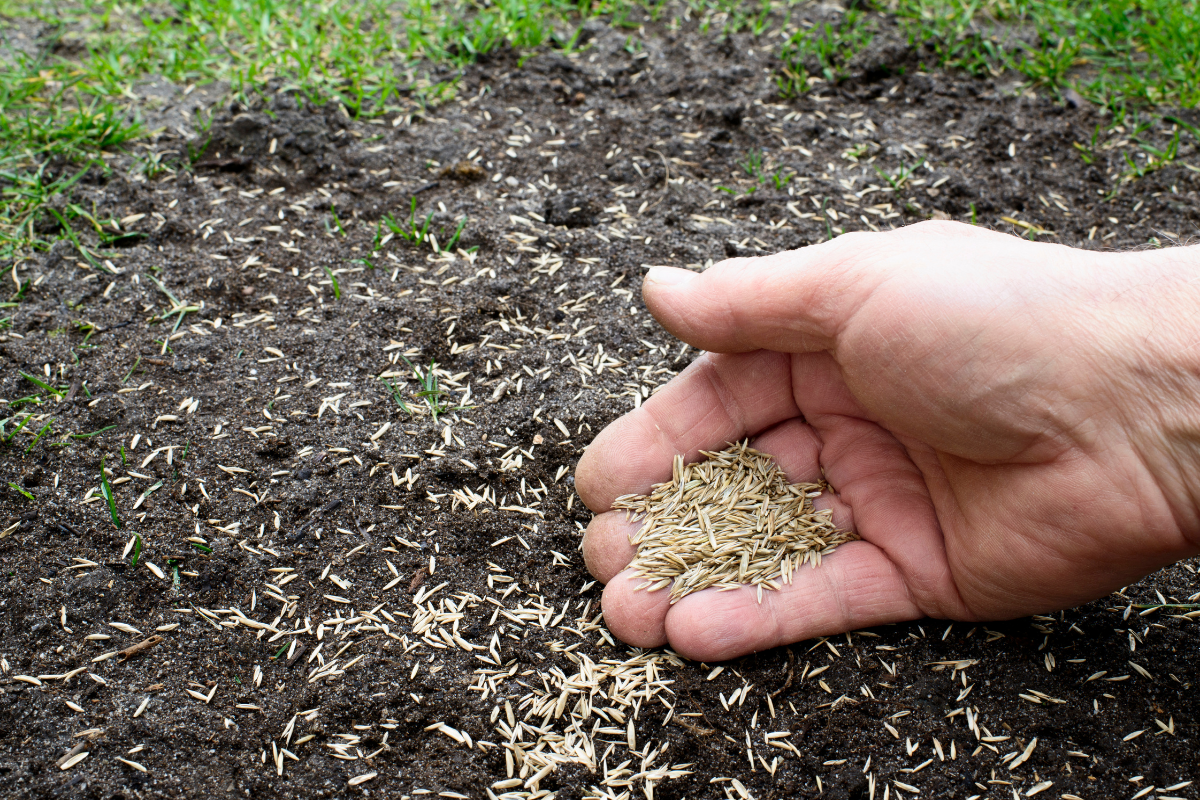
Divide the seed into two halves. Scatter one half walking in parallel lines across the area and the other half at right angles to the first, so no thin patches are left. For large areas, a simple spreader ensures even coverage.
Then cover the seed lightly with a rake, or with a thin layer of peat or compost, and firm the surface gently with a roller or by treading, so the seed makes close contact with the soil. The seed is only lightly covered because when buried deep, it germinates poorly or not at all.
Watering until germination
This is the most critical stage and the most common reason for failure. Grass seedlings are extremely susceptible to drying out, so the soil surface must not dry out even once during germination. In practice, that means a light, rain-like watering two to three times a day, and more often on sunny, windy days.
The aim is for the soil to stay constantly moist but never waterlogged. Too much water washes the seed away, gathers it into hollows and leaves bare gaps. The first seedlings appear a week to ten days after sowing, with ryegrass germinating fastest and fescues a little later.
Once the grass reaches about 5 cm, water less often but more deeply, which forces the roots further down into the soil, making the lawn far more drought-tolerant in its first summer.
The first mowing
The first mowing takes place when the seedlings reach 5-7.5 cm. A few days before, firm the soil lightly again with a roller to settle the seedlings, then mow with very sharp blades on the highest setting.
The rule that applies for life is the one-third rule, meaning each mowing removes no more than one-third of the grass height. Cutting too hard stresses the young plants and leaves them vulnerable to drought, weeds and wear. For an autumn-sown lawn, no further mowing is usually needed until spring.
A new lawn needs time before it can be used. Keep traffic to a minimum for about eight months, so an autumn-sown lawn is ready for normal use from early summer. Broadleaf weedkillers are avoided on young seedlings, which are sensitive to chemical injury, and the few weeds that appear are pulled by hand.
Overseeding thin patches
An existing lawn that has thinned from summer, wear or disease does not need to be started again. Overseeding fills the gaps in five steps:
- Low mowing and clearing: mow the existing lawn shorter than usual and rake out dead grass, leaves and weeds
- Aerating: loosen or spike the soil in the thin areas, so the seed makes contact with the ground, with hollow-tine aeration giving the best result
- Sowing the same seed: use the same grass or mix as the existing lawn, to avoid patches of different colour and texture
- Covering and firming: a thin layer of peat or compost covers the seed, and the surface is firmed gently
- Watering: lightly, two to three times a day, until the new seed germinates
The best season for overseeding is autumn or spring.
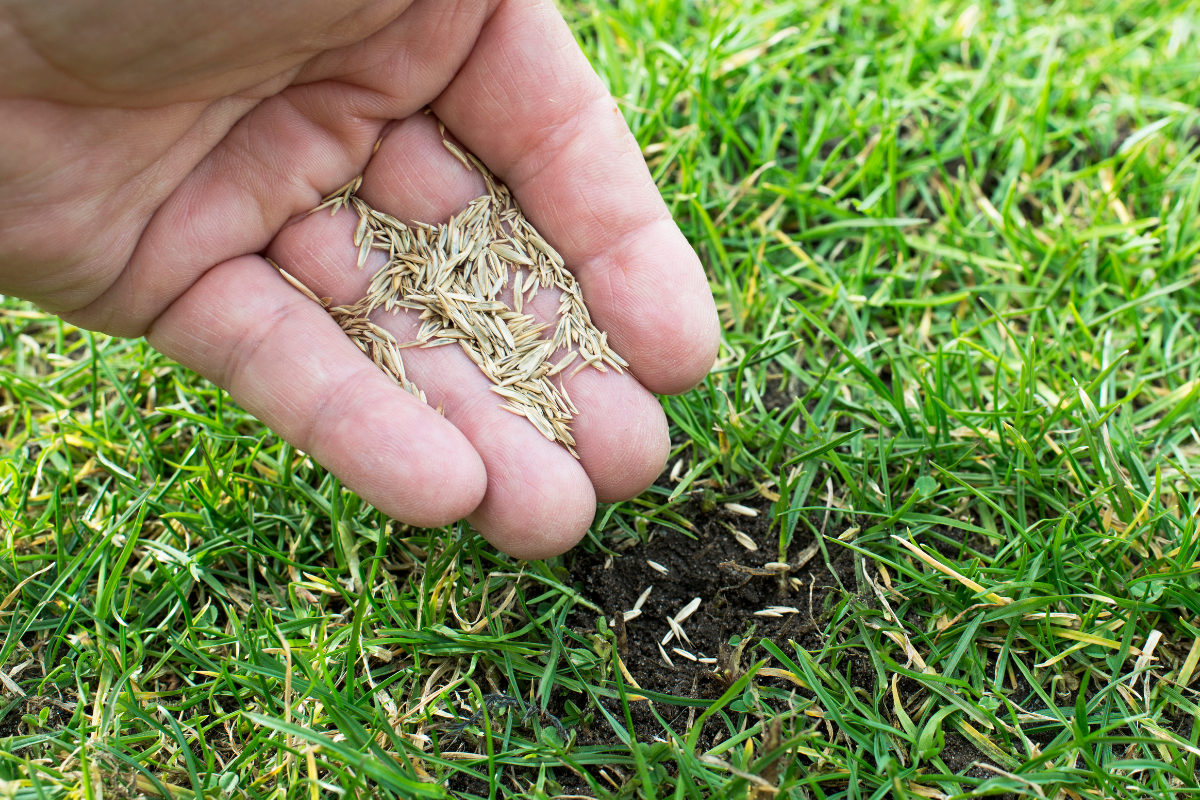
Overseeding fills thin patches in an existing lawn without starting a new lawn.
Seed or ready-made turf
Sowing costs considerably less than turf, offers a far wider choice of grasses and mixes, and seed can be stored until conditions are ideal. In contrast, turf deteriorates if not laid soon after delivery. The drawback is time, since a sown lawn takes months to reach a full, hard-wearing result. Turf gives instant green and can be laid over a slightly longer window, roughly a month wider than sowing.
Frequently asked questions
When is the best time to sow a lawn?
Early autumn and mid-spring. Autumn has the advantage because the soil is warm, the rains hold moisture, and weed competition is lower.
How much grass seed do I need per square metre?
For mixes and fescues, 35 to 50 grams per square metre, at the upper end for autumn sowing. For warm-season grasses such as kikuyu, 15-20 grams.
How long does grass seed take to germinate
The first seedlings appear a week to ten days after sowing, provided the soil stays constantly moist. Ryegrass germinates fastest and fescues a little later.
Can I sow Bermuda grass in October?
No. Bermuda grass seed does not germinate until soil temperature reaches about 18°C, so it is sown only from spring to summer. In autumn, cool-season grasses such as fescues and ryegrass are the right choice.
Why did my grass seed not germinate
The usual causes are surface drying out during germination, burying the seed too deeply, sowing a warm-season grass in cold weather, and overwatering that washes the seed away.
When should a new lawn be mowed for the first time
When the seedlings reach 5 to 7.5 cm, use sharp blades on the highest setting and remove no more than one-third of the height. An autumn-sown lawn usually needs no further mowing until spring.
Important notes
Every garden differs, and sowing dates shift with region, altitude and each year's weather. The seed rate printed on the packet of each mix takes precedence over the general rates given here.
References
- Royal Horticultural Society, Starting a lawn from seed.
- Royal Horticultural Society, Lawn mowing guide.
- University of Maryland Extension, Care and maintenance of a lawn after seeding.
- Iowa State University Extension, Seeding a new lawn.
- Oklahoma State University Extension, Bermudagrass establishment.